
San Francisco Draws a Line Against Eviction
Supervisor Jackie Fielder’s proposal would set a minimum rent debt before a tenant can be evicted for nonpayment. After months of reporting on San Francisco’s housing crisis, the question is no longer simply what housing costs — but how easily a family can lose it.
SAN FRANCISCO — For months, I have walked into apartments where tenants showed me ceilings that leaked, elevators that did not work, sewage that backed up, rats that would not leave and repairs that never seemed to come.
I have listened to elderly residents describe the fear of losing homes they have occupied for decades. I have watched tenants arrive at City Hall carrying photographs, documents, notices and stories of conditions they said they had reported again and again.
And throughout The Price of Being Poor, I have asked the same fundamental question: What does “affordable housing” mean if the people it was supposedly created to protect cannot safely remain in it?
On Monday, October 5, that question took a different form inside San Francisco City Hall.
This time, the issue was not mold. It was not sewage. It was not a broken elevator. It was not rats.
It was a rent balance — and how small a debt should be allowed to cost a human being their home.
Threshold, Not a Pardon
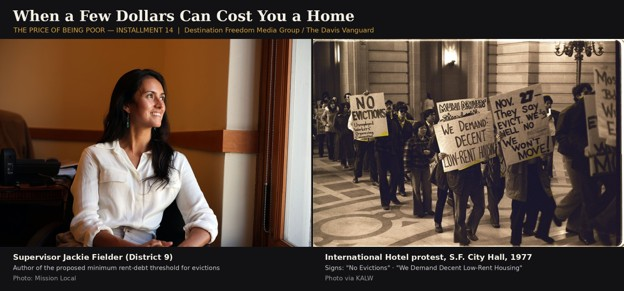
Supervisor Jackie Fielder has proposed an amendment to San Francisco’s Administrative Code that would establish a minimum threshold before a residential tenant could be evicted for nonpayment of rent.
Under current city law, according to Fielder and tenant advocates who testified before the Board of Supervisors’ Land Use and Transportation Committee, a tenant can face eviction for owing virtually any amount of unpaid rent.
Fielder’s proposal would change that. A landlord could not evict a residential tenant for nonpayment while the amount owed remains below the local Fair Market Rent that the U.S. Department of Housing and Urban Development sets annually for an equivalently sized unit.
| THE PROPOSAL AT A GLANCE | |
| Unit size | 2026 eviction threshold (HUD Fair Market Rent) |
| Studio | $2,485 |
| One-bedroom | $2,977 |
| Two-bedroom | $3,604 |
| What it does NOT do: forgive the debt, erase the rent owed, or end nonpayment as a lawful ground for eviction. Once unpaid rent reaches the threshold, the landlord may proceed. Status: recommended by the Land Use and Transportation Committee to the full Board. | |
Figures as published in reporting on the proposal, based on HUD’s fiscal year 2026 Fair Market Rents.
The proposal does not forgive unpaid rent. It does not erase the debt. It does not eliminate nonpayment as a lawful basis for eviction. Once a tenant’s qualifying unpaid rent reaches the threshold, the landlord’s ability to pursue eviction remains.
What the legislation creates is something far more modest — and, for a family living paycheck to paycheck, potentially far more consequential.
Time.
The Difference Between Debt and Displacement
At Monday’s hearing, Fielder described a city in which an unexpected expense, reduced work hours or a temporary financial setback can put a tenant’s housing at risk.
That distinction matters. There is a profound difference between owing money and losing your home.
A debt can be repaid. A missed paycheck can arrive. Work hours can return. Emergency rental assistance can be obtained. A family member can help. A payment agreement can be negotiated.
But eviction sets in motion consequences that cannot be so easily reversed. A child may leave a school. A senior may lose the neighborhood where doctors, friends and support networks are. A worker may suddenly have no stable address. A family may be separated. And an eviction record can make the next apartment harder to find.
One public commenter captured that human cost. Losing a home, the speaker told supervisors, means losing far more than “four walls and a roof.” It can mean losing stability, community, safety, health and dignity.
“Losing a home means losing far more than four walls and a roof.”
That testimony deserves to be remembered when this legislation reaches the full Board. San Francisco’s housing crisis is usually discussed through numbers: units, vacancy rates, rents, permits, density, subsidies, eviction filings.
But people do not live inside statistics. They live inside homes.
The Price of Being Poor
That is what months of reporting for this series have taught me.
At Alice Griffith in Bayview–Hunters Point, residents described deteriorating conditions in housing built as part of one of San Francisco’s most ambitious redevelopment efforts. At Plaza East in the Fillmore, tenants raised questions about habitability, management and whether residents hold any meaningful power over decisions affecting their homes. Across other publicly subsidized properties, residents have described mold, plumbing failures, pests, broken elevators and maintenance delays.
Then, on October 1, I sat through another Board of Supervisors hearing. Residents from some of San Francisco’s historically Black affordable-housing communities described alleged recertification problems, payment disputes, repairs, safety concerns and threatened displacement.
Samuel Broadnax came before the Board in a wheelchair. He is 80 years old. He has lived at Martin Luther King–Marcus Garvey Square Cooperative for nearly four decades.
His presence raised a question that should haunt every housing debate in this city: After someone survives San Francisco’s redevelopment, displacement, rising rents and decades of neighborhood transformation, how fragile should their right to remain finally be?
Four days later, Fielder’s legislation came before the Land Use Committee. Different hearing. Different legislation. Same city. And, at its core, the same question.
Who gets to stay?
One Quarter of the Cases
Supporters say this is not a hypothetical problem. The Eviction Defense Collaborative reviewed a sample of last year’s nonpayment cases and found that roughly one-quarter involved rent debt below the proposed Fair Market Rent threshold, according to testimony and previous reporting.
That finding is significant, though it should not be mistaken for a comprehensive count of every completed eviction in San Francisco. It does suggest that relatively modest rent debts appear in a meaningful share of nonpayment cases.
And the economic conditions surrounding those cases are shifting fast. San Francisco is experiencing sharply rising rents alongside increasing eviction activity; city officials have said more than 1,000 eviction notices have been filed this year, according to KALW. Mayor Daniel Lurie has declared what his administration calls a “rent emergency” and has publicly supported Fielder’s proposal as part of a broader response to housing instability.
The legislation therefore arrives at a particular moment: a city trying to encourage economic growth while confronting the housing pressures that growth can produce.
San Francisco has been here before. And Black San Francisco knows that history particularly well.
The People Who Disappear From the Numbers
During public comment Monday, speakers returned again and again to displacement.
One speaker described growing up amid the consequences of gentrification and urged supervisors to remember the African American families who have spent generations in San Francisco.
Jackie Barsha, who identified herself as a senior and long-term rent-controlled tenant, described receiving repeated communications threatening eviction after disputes with her landlords over alleged underpayments.
Another tenant told the committee simply: “I am struggling to keep up with rent.”
“I am struggling to keep up with rent.”
TJ Harrison, who identified himself as a lifelong San Franciscan, spoke about residents working multiple jobs merely to remain in supposedly affordable housing.
D.J. Proctor, a District 10 resident and former participant in San Francisco anti-displacement organizing, argued that what the city faces has grown beyond an affordability crisis. It is, he said, a cost-of-living crisis.
These are not abstract observations. They describe the people who live in the space between a missed payment and an eviction notice.
There Is Opposition — and a Serious Legal Question
The hearing was not unanimous in its assessment of the proposal. Representatives of housing providers and landlord organizations raised both economic and legal objections.
One opponent offered a pointed example. Because the threshold is based on HUD Fair Market Rent rather than the tenant’s actual rent, a long-term rent-controlled tenant paying far below market could accumulate more than one month of actual rent before reaching the eviction threshold. Landlords, the opponent argued, have mortgages, taxes, maintenance costs and other obligations of their own.
That is a legitimate policy consequence for the Board to weigh.
A more significant challenge may be legal. Housing-industry representatives argued Monday that California law preempts the ordinance because, in their view, it impermissibly alters the state’s unlawful-detainer procedures. The San Francisco Apartment Association urged supervisors to wait for the California Supreme Court to resolve litigation over a similar Los Angeles ordinance. Another industry representative proposed a middle path: pass the legislation, but include a trigger delaying its operation until the court rules.
Those arguments cannot simply be dismissed. Nor should they be overstated.
The dispute turns largely on whether a local minimum-rent-debt requirement is a substantive local restriction on the grounds for eviction — or an impermissible procedural change to California’s unlawful-detainer system. That distinction now sits before the courts, and San Francisco may ultimately have to defend its authority if Fielder’s ordinance becomes law.
That is part of the story. It is not the entire story.
What Happens Before Homelessness?
For years, government has spent enormous sums responding to homelessness after people have already lost stable housing: shelters, navigation centers, emergency services, street outreach, temporary placements, behavioral health interventions, supportive housing.
The harder question is what government is willing to do before the eviction happens. Fielder’s ordinance is, at bottom, an intervention at that earlier point. It does not promise that tenants will never be evicted. It sets a threshold before the machinery of eviction can be used for nonpayment.
Supporters repeatedly described the proposal as “breathing room.” Breathing room to obtain rental assistance. To pick up another shift. To borrow money. To resolve a disputed charge. To recover from an emergency. To pay the debt.
For a person facing displacement, breathing room can be the distance between being temporarily behind and becoming homeless.
Housing Is More Than Construction
San Francisco’s housing debate too often collapses into a single argument over production: how many units, where, how quickly, at what density. Those are important questions.
But another housing policy is happening at the same time. Preservation.
Not merely preservation of buildings — preservation of people in communities. Of seniors in the neighborhoods where they grew old. Of Black families in neighborhoods from which generations of Black San Franciscans have already been displaced. Of working families and rent-controlled households. Of the possibility that a teacher, janitor, home-care worker, restaurant employee, nonprofit worker or retired senior can still call San Francisco home.
You cannot build your way out of a housing crisis while ignoring the people being displaced from the housing that already exists.
That lesson has surfaced again and again in my reporting. Alice Griffith taught it. Plaza East taught it. The Fillmore continues to teach it. And the testimony at City Hall on Monday taught it once more.
Now It Goes to the Board
The Land Use and Transportation Committee has recommended Fielder’s ordinance to the full Board of Supervisors. That does not make it law. The Board must now take it up, and the unresolved legal questions raised by opponents remain part of that deliberation.
But reaching this point matters. For all of San Francisco’s declarations about affordability, Monday’s hearing forced policymakers to confront a remarkably simple question:
How much debt should be enough to take someone’s home?
Jackie Fielder has put an answer before the Board. Not zero. Not unlimited. A defined threshold.
And behind that legislative language stand people whose lives rarely fit neatly into a municipal code: the senior whose Social Security check arrives after the rent is due; the worker whose hours were cut; the mother with an unexpected medical bill; the tenant disputing an unexplained charge; the family waiting on emergency rental assistance; the longtime Black San Franciscan watching another neighbor leave; the resident who needs a little more time.
After months investigating San Francisco’s housing crisis, I have learned something from the people living inside it. They are not asking government to make hardship disappear. They are asking government to recognize what hardship costs.
A missed payment is a debt. A lost home can become a life-changing event.
San Francisco’s Board of Supervisors will now decide what legal protection should exist between those two things. And this time, the people most affected by that decision have made sure their voices are part of the record.
About This Series
The Price of Being Poor is the continuing investigative series by journalist Malik Washington, produced by Destination Freedom Media Group in partnership with The Davis Vanguard. It opened in March 2026 with a special investigative report into how San Francisco rewards the corporate landlords it accuses of neglecting its poorest residents, and it has grown into the most sustained recent accounting of privatized public housing in the city. Parts 1–12 documented a ceiling collapse that injured a 66-year-old resident at Alice Griffith, more than 129 failed inspections in a single year, the tenant lawsuits and management exits at Plaza East, and the city’s first-of-its-kind $9 million code-enforcement settlement of August 26, 2026. Part 13 connected Plaza East and Alice Griffith as one system. Installment 14 turns from the conditions inside San Francisco’s affordable housing to the machinery that removes people from it — and asks how small a rent debt may cost someone their home.
Reporting Note
This article draws on the October 5, 2026 San Francisco Board of Supervisors Land Use and Transportation Committee hearing; San Francisco legislative records (File No. 260962); HUD Fair Market Rent information; testimony from tenant advocates, tenants and housing-industry representatives; KALW’s September 11, 2026 reporting on the mayor’s rent-emergency package; and prior reporting in The Price of Being Poor and related Destination Freedom Media Group/Davis Vanguard investigations. Statements made during public comment and allegations concerning individual landlords or properties are attributed testimony unless independently verified.
Photo Credits
Lead photo, left: Supervisor Jackie Fielder — Mission Local. Lead photo, right: housing protesters supporting the International Hotel at San Francisco City Hall, 1977 — via KALW (published with KALW’s September 11, 2026 report on the city’s rent emergency).