A New Discovery, an Old Wound, and the Mounting Implications for Health, Redevelopment, Trust, and Environmental Justice in Bayview–Hunters Point
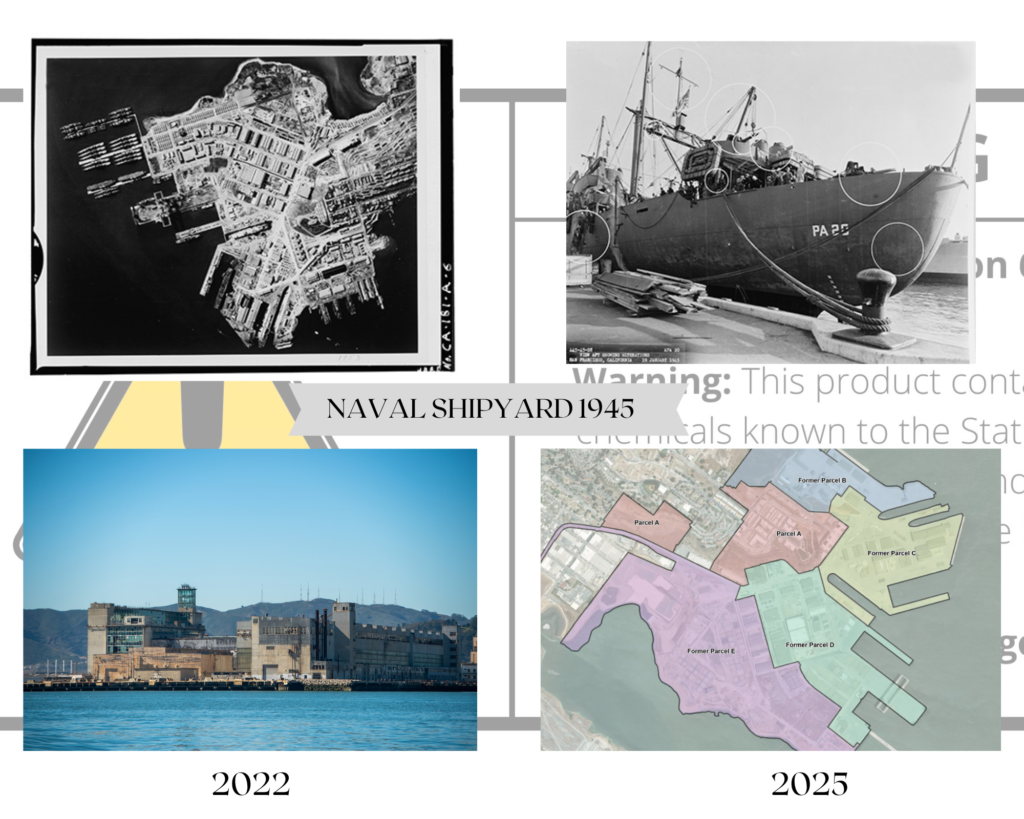
Photo credits:
https://www.sfheritage.org/research/hunterspoint/ (1945)
https://www.sf.gov/hpns-cleanup-status (2025)
https://www.kqed.org/science/1999631/navy-apologizes-for-11-month-delay-in-reporting-radioactive-material-at-hunters-point (2022)
There are discoveries that surprise a city, and there are discoveries that confirm what a community has been saying for decades.
The recent finding of additional radiological material at the former Hunters Point Naval Shipyard falls into the second category. For Bayview–Hunters Point residents, it did not arrive as an isolated incident. It arrived as another chapter in a long-running story of contamination, denial, delayed disclosure, and redevelopment pressure bearing down on land that still carries the unfinished burden of its radioactive past.
KPIX/CBS Bay Area reported on May 16, 2026, that additional radiological material had been discovered in a cabinet inside a secure building at the former shipyard, near an area where homes are being built. According to the report, the initial discovery was made on April 8, and additional boxes containing chemicals requiring disposal were later found in the same building. The Navy reportedly stated that the discovery was not directly related to the active cleanup project.
But for a community shaped by the legacy of the Naval Radiological Defense Laboratory, the distinction between “cleanup-related” and “not cleanup-related” may matter less than the larger fact:
Radioactive material is still being found at Hunters Point in 2026.
That fact matters because Hunters Point is not a generic brownfield. It is a former naval shipyard and federal Superfund site where radiological operations historically included decontamination of ships exposed to atomic weapons testing, industrial radiography, radioactive instrument calibration, disposal of radioluminescent materials, and research conducted through the Naval Radiological Defense Laboratory.
Federal historical assessments identify radionuclides associated with Hunters Point including:
Plutonium-239
Radium-226
Strontium-90
Cesium-137
Cobalt-60
Tritium
Uranium isotopes
Thorium
Americium-241
Iridium-192
In plain language, Hunters Point’s contamination history is not anecdotal.
It is documented.
It is technical.
And it is extensive.
A SITE THAT REFUSES TO STAY IN THE PAST
The City and County of San Francisco does not treat Hunters Point as if the radiological history has disappeared. The City’s current Hunters Point radiation guidance acknowledges that radiation-containing objects such as deck markers may still be discovered within cleanup areas and instructs the public not to touch suspicious objects.
The City’s position is that these areas remain controlled and do not pose a threat to public health because public access is restricted.
But even that reassurance contains an unavoidable truth:
A modern urban redevelopment zone in San Francisco still requires an active warning system regarding the possible discovery of radioactive objects. That reality alone should give policymakers pause.
THE PUBLIC TRUST CRISIS
The latest finding also arrives against the backdrop of a growing crisis of public confidence.
Official records from the San Francisco Health Commission and the Department of Public Health reveal that a November 2024 air sample collected at Hunters Point contained plutonium-239 above the project’s action level.
More troubling was the disclosure that the Navy did not inform city officials for approximately eleven months. San Francisco officials ultimately stated that there was no immediate public-health threat associated with the exceedance. Yet they also demanded a rigorous investigation and publicly criticized the delay in notification.
The significance of that episode extends beyond one air sample.
The issue is not simply contamination.
The issue is credibility.
The issue is whether communities can trust institutions to provide complete and timely information when contamination events occur.
That trust was already strained by the Tetra Tech scandal. The plutonium disclosure deepened those concerns. The latest radiological discovery does little to restore confidence.
HUNTERS POINT IS NOT A CLOSED CASE
One of the most misleading assumptions surrounding Hunters Point is that the cleanup belongs entirely to the past. The public record says otherwise.
The Navy continues to publish radiological reports, object-recovery documentation, technical memoranda, and air-monitoring summaries.
Dust monitoring continues.
Radiological oversight continues.
Institutional controls remain necessary.
Environmental management continues.
In other words:
Hunters Point is not a closed case.
It remains an active environmental management zone.
And that distinction matters. Because communities are often told to move on long before the evidence does.
THE DEVELOPMENT QUESTION
The debate surrounding Hunters Point has never existed in a vacuum. For decades, the former shipyard has been viewed as one of the largest redevelopment opportunities in California. Lennar Corporation was originally selected as master developer for significant portions of the Shipyard and Candlestick Point redevelopment effort.
FivePoint Holdings later assumed control of major components of that vision. Supporters see redevelopment as a long-overdue investment in a historically neglected community.
Many residents welcome new housing, jobs, infrastructure, and economic opportunity. But redevelopment cannot be separated from environmental reality.
The concern expressed by many Bayview–Hunters Point residents is not opposition to development. The concern is whether development is moving forward on a foundation of complete and accurate information.
FivePoint’s own public filings have acknowledged delays caused by the Tetra Tech fraud scandal, government investigations, criminal proceedings, and additional radiological sampling requirements. The latest radiological discovery adds another layer of uncertainty.
No evidence suggests that regulators altered environmental methodologies to benefit developers.
But community members are asking a different question:
How much confidence should the public place in declarations of normalcy when radioactive material continues to surface?
Moreover, should we allow our community to be poisoned and also shut out from economic opportunities connected directly to development surrounding the Hunters Point Shipyard area?
I SAY NOT! WHAT DO YOU SAY?
THE CAL ENVIRO SCREEN 5.0 CONTROVERSY
That question becomes even more urgent when viewed alongside California’s Draft Cal Enviro Screen 5.0 map. Cal Enviro Screen was created to identify communities disproportionately burdened by pollution and environmental hazards. The tool influences environmental justice policy, funding priorities, and resource allocation throughout California.
Under Cal Enviro Screen 4.0, Bayview–Hunters Point ranked among the most burdened communities in the state. Yet critics argue that Draft Cal Enviro Screen 5.0 significantly reduces the apparent burden associated with portions of Hunters Point.
What is “Green” About Hunters Point? – Malik Washington April 2026
Cal Enviro Screen 5.0, Redevelopment Pressure, and the Fight Over Who Gets Counted
https://destination-freedom.org/wp-content/uploads/2026/05/What-is-Green-About-Hunters-Point.pdf
For many residents, the timing feels impossible to ignore. While radioactive material is still being discovered…While the community is still reckoning with delayed disclosure of airborne plutonium…While unresolved questions surrounding contamination persist…
A state mapping tool appears poised to classify portions of Hunters Point as significantly less burdened.
That does not automatically mean the map is wrong. Nor does it mean OEHHA acted improperly.
But it does raise a legitimate question:
What exactly changed in the data that did not change in reality?
THE HUMAN COST BEHIND THE NUMBERS
Statistics tell part of the story.
People tell the rest.
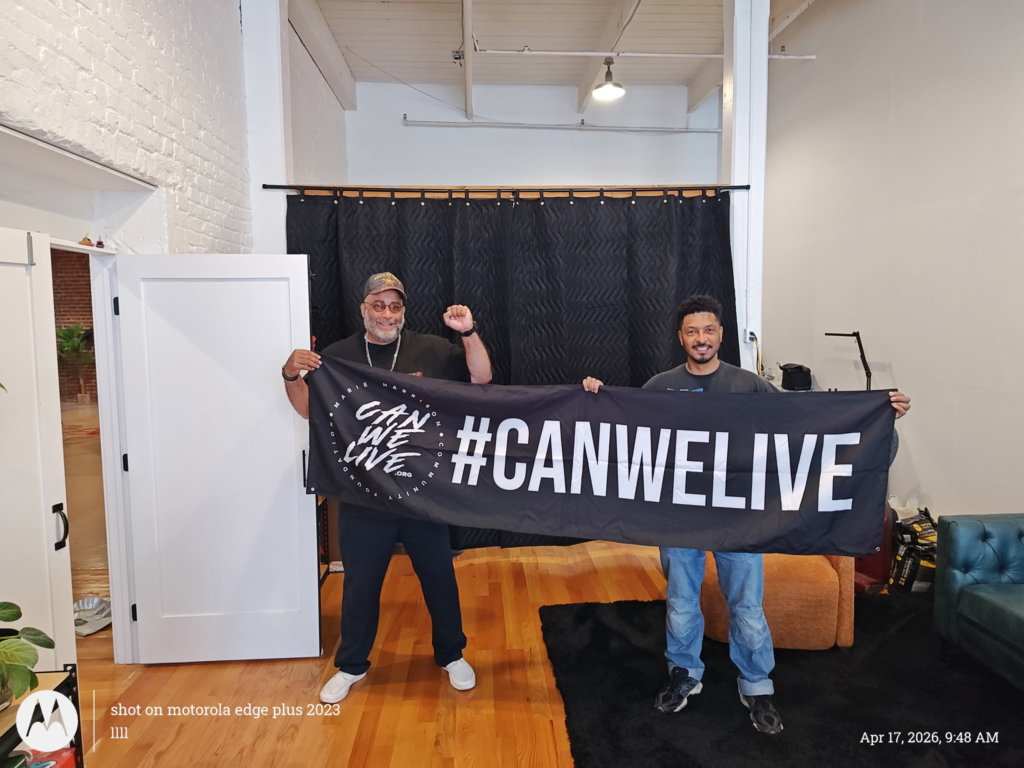
Along with being a fairly well-know journalist in San Francisco, Malik is also a coordinator for the Marie Harrison Community Foundation, an environmental justice and social justice organization
Arieann Harrison, founder and CEO of the Marie Harrison Community Foundation and one of the Bay Area’s most respected environmental justice advocates, sees the issue through the lens of lived experience.
“For decades, our community has lived beside radioactive waste while being denied the health protections, investments, and truth we deserve. Toxic exposure in Bayview Hunters Point is real, and the health outcomes in our district speak for themselves. Asthma, respiratory illness, and other chronic conditions continue to burden both youth and adults in District 10. And Cal Enviro Screen 4.0 shows that the Hunters Point Shipyard tract ranks near the very top of the state for low birth weight — a devastating marker of maternal and infant health inequity.”
Harrison continued:
“We have to do our very best to change this narrative. But that has proven difficult because of a lack of leadership and a lack of political will to act proactively when it comes to preserving the lives of our working poor. The people of Bayview Hunters Point are owed more than an apology — we are owed reparations, healing, and a future free from environmental harm.”
That statement is not merely a critique of policy. It is a reminder that environmental justice is ultimately about people.
Not maps.
Not parcels.
Not spreadsheets.
People.
THE OFFICIAL POSITION
A complete account requires acknowledging the position of regulatory agencies. The Environmental Protection Agency continues to maintain that completed remedies are protective of human health and the environment where response actions have been completed. EPA has stated that institutional controls, ongoing monitoring, and remaining remedial work are designed to ensure long-term protectiveness.
That position deserves inclusion because the story is not simply one of government neglect. The reality is more complicated.
Government agencies continue to oversee cleanup activities while communities continue to question whether those efforts are sufficient. Both facts can be true simultaneously.
And that tension sits at the center of the Hunters Point story.
WHAT THE LATEST FINDING REALLY MEANS
The recent radiological discovery is not merely about contamination found in a cabinet.
It is about the inability of the Hunters Point story to stay in the past. Every new finding pulls history into the present.
It complicates redevelopment narratives.
It reinforces community concerns.
It intensifies scrutiny of environmental justice mapping tools.
It reopens questions that many institutions would prefer to consider settled.
And it reminds the public that Bayview–Hunters Point residents have had to become fluent in the language of radionuclides, action levels, parcel transfers, institutional controls, and environmental monitoring simply to defend their right to know what is happening in their own neighborhood.
THE FINAL QUESTION
The public comment period on Draft Cal Enviro Screen 5.0 has ended.
The maps will be reviewed.
The methodology will be debated.
The rankings will be challenged and defended.
That is how public process is supposed to work. But before California finalizes any map suggesting that Hunters Point has become “Green,” there is one question that deserves a clear public answer.
If radioactive material is still being found…
If airborne plutonium has already triggered public concern…
If fraud in radiological testing has already been proven…
If contamination concerns remain unresolved…
And if Bayview–Hunters Point continues to rank among California’s most historically burdened environmental justice communities…
Then what exactly changed?
Because if the answer is the methodology, the public deserves to understand why. And if the answer is that conditions have genuinely improved, the public deserves evidence that reflects the reality residents continue to experience.
The people of Bayview–Hunters Point have spent generations living with the consequences of environmental decisions made by others. They should not be asked to accept a new narrative—or a new map—on faith alone.
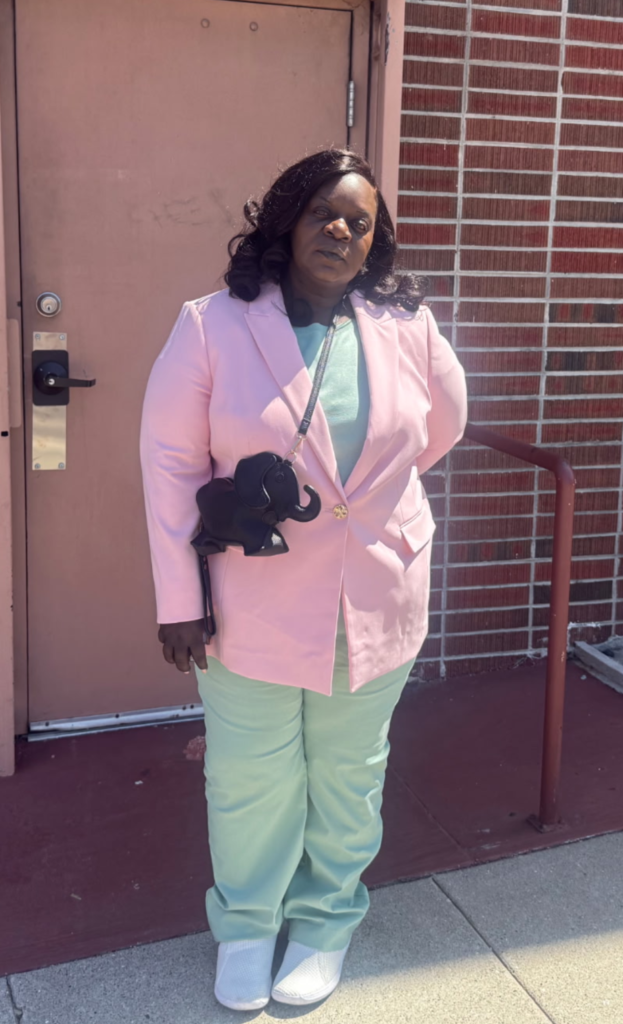
A CALL TO ACTION FROM ARIEANN HARRISON
For far too long, the people of Bayview–Hunters Point have carried a burden that no community should be asked to bear. We have lived beside contamination, fought for clean air and safe land, and demanded accountability while powerful institutions have too often treated our concerns as an inconvenience rather than a matter of life and death.
Today, new discoveries of radiological material and continuing questions about contamination remind us that this struggle is not over. We cannot allow environmental hazards to be minimized, ignored, or paved over in the rush toward development.
I am calling on environmental organizations, labor unions, faith leaders, public-health advocates, climate activists, civil-rights groups, tenant organizations, and every person who believes that human life is more important than profit to prepare to stand with Bayview–Hunters Point.
IN THE COMING WEEKS, WE WILL ANNOUNCE A MAJOR RALLY AT SAN FRANCISCO CITY HALL.
WHEN THAT DAY COMES, WE NEED THE BAY AREA UNITED.
Because environmental justice delayed is environmental justice denied—and the people of Bayview–Hunters Point deserve truth, accountability, healing, and a future free from environmental harm.
Here’s our song/video for this article:
Gifted Hands – One Of Them Ones