CalEnviroScreen 5.0, Redevelopment Pressure, and the Fight Over Who Gets Counted
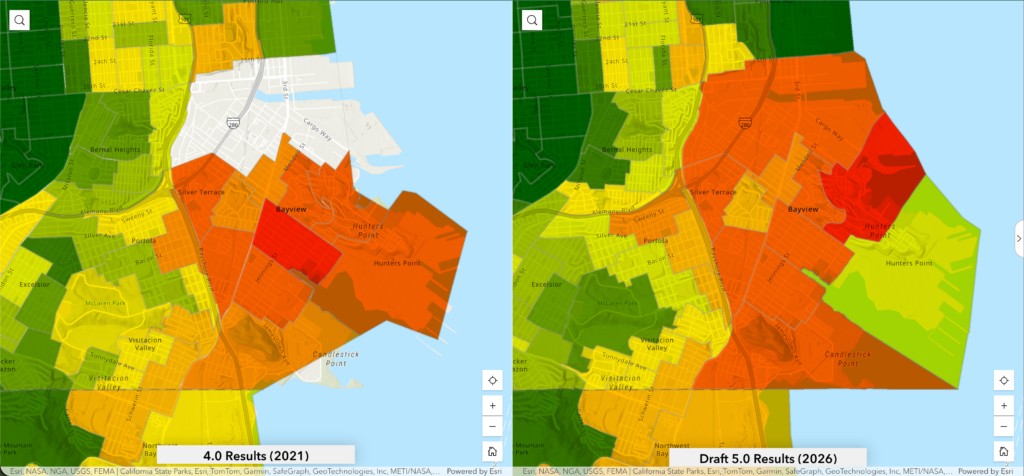
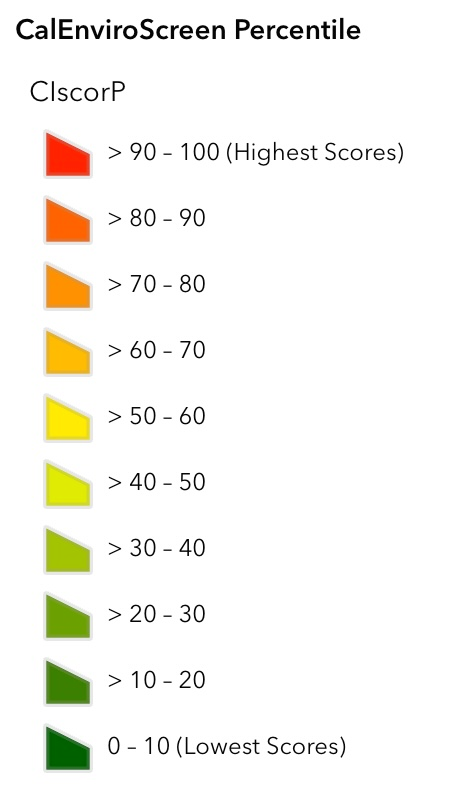
San Francisco documented environmental racism. The State built tools to measure it.
Now, as redevelopment accelerates in Hunters Point, a new map raises a deeper question: what happens when the data no longer reflects the lived reality?
I want to be clear here.
I don’t think there are very many people in Bayview–Hunters Point who are aware how detrimental this newly proposed 5.0 map could be.
The Marie Harrison Community Foundation, Brightline Defense, the Committee to Bridge the Gap, and journalists like Greg Schwartz and myself have been silently watching.
April 1, 2026 was the deadline for public comment on these maps, and the public can view my submitted comment (link below) on the proposed 5.0 map.
https://drive.google.com/file/d/1oVwix9ku5BPzJv-dn-52qN4R_rEfxR_G/view?usp=drivesdk
I feel it is my duty to educate our community on this topic to promote dialogue.
They didn’t remove the pollution. They removed the measurement. And in Bayview–Hunters Point, that distinction is not semantic. It is structural.
I
If contamination is increasing—what is “Green” about Hunters Point? That is a governance question now part of the public record.
In Part 1, we established the record: environmental racism acknowledged, health disparities documented, and radiological fraud prosecuted.
https://share.google/W3upCjLJfh9uIr68k
In Part 2, we examined enforcement: oversight exists, matters, and is being debated.
https://share.google/90ULPVQXhPec4aG2E
In Part 3, we confront measurement itself.
Hunters Point remains adjacent to a federal Superfund site. Radiological contamination is embedded in its history. Asthma, birth outcomes, and cumulative exposure indicators remain elevated.
There is a growing body of concern that modeled outcomes in CalEnviroScreen 5.0 do not align with observed conditions on the ground, particularly near the Shipyard.
CalEnviroScreen 5.0 reflects a significant decline in diesel particulate matter, yet there have been no major reductions in truck traffic, industrial activity, or freight movement.
This raises a critical question: what changed on the ground?
In communities like Bayview–Hunters Point, legacy contamination can suppress activity while risk remains. A model based on current emissions can mistake reduced activity for reduced danger.
CalEnviroScreen 5.0 does not meaningfully include radiological contamination or cancer burden indicators tied to environmental exposure. What is not measured does not count. What does not count does not trigger protection.
Hunters Point is also one of the most significant redevelopment zones in San Francisco, with projects advanced by FivePoint Holdings (fka Lennar Corporation).
Redevelopment is not the issue. But redevelopment advancing alongside unresolved contamination and shifting environmental classifications warrant scrutiny.
In communities undergoing redevelopment, data is not just descriptive—it is determinative. Stakeholders have raised concerns about “false greening”—where statistical outputs suggest improvement while burdens remain.
If a community is reclassified, environmental justice protections, funding, and regulatory attention may all decline. The record is clear. The question is whether the system reflects that reality.
CalEnviroScreen remains a critical tool. These concerns do not diminish its value—they underscore the need for refinement. If Hunters Point remains burdened, the question becomes: what changed in the data that did not change in reality? If the system fails to measure what is present, it will fail to protect those who live with it.
The issue has never been whether they knew. It is whether systems are operating in alignment—or in contradiction.
SOURCE LIST
Supporting the factual claims made in the above Public Comment
I. COMMITTEE TO BRIDGE THE GAP — PRIMARY RESEARCH REPORTS
S-1. Committee to Bridge the Gap. CBG Statement on the Navy’s Airborne Plutonium-239 Detection at Hunters Point. November 19, 2025.
https://www.committeetobridgethegap.org/2025/11/19/cbg-statement-on-the-navys-airborne-plutonium-239-detection-at-hunters-point/
S-2. Committee to Bridge the Gap. Report 2: The Great Majority of Hunters Point Sites Were Never Sampled for Radioactive Contamination. October 2018.
https://www.committeetobridgethegap.org/wp-content/uploads/2018/10/HuntersPointReport2.pdf
S-3. Committee to Bridge the Gap. Report 3: Hunters Point Shipyard Cleanup Used Outdated and Grossly Non-Protective Cleanup Standards. October 2018.
https://www.committeetobridgethegap.org/hunters-point-reports/updated/Report%203%20-%20Final.pdf
S-4. Committee to Bridge the Gap. From Cleanup to Coverup. August 2019.
https://www.committeetobridgethegap.org/hunters-point-reports/FromCleanupToCoverup.pdf
S-5. Committee to Bridge the Gap. Critique of the Navy’s Draft Fifth Five-Year Review of Hunters Point Naval Shipyard. May 2024.
https://www.committeetobridgethegap.org/2024/05/08/critique-by-cbg-of-the-navys-draft-fifth-five-year-review-of-hunters-point/
S-6. Committee to Bridge the Gap. Hunters Point Naval Shipyard Reports Overview.
https://www.committeetobridgethegap.org/hunters-point-reports1/
II. CALENVIROSCREEN — OEHHA OFFICIAL DOCUMENTS
S-7. OEHHA. Draft CalEnviroScreen 5.0 — Overview Document. January 28, 2026.
https://oehha.ca.gov/sites/default/files/media/2026-01/calenviroscreen50overview12226.pdf
S-8. OEHHA. Draft CalEnviroScreen 5.0 — Technical Report. January 28, 2026.
https://oehha.ca.gov/sites/default/files/media/2026-01/calenviroscreen50techreportd12226.pdf
S-9. OEHHA. Draft CalEnviroScreen 5.0 — Public Comment and Participation Page.
https://oehha.ca.gov/calenviroscreen/press-release/public-comment-period-calenviroscreen/get-involved
S-10. OEHHA. CalEnviroScreen 4.0 Final Report. October 2021.
https://oehha.ca.gov/calenviroscreen/report/calenviroscreen-40
III. AB 617 AND BAYVIEW HUNTERS POINT DESIGNATION
S-11. Bay Area Air Quality Management District. State Approves Bayview Hunters Point/Southeast San Francisco for AB 617 Program. February 27, 2023.
https://www.baaqmd.gov/news-and-events/page-resources/2023-news/022723-bvhp-ab-617
S-12. Bay Area Air Quality Management District. Bayview Hunters Point / Southeast San Francisco — AB 617 Community Emissions Reduction Plan.
https://www.baaqmd.gov/community-health/community-health-protection-program/bayview-hunters-point-community-emissions-reduction-plan
S-13. Bay Area Air Quality Management District. Annual Report, 2023.
https://annualreport.baaqmd.gov/2023/introduction.html
S-14. BAAQMD Board of Directors, Community Equity, Health and Justice Committee Agenda. March 11, 2026.
https://www.baaqmd.gov/
IV. NAVY FRAUD, FEDERAL PROSECUTION, AND PLUTONIUM COVER-UP
S-15. U.S. Department of Justice. United States Joins Lawsuits Against Tetra Tech EC Inc. Alleging False Claims.
https://www.justice.gov/archives/opa/pr/united-states-joins-lawsuits-against-tetra-tech-ec-inc-alleging-false-claims-connection
S-16. Committee to Bridge the Gap / San Francisco Chronicle. Ex-Contractor to Pay $97 Million Over Fraud Claims at S.F. Hunters Point Shipyard. January 20, 2025.
https://www.committeetobridgethegap.org/2025/01/20/ex-contractor-to-pay-97-million-over-fraud-claims-at-s-f-hunters-point-shipyard-sf-chronicle/
S-17. KQED. Navy Apologizes for 11-Month Delay in Reporting Radioactive Material at Hunters Point. 2025.
https://www.kqed.org/science/1999631/navy-apologizes-for-11-month-delay-in-reporting-radioactive-material-at-hunters-point
S-18. The Guardian. US Navy Accused of Cover-Up Over Dangerous Plutonium in San Francisco. November 27, 2025.
https://www.theguardian.com/us-news/2025/nov/27/us-navy-san-francisco-plutonium
V. HUMAN RADIATION EXPERIMENTS
S-19. The Guardian / SF Public Press / Committee to Bridge the Gap. Revealed: How a San Francisco Navy Lab Became a Hub for Human Radiation Experiments. November 25, 2024.
https://www.theguardian.com/us-news/2024/nov/25/san-francisco-navy-lab-human-radiation
VI. COMMUNITY HEALTH DATA
S-20. Inside Climate News. How San Francisco’s Bayview Neighborhood Is Battling Toxic Air. November 2021. — Cites 2006 SFDPH survey: 86% of babies born in Bayview developed severe asthma before kindergarten.
https://insideclimatenews.org/news/27112021/air-pollution-bayview-hunters-point-san-francisco/
S-21. City and County of San Francisco. The State of the Environment in Bayview Hunters Point. 2004. — Documents cancer rates above regional averages; chronic disease hospitalizations approximately 3x the statewide average.
S-22. San Francisco Human Rights Commission. Environmental Racism: A Status Report and Recommendations. December 2003.
S-23. San Francisco Health Improvement Partnership (SFHIP). Summary of Data Findings. — Documents asthma and COPD hospitalizations for Black and African American residents at approximately 10 times the rate of white San Franciscans.
https://sfhip.org/chna/community-health-data/summary-of-data-findings-by-section/
S-24. Greenaction for Health and Environmental Justice. Bayview Hunters Point Comments — CalEnviroScreen 4.0. September 30, 2021. — Documents Bayview-Hunters Point at 90th percentile for pollution burden in CalEnviroScreen 4.0.
https://greenaction.org/wp-content/uploads/2021/09/Greenaction-BVHP-Mothers-and-Fathers-Committee-and-Marie-Harrison-Community-Foundation-Comments-to-CCSF-September-30-2021.pdf
VII. CALENVIROSCREEN METHODOLOGY CRITIQUES
S-25. CalMatters. Why New CA Pollution Tool Let Down Environmental Justice Groups. February 2026. — Confirms Bay Area decreased in ranking; approximately 20% of communities losing DAC status.
https://calmatters.org/environment/2026/02/cal-enviro-screen-pollution-funding/
S-26. CalMatters. CA’s Flawed Tool Could Deny Billions to Polluted Communities. February 2024. — Cites Johns Hopkins/Stanford research: 16% of census tracts could be ranked differently; tool omits cancer and kidney disease.
https://calmatters.org/environment/2024/02/california-screening-environment-communities/
S-27. Huynh, Benjamin Q., et al. “Algorithmic Fairness in Environmental Justice Screening Tools.” Nature Machine Intelligence, 2024.
https://www.nature.com/articles/s42256-024-00793-y
VIII. MARIE HARRISON COMMUNITY FOUNDATION
S-28. Marie Harrison Community Foundation. Environmental Justice Programs.
https://www.canwelive.org/environmental-justice
S-29. Malik Washington. “They Knew: San Francisco’s 23-Year Reckoning with Environmental Racism in Bayview-Hunters Point, Part 1.” Davis Vanguard, February 2026.
https://davisvanguard.org/2026/02/they-knew-san-franciscos/
S-30. Malik Washington. “Fund the Oversight — Or Answer the Question: Part 2 of San Francisco Environmental Racism Investigation.” Davis Vanguard, February 2026.
https://davisvanguard.org/2026/02/oversight-reduction-bayview-hunters-point/