
Residents accuse powerful actors inside historic Black cooperative of weaponizing legal pressure against elders while city officials vow hearings and possible investigations
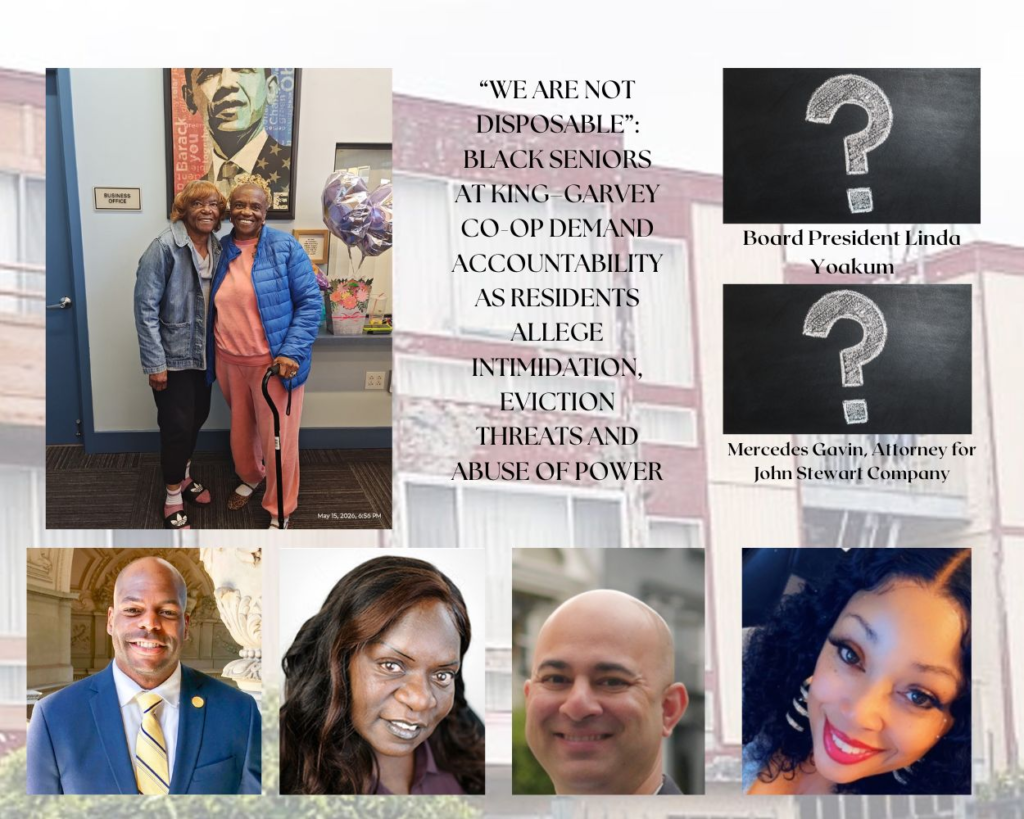
Photo credits:
https://www.pexels.com/@gale-sanders-1349874640/downloads/ (question marks)
Top Left: Dorothy Ward and Loloa Jackson
Bottom row: Mawuli Tugbenyoh, Arieann Harrison, Bilal Mahmood, and Dede Hewitt
SAN FRANCISCO — The room inside the King–Garvey Co-Op on Friday evening did not feel like an ordinary community meeting. It felt like a people placing history on the record. By the time the meeting ended at the historic cooperative at 1680 Eddy Street, longtime Black residents, shareholder-owners, housing advocates and city officials had sat through nearly three hours of emotional testimony, allegations of intimidation, claims of governance abuse, and repeated calls for intervention into what many residents described as a growing campaign of fear targeting Black seniors inside one of San Francisco’s most historically significant cooperative housing communities.
And at the center of that storm were two names repeatedly raised by residents and board members alike:
King–Garvey Co-Op and
King–Garvey Co-Op Board President Linda Yoakum.
Present at the May 15 meeting were District 5 Supervisor Bilal Mahmood, San Francisco Human Rights Commission Executive Director Mawuli Tugbenyoh, Ernie “EJ” Jones from Mayor Daniel Lurie’s Office, attorneys from Open Door Legal and the Eviction Defense Collaborative, along with longtime residents and shareholder-owners who said they are exhausted, frightened and increasingly convinced that powerful actors inside the cooperative are operating without meaningful oversight.
Also present at the meeting was longtime community advocate Arieann Harrison, Executive Director of the Marie Harrison Community Foundation, whose presence underscored the growing concern among Black community leaders about the future of historic Black housing institutions in San Francisco.
Harrison listened carefully as residents described alleged intimidation, displacement fears and what several speakers characterized as the gradual erosion of shareholder power inside the cooperative. Her attendance carried symbolic weight in a city where Black residents increasingly view housing instability, displacement and institutional neglect as interconnected parts of a larger crisis facing San Francisco’s remaining Black communities.
But perhaps no voice cut through the room with more force, historical clarity and moral urgency than that of community advocate Dede Hewitt. Hewitt did not speak like someone reading notes. She spoke like someone carrying institutional memory.
Like someone who understood the architecture of power well enough to expose where the walls had begun to crack.
At various moments during the meeting, Hewitt methodically explained the complex legal and structural history of the cooperative — not only as a longtime resident, but as a former board president and former housing professional with direct operational experience overseeing cooperative housing systems.
What emerged from her testimony was a devastating allegation:
That a cooperative originally built around Black ownership, collective governance and shareholder rights is, according to residents, increasingly being operated like a traditional landlord-tenant structure where dissent is punished, transparency is restricted, and elders are made to fear displacement.
“We’re not tenants,” Hewitt told the room. “We’re shareholder owners.”
That distinction matters.
Under cooperative housing structures, residents possess proprietary interests that differ significantly from those of ordinary renters. But Hewitt and several residents alleged that official language, legal framing and internal practices have increasingly shifted toward describing shareholder-residents as “tenants” or “apartment renters” — a transformation they believe weakens residents’ legal standing and erodes community governance protections.
Hewitt also raised concerns about what she described as potential violations of the Davis–Stirling Act, the California law governing common-interest developments and cooperative housing associations.
Board members alleged they were denied access to governing documents, contracts and key legal materials. Residents described an atmosphere where major decisions were allegedly being made without transparency or full board participation.
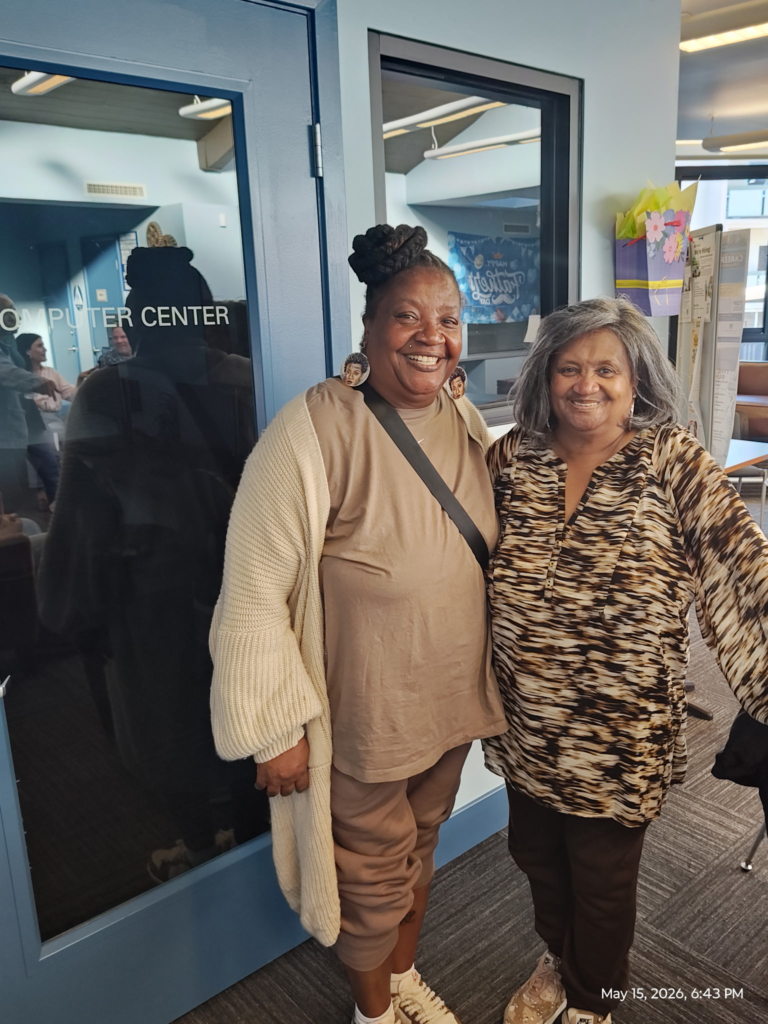
Martina Roland (left) and Jacqueline Butler (right)
And repeatedly, residents alleged that Attorney Mercedes Gavin occupied an unusually powerful and deeply troubling role inside the cooperative structure. Several speakers accused Gavin of functioning simultaneously as an eviction attorney, corporate counsel and legal enforcer aligned with Board President Linda Yoakum — an arrangement residents described as rife with conflicts of interest. Those allegations became intensely personal during testimony from longtime resident Jacqueline Butler.
Butler told the audience she first received notice from Domus Property Management alleging she owed approximately $50,000. According to Butler, the amount was later reduced to roughly $11,000. Her family, she said, rallied together and raised the money.
But when she attempted to pay, Butler said she was instructed to speak with Attorney Mercedes Gavin. “I received some sort of contract from Mercedes Gavin,” Butler said.
Her daughter, Martina Roland — herself a member of the King–Garvey Co-Op Board — advised her not to sign the document.
Stipulation for Judgment and Settlement Agreement
https://destination-freedom.org/wp-content/uploads/2026/05/Settlement-Agreement_Redacted.pdf
Two days later, Butler said, she received an eviction notice. “Something illegal and foul is happening here,” Butler said emotionally. “And I hope and pray that Mayor Daniel Lurie gets directly involved.”
That testimony electrified the room because residents said Butler’s experience did not feel isolated.
Several speakers alleged that fear of retaliation now hangs over the cooperative.
Residents openly worried that speaking against Gavin or Yoakum could expose them to legal pressure, targeting, harassment or eviction threats. Board members described alleged intimidation campaigns, restricted information access and efforts to silence dissent inside the governance structure itself.
One board member alleged that attempts to remove leadership or challenge decisions were met with legal threats and procedural obstruction. Another resident described what they believed was a coordinated effort to consolidate power around a small circle while marginalizing dissenting shareholders.
Longtime resident and community member Dennis Williams also spoke candidly about the growing distrust residents feel toward the systems governing the cooperative.
Williams described an atmosphere where many residents no longer believe transparency exists inside the governance structure and where elders fear retaliation for questioning decisions or challenging leadership. According to Williams, many residents feel trapped between legal pressure, housing insecurity and a governance process they no longer recognize as accountable to the people living there.
His comments echoed a theme repeated throughout the evening: that residents are not merely frustrated — they are afraid.
Afraid of eviction.
Afraid of retaliation.
Afraid that speaking publicly could make them targets.
And afraid that one of San Francisco’s historic Black cooperative housing communities is being transformed into something fundamentally different from what it was originally intended to be.
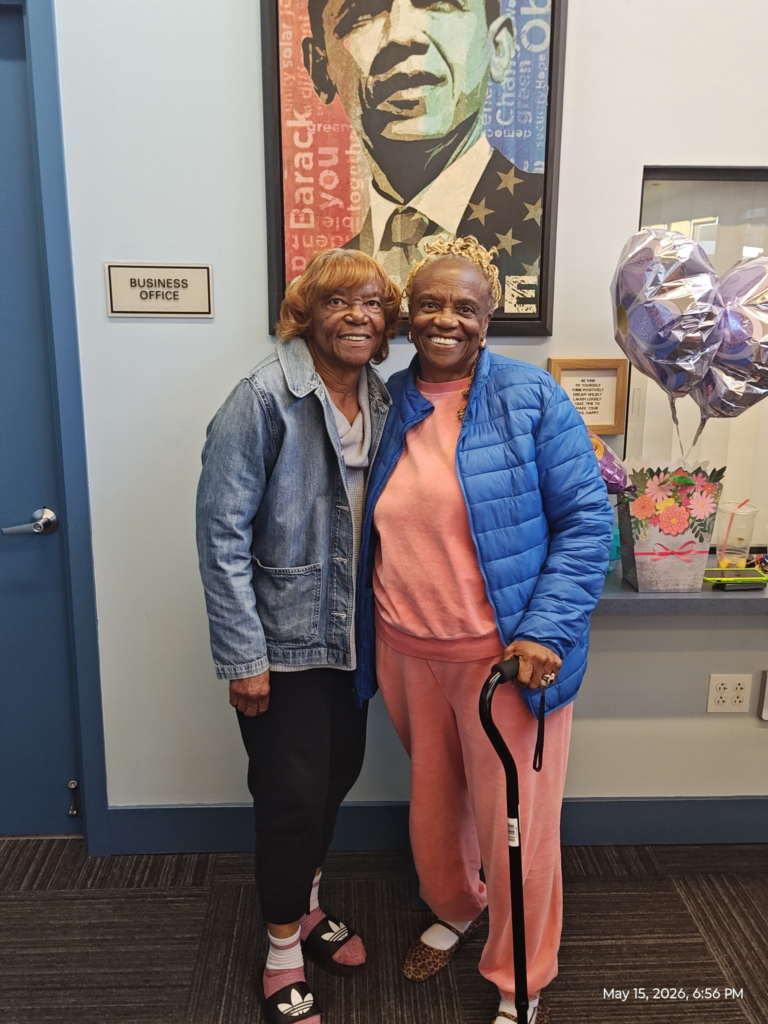
Dorothy Ward (left) and Lola Jackson (right)
The emotional weight of that reality became even more visible when Dede Hewitt introduced this reporter to two of the most senior residents living inside the cooperative: biological sisters Dorothy Ward, 84, and Lola Jackson. The sisters have survived decades inside King–Garvey. They have watched generations come and go.
They have weathered economic downturns, political neglect and the steady shrinking of San Francisco’s Black population.
But both women said the current atmosphere inside the cooperative feels different.
More hostile.
More unstable.
More frightening.
Ward, who said she moved into the cooperative around 1978, spoke bluntly about what she believes is happening to longtime residents. “In regard to what’s happening to so many of my fellow residents and friends, I blame the management agent,” Ward said. “You don’t wait for people to get behind thousands of dollars on rent or fees unless you are secretly conspiring to evict them.”
Then she said something that reflected the growing anger among many residents inside the room.
“Truthfully,” Ward said, “we need to get together and remove Linda Yoakum from the Co-op board.”
Ward also described ongoing maintenance frustrations, including how long it takes for hot water to come through her faucet — a seemingly small issue that residents say reflects larger patterns of neglect throughout the property.
What stood out most, however, was not fear.
It was resolve.
Despite their age, both Ward and Jackson appeared more than willing to publicly confront the people they believe are threatening and intimidating their friends and neighbors.
In a city where Black elders are too often erased from public conversations until they become statistics, the sight of two elderly Black sisters standing together inside a crowded cooperative meeting — refusing silence, refusing intimidation and refusing to abandon their community — carried enormous emotional power.
These are serious allegations that deserve careful scrutiny, independent review and documentary examination. But what made Friday’s meeting especially significant was that public officials were forced to hear those allegations directly — face to face — from the people living through them.
After the meeting, Supervisor Bilal Mahmood spoke with Destination Freedom Media Group and made clear that his office intends to pursue accountability measures.
According to Mahmood, he plans to call for hearings that could compel Attorney Mercedes Gavin to appear and answer questions publicly regarding allegations raised by residents and board members.
Mahmood also stated that he intends to contact San Francisco City Attorney David Chiu regarding recent allegations leveled against both Gavin and Board President Linda Yoakum.
The Supervisor appeared particularly concerned about the fear expressed by residents who said they worry about retaliation simply for speaking publicly. That fear matters.
Because once residents begin believing that raising concerns could cost them their housing, governance rights or safety, democratic participation inside a cooperative effectively begins to collapse.
And beneath all of this lies an even larger question San Francisco cannot afford to ignore:
How does a historic Black cooperative founded during an era when Black San Franciscans were fighting for housing access and economic dignity become a place where Black seniors now say they fear displacement from the very institution built to protect them?
That question hovered heavily over the room Friday night.
So did another.
Where is the oversight?
Residents repeatedly called for intervention not only from City Hall, but potentially from the California Attorney General’s Office, arguing that the alleged conflicts of interest, governance disputes and legal practices inside the cooperative may warrant outside review.
And as testimony unfolded, Dede Hewitt emerged not merely as a resident advocate, but as something increasingly rare in San Francisco politics: A deeply informed Black woman unafraid to confront institutional power publicly, specifically and intelligently.
Hewitt’s command of cooperative law, governance structure, housing policy and institutional history repeatedly shifted the room. She spoke with the precision of someone who understood not only what residents were feeling — but exactly where systems may have failed them.
She challenged officials directly.
She demanded monthly accountability meetings.
She called for audits, oversight and hearings.
And perhaps most importantly, she reminded the room that Black residents in San Francisco are not politically insignificant.
“My vote is just as powerful,” Hewitt said, “as anybody in Chinatown, anybody in the Marina, anybody in any other area of San Francisco.”
That statement landed with force because it cut through the sanitized language that often surrounds affordable housing discussions.
What unfolded at King–Garvey on Friday night was bigger than a housing dispute.
It was a public reckoning over Black political power, cooperative ownership, elder protection and institutional accountability in a city where the Black population continues to shrink year after year.
The presence of advocates like Dede Hewitt, Arieann Harrison, Dennis Williams, Dorothy Ward, Lola Jackson and the many residents who risked speaking publicly despite fears of retaliation demonstrated that this community is not surrendering quietly.
They came not simply to complain.
They came to document.
They came to warn.
And they came demanding that San Francisco finally decide whether historic Black communities are worth protecting before they disappear altogether.
What residents described Friday was not simply property management frustration.
They described a struggle over power.
Over ownership.
Over race.
Over who gets protected in San Francisco and who gets ignored until they disappear.
Now those allegations sit before the City.
And the question is no longer whether officials know.
The question is whether San Francisco will finally intervene before another historic Black community is quietly dismantled from the inside.
FINAL ANALYSIS FROM DEDE HEWITT
After the meeting concluded Friday evening, longtime community advocate and former King–Garvey Co-Op board president Dede Hewitt agreed to speak further with Destination Freedom Media Group about the conditions residents say have been allowed to fester inside the historic cooperative.
What followed was not simply criticism of management. It was a sweeping indictment of what Hewitt described as years of neglect, failed oversight, displacement pressure and systemic disregard for Black elders living inside one of San Francisco’s historically Black housing communities.
“It is evident in this city that Black people are treated like we are expendable,” Hewitt said. “MLK/MG Co-Op is no exception. Residents are living with rodents, bug infestations, asbestos exposure, plumbing problems, electrical issues, collapsing roofs and ongoing habitability violations while seniors and longtime shareholder-owners are simultaneously being targeted for eviction.”
Hewitt pointed directly to what she described as a dangerous contradiction at the center of the crisis.
“We are owners, not renters,” she said. “Many of these elders have lived here for decades and now people in their 70s, 80s and even 90s are facing removal from their homes because of management errors, recertification mistakes, lost records, missing payments and financial miscalculations that were never the fault of the residents.”
Hewitt also alleged that residents who raise concerns about conditions or request repairs often fear retaliation.
“When people complain about unsafe living conditions, many believe they are targeted,” Hewitt said. “That fear is real in this community.” She described a cooperative structure where, in her view, proper oversight has broken down.
“The problem is made worse by leadership that refuses to properly oversee management and by an attorney residents believe has been allowed to operate with extraordinary power and very little accountability,” Hewitt said. “Board members are allegedly being denied access to contracts, governance documents and records they are legally entitled to review before decisions are made.”
Hewitt further raised concerns regarding disability access and treatment of elderly residents.
“We have seniors in their 80s and 90s trapped in apartments without proper lifts or accessibility accommodations while reasonable accommodation requests are delayed or ignored,” she said. “That is not just mismanagement. That is a human-rights issue.”
She also questioned why residents say they have not received annual equity statements or tax-interest documentation in recent years despite cooperative ownership requirements.
“We want audits. We want oversight. We want transparency regarding where residents’ equity money is and how calculations are being made,” Hewitt said. “People deserve to know what is happening with their homes, their ownership rights and their financial interests.”
Standing just outside the meeting hall as residents slowly filtered into the San Francisco evening, Hewitt made clear that, in her view, what is happening inside King–Garvey extends beyond one property dispute.
“This is about dignity,” she said. “This is about whether Black seniors in San Francisco have the same rights, protections and value as everybody else in this city. We are not expendable.”
Here’s our song/video for this article:
Sounds of Blackness – Optimistic