
THE PRICE OF BEING POOR – PART 13
Plaza East warned us. Alice Griffith confirmed it. Now the man who has lived inside both stories — as tenant, as plaintiff, and as developer — is asking the question City Hall has avoided for two decades: while billions flow into Black San Francisco’s neighborhoods, who gets to own what gets built — and who pays when it fails?
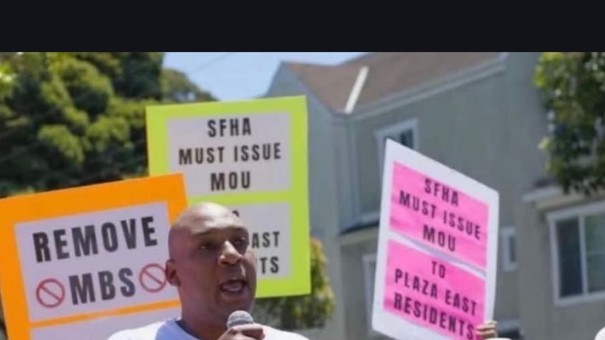
SAN FRANCISCO — The letter did not come from an activist group, a law firm, or a City Hall insider. It came from a man who carries this story in his own address.
Dennis C. Williams Jr. lives at Plaza East Apartments in the Western Addition — District 5. In 2021, he was one of eighteen tenants who sued the property’s owner, McCormack Baron Salazar, over conditions inside their homes. He is also the Director of the Fillmore Community Development Corporation and the principal of his own firm, D.C. Williams Development Company — a community-rooted developer who once believed he would have a role in redeveloping the very complex where he pays rent.
That role never came. The development structure collapsed. The mold did not.
Williams has now written to this reporter twice, and his letters do something twelve installments of this series have circled but never fully done. They connect Plaza East to Alice Griffith — District 5 to District 10 — and they connect both of them to the billions of dollars of new construction rising around San Francisco’s historically Black neighborhoods at Candlestick Point and in the Fillmore.
His argument, in plain English: San Francisco always finds the money to rescue failed housing. It never seems to find a pathway for the people who live in that housing to own what replaces it.
For this article, Mr. Williams provided a specific statement to this newsroom. In full:
“Why is there not a clearly defined pathway for qualified local, community-rooted private developers and contractors to participate meaningfully in the ownership and development occurring in their own communities? How can San Francisco create a state-of-the-art new neighborhood next to an existing Black affordable-housing community where residents have required government intervention simply to obtain safe and habitable living conditions?”
— Dennis C. Williams Jr., in a statement provided to Destination Freedom Media Group for this article
After months of reporting on both properties, I believe he is right. And I believe the record — the public, documented, undeniable record — backs him.
About This Series — and Why Part 13 Matters
The Price of Being Poor is the continuing investigative series by journalist Malik Washington, produced by Destination Freedom Media Group in partnership with The Davis Vanguard. It opened in March 2026 with a special investigative report into how San Francisco rewards the corporate landlords it accuses of neglecting its poorest residents — and it has since grown into the most sustained accounting of privatized public housing in the city’s recent history.
Across its first twelve installments, the series has documented the collapse of a ceiling onto a 66-year-old resident inside a development built in 2017; the 129-plus failed inspections at Alice Griffith Apartments in a single year; the pattern of fear and alleged retaliation that follows residents who complain; the tenant lawsuits and management exits at Plaza East; the removal of the John Stewart Company from a San Francisco public housing property; the legal reckoning carried to the California Department of Justice; the demand for an independent fact-finding investigation — and, in Part 12, the first-of-its-kind $9 million code-enforcement settlement the City of San Francisco reached on August 26, 2026.
Part 13 is the installment that connects the dots. For the first time, this series examines Plaza East (District 5) and Alice Griffith (District 10) not as two separate scandals but as one system — the same owner, the same manager, the same sequence of privatize, deteriorate, litigate and subsidize — and sets that habitability record against the billions of dollars of new development now rising in and around the same historically Black neighborhoods. It is also the first installment to be built around a formal statement and photograph provided to this newsroom by a resident who is both a named plaintiff and a community-rooted developer. What follows is not merely a story about two buildings. It is a story about who owns San Francisco’s future — and who is expected to keep paying for its past.
The Warning: Plaza East
Plaza East was supposed to be the proof that privatization works.
The original Plaza East Towers — high-rise public housing built in 1954, notorious enough to carry the nickname “Outta Control,” and later famous as the childhood home of Mayor London Breed — were demolished and replaced in 2001 with 193 townhome-style apartments for low-income families. Ownership and management passed from the San Francisco Housing Authority to a private firm: McCormack Baron Salazar, the St. Louis-based developer that would later rebuild Alice Griffith.
Twenty years later, the promise collapsed into a courtroom.
In 2021, eighteen tenants — Dennis Williams among them — sued McCormack Baron Salazar, alleging harassment, uninhabitable conditions, and a refusal to carry out repairs. The suit was settled. As part of the new arrangement, MBS hired the largest affordable-housing manager in California to run the property: the John Stewart Company.
Two years later, twenty-eight tenants sued again — this time naming the John Stewart Company itself, alleging harassment, negligence, and rent charged for uninhabitable living conditions. The tenants are seeking unlimited damages, meaning a judge will decide what the harm was worth.
What life inside Plaza East looked like in those years is on the record, documented by Mission Local and the San Francisco Public Press:
- Mold under the carpets and blooming across walls and doors, painted over again and again, returning “with a vengeance.”
- Sewage seeping through floorboards. Broken pipes. Failing plumbing.
- Bullet holes in window frames. A man shot to death in the complex on March 2, 2025. Residents describing themselves as feeling “like prisoners” in units infested with mold.
- A tenant, Silvio Ocampo, who developed a rash across his hands and arms and had difficulty breathing — and who says that when he brought his concerns to staff, he was told four words that belong in the permanent record of this city’s housing history:
“Remember where you are.” — What a Plaza East staff member allegedly told tenant Silvio Ocampo when he complained, per Mission Local, July 2025.
The public money followed the failure, as it always does. In 2021, McCormack Baron Salazar received a $2.7 million emergency loan from the Mayor’s Office of Housing and Community Development for repairs. Two years later, HUD assigned Plaza East a failing physical inspection score of 40 out of 100 — down from a previous passing score of 82. This year, the San Francisco Housing Authority committed $10 million more in capital improvements, for exterior painting and related work.
And still the exits continued. In July 2025, the John Stewart Company departed Plaza East, declining to say why, while the second tenant lawsuit continued. In September 2025, McCormack Baron Salazar itself withdrew from the property it had owned through a generation of complaints. A planned private redevelopment — opposed by tenants — had already lost its development partner, Strada Investment Group, which exited without explanation in 2024.
The owner is gone. The manager is gone. The tenants — and the mold — remain.
Dennis Williams still lives there. He told Mission Local what he expected from the next management company: “More of the same.” And he has told this reporter something else — that he is currently assisting another Plaza East household experiencing severe moisture and mold conditions and recurring plumbing failures, right now, in September of 2026, after the lawsuits, after the loans, after the $10 million.
Plaza East is not a closed case. It is an open warning.
The Confirmation: Alice Griffith
Cross town to District 10, and the warning becomes a mirror.
The Alice Griffith Apartments — described by Mission Local as a 504-unit development built in 2017 on Arelious Walker Drive, across from Candlestick Point — were marketed as the future: the flagship completed component of the Candlestick Point / Hunters Point Shipyard Phase 2 redevelopment, LEED-certified, federally subsidized, rebuilt with a $30.5 million HUD Choice Neighborhoods grant, HOPE SF bond authority, $68.3 million in loans from the Office of Community Investment and Infrastructure, and more than $20.6 million in tax-credit equity. Mission Local’s reporting, as cited in Williams’ letter, places the total public and private financing behind the rebuild at approximately $230 million.
The owner-developer: McCormack Baron Salazar. The property manager, hired in 2019: the John Stewart Company.
Readers of this series know the litany, and it bears repeating until it cannot be ignored:
- More than 129 deficiencies documented by the San Francisco Housing Authority in a single year — broken elevators, electrical hazards, pest infestations, sewage backing into bathtubs.
- Twenty-seven active, unresolved complaints in the Department of Building Inspection’s tracking system — some more than three years old — including water leaking through ceilings and light fixtures, dead fire alarms, broken fire sprinklers, and mold.
- A disabled resident trapped in his apartment for nine days when the elevators failed, forced to slide down the stairwell on his body to reach the outside world.
- On April 21, 2025, a slab of fiberglass ceiling tile tore loose during a youth art show and slammed into the neck of 66-year-old Annette McClendon, who returned from the hospital in a neck brace. A building inspector told residents water must have been leaking overhead for weeks.
- A regional manager, asked at a tenant meeting about a stench that never leaves the building, answering matter-of-factly: “That’s the smell of dying rats.”
- On July 14, 2026, mass-produced “Balance Due” notices taped to hundreds of apartment doors in a single day — private debts displayed in public corridors, signed only “Management” — while the habitability record remained publicly unresolved.
- A resident-reported cluster of approximately ten deaths since January 2026, including community activist Dewayne Gaines, with no publicly disclosed cluster analysis by the Department of Public Health.
To be fair to the record: the John Stewart Company has said the property’s finances are dire. CEO Noah Schwartz told Mission Local that “financial issues at Alice Griffith remain severe,” blaming unpaid rents and abated housing subsidies, and said the company conducts regular inspections and had repaired elevators. McCormack Baron Salazar asked the city for a $500,000 stabilization loan in February 2025, citing low rent collection and high staff turnover. Those statements are part of this story too — because a property this distressed, built eight years ago with a quarter of a billion dollars of financing, is precisely the kind of failure the public is entitled to examine from the foundation up.
Then, on August 26, 2026, the City of San Francisco answered — and this series honored that answer in Part 12. A first-of-its-kind code-enforcement settlement. A stipulated injunction with a 30-day clock. Consequences, at last, in writing. But Williams’ letter asks the question the press conference did not. Read the settlement’s arithmetic closely:
| Component | Amount | Where it goes |
| Penalties for code violations, paid by owner McCormack Baron Salazar | $3 million | The City — punishment, not repairs |
| Unpaid water and sewer fees owed to the SF Public Utilities Commission | $3 million | Recovery of money already owed the public |
| Required owner investment in the property | $3 million | Pest control, security, health and safety repairs |
| City loan (MOHCD) — to be repaid | $2.5 million | Elevators, hot water, rehab of 50 uninhabitable units, $200,000 for pest control |
| City grant (MOHCD) | $2 million | Outdoor play areas and common spaces |
Nine million dollars is the headline. But of the owner’s $9 million, only $3 million is required to go into the physical property. The repair of 50 uninhabitable units rests substantially on a $2.5 million city loan — more public money, stacked on top of the public money already spent. And City Attorney David Chiu, to his credit and to this story’s point, acknowledged in public what the number implies: the settlement will not solve everything.
Which raises the question Williams puts at the center of his letter — the question this article now formally places on the record:
What is the actual, comprehensive capital need at Alice Griffith — and how was the repair number set without a publicly disclosed, property-wide capital-needs assessment showing what it will truly cost to restore and maintain the development?
No such assessment has been made public. Not at Alice Griffith. Not at Plaza East, where $2.7 million in emergency loan money in 2021 and $10 million in capital funds this year have not ended the mold in Silvio Ocampo’s floorboards or the moisture crisis in the household Williams is assisting today.
Without that number, every settlement is a guess. Every ribbon-cutting is a gamble. And every family inside those walls is being asked to live inside the gap between what was announced and what was needed.
Two Buildings, One Blueprint
Lay the two records side by side, and the pattern stops looking like property management. It looks like a business model.
| Plaza East (Western Addition, D5) | Alice Griffith (Bayview–Hunters Point, D10) | |
| Rebuilt | 2001 — public housing privatized into 193 townhome units | 2017 — HOPE SF / Choice Neighborhoods rebuild, ≈$230M in financing |
| Owner / developer | McCormack Baron Salazar | McCormack Baron Salazar |
| Property manager | MBS, then the John Stewart Company (2021–2025) | The John Stewart Company (2019–present) |
| Resident allegations | Mold, sewage, failing plumbing, harassment, violence, broken security | Mold, sewage, rats, broken elevators, dead fire systems, ceiling collapse, retaliation |
| Litigation | 2021 — 18 tenants sue MBS; second suit by 28 tenants names John Stewart Co.; unlimited damages sought | Habitability complaints, DBI cases, and testimony carried to the California Attorney General’s housing office in April 2026 |
| Public rescue money | $2.7M emergency loan (2021); $10M SFHA capital improvements (2025); HUD failing score of 40 (2023) | $500K stabilization loan request (2025); $9M settlement + $2.5M city loan + $2M MOHCD grant (2026) |
| Outcome to date | John Stewart Co. departed July 2025; MBS withdrew Sept. 2025; conditions persist | Settlement under court supervision; 30-day repair clock now running; long-term capital need undisclosed |
The same corporate names. The same categories of failure. The same sequence: privatize, deteriorate, litigate, subsidize — and repeat. Williams is not speculating when he says San Francisco should not repeat at Alice Griffith what residents already lived at Plaza East. He is reading from a blueprint the city itself has now run twice.
And the blueprint extends beyond these two addresses. This series has documented sewage flooding at Holly Court; displacement pressure at the Martin Luther King–Marcus Garvey Cooperative; tenant complaints at Treasure Island; the ouster of Eugene Burger Management at Potrero after scandal; the John Stewart Company’s eviction filing against Pinole resident Lynette Moore on the very day she settled her habitability case. Citywide, the pattern holds. District 5 and District 10 are simply where it is written in the boldest ink.
Enough Is Enough: The Community Stops Asking — and Starts Scheduling
The flyer does not ask. It announces.
It is circulating the way these things now travel — phone to phone, thread to thread, window to window — a bright yellow field beneath a domed seat of government, with the grievances running down the margins like a checklist of the years: CORRUPT BOARD MEMBERS! SLUMLORDS! ILLEGAL EVICTIONS! CORRUPT ATTORNIES [sic]! And then, in letters too large to misunderstand: ENOUGH IS ENOUGH!!! STOP CORRUPTION IN SF LOW-INCOME HOUSING.
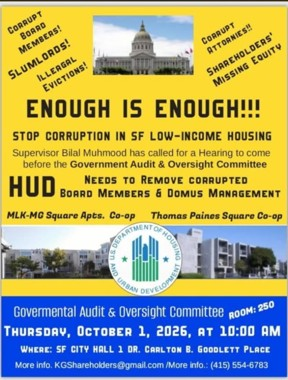
The flyer announces that District 5 Supervisor Bilal Mahmood — whose office this newsroom contacted for comment in our July reporting on Plaza East — has called for a hearing before the Board’s Government Audit & Oversight Committee into conditions at the Martin Luther King–Marcus Garvey Square Apartments Co-op and the Thomas Paine Square Co-op, two Fillmore-district properties managed by Domus Property Management. The flyer’s own text places that hearing before the committee in Room 250, San Francisco City Hall, on Thursday, October 1, 2026, at 10:00 a.m. The Standard confirmed in July that Mahmood called for a fall hearing focused on Domus, after residents at both complexes reported neglect, shoddy record-keeping, and eviction threats — including 16 Marcus Garvey tenants, most of them seniors, who said they could not learn how much equity they actually own in their cooperative. The flyer’s demand is directed over the City’s head, to Washington: that HUD “remove corrupted board members & Domus Management” from the same two cooperatives whose residents this series has stood with before.
Now read the margins again: “Shareholders’ missing equity.” That is the ownership question of this entire article, scrawled in protest lettering. The residents of these cooperatives are not merely tenants — they are shareholders, people who were told they owned a piece of their community. The flyer says the piece is missing. When the people who were promised ownership are printing flyers about where their equity went, the question of who owns Black San Francisco is no longer a policy seminar. It is a grievance with a date and a room number.
And understand what a flyer like this represents. Before it came letters. Then a march. Then a nearly five-foot-tall copy of the tenants’ letter carried to City Hall. Then litigation. Then federal officials escorted past the mold. Then a $9 million settlement with a 30-day clock. And still the community is printing flyers — because for every intervention that finally arrived, there were years of requests that preceded it. The patience is gone. What has replaced it is precision: a date, a time, a room, a phone number, an email address. A community that has spent years requesting intervention from the City and County of San Francisco is now telling its government where and when to show up.
This series will be in Room 250 on October 1. The watch continues.
The Other Half of the Story: Who Owns the Future
Here is where Williams’ letter becomes bigger than habitability — and where San Francisco’s conscience should start to ache.
Immediately adjacent to Alice Griffith, the Candlestick Point / Hunters Point Shipyard Phase 2 redevelopment is moving forward: 693 acres, two new waterfront neighborhoods, more than 10,600 housing units, nearly five million square feet of office and R&D space, and over 340 acres of parks and open space, under a development agreement with master developer FivePoint. Under a 2024 amendment to that agreement — memorialized in FivePoint Holdings’ August 2025 filing with the Securities and Exchange Commission — the project’s bonded indebtedness ceiling rose from $1.7 billion to $5.9 billion, and roughly two million square feet of office and R&D space was reassigned to the Candlestick side. Construction at Candlestick Point has begun.
Alice Griffith — the only major residential component of that project already built and occupied — sits inside its footprint, documented by this series as a flagship of failure. As Part 9 of this series argued: Alice Griffith is the report card for Candlestick Point. You cannot sell a $5.9 billion vision of a waterfront innovation district while the affordable housing already standing inside it is telling reporters about mold, dead elevators, and hand-highlighted Balance Due letters.
But Williams takes the question one level deeper, and this is the ground no official has wanted to stand on:
“How can San Francisco create a state-of-the-art new neighborhood next to an existing Black affordable-housing community where residents have required government intervention simply to obtain safe and habitable living conditions? And where is the corresponding economic-development strategy for the longstanding Alice Griffith and Bayview community? The issue is not simply affordable housing. It is ownership, development, contracting, employment and wealth creation.”
— Dennis C. Williams Jr., letter to this reporter
Look at the machinery now in motion. The Office of Community Investment and Infrastructure is currently soliciting a developer to develop, own and operate roughly 100 units of affordable housing at Candlestick Point North Block 7 — proposals are due October 8, 2026, eleven days from today. OCII’s Candlestick procurement materials encourage local and small business participation — in specified construction scopes. In subcontracts. In workforce hours. In community outreach.
Those are opportunities. They are also a ceiling.
Where is the pathway for a qualified, community-rooted firm to sit at the head of the table — as developer, as owner, as the entity that signs instead of the entity that is consulted?
The same question now hangs over the Fillmore. Freedom West 2.0 proposes to redevelop an 11-acre site holding 382 existing affordable cooperative units — a pillar of Black homeownership and cooperative economics in the Western Addition — into a roughly $2 billion project adding affordable rentals, some 1,500 market-rate units, hotel and commercial space. The City’s project page identifies the sponsor as a partnership between Freedom West Homes Corporation and MacFarlane Partners, a national firm. The community’s cooperative is at the table — but the capital, and the development-level control, tell their own familiar story about who San Francisco considers capable of holding the pen.
Williams asks his question carefully, and I want the record to show that care: he is not arguing that community-rooted firms should receive contracts without qualifications or competition. He is asking whether the City’s qualification, procurement, capitalization and development-partner requirements have been structured so that smaller, community-rooted firms can never accumulate the experience and the balance sheet required to become prime developers — a gate that cannot be passed because no one is ever allowed through it.
He has standing to ask. He told this reporter that as both a Plaza East resident and a local developer, he had been told he would have a role in the redevelopment of his own complex — before the previous development structure collapsed, before Strada walked away, before MBS itself withdrew. The people with the most at stake in these neighborhoods keep being cast as the beneficiaries of other people’s projects, and billed as the witnesses to other people’s failures.
The Contracting Record City Hall Already Owns
Williams’ argument about economic exclusion does not exist in a vacuum — San Francisco’s own government has been studying it.
The City is currently completing a formal Contracting Equity Study, working with BBC Research & Consulting — a firm that has conducted more than 150 disparity studies for governments across the country — to measure the percentage of City contract and procurement dollars that went to small and local business enterprises between July 1, 2020 and December 31, 2024, against the percentage those firms might be expected to receive based on their availability to perform the work. The study’s results are scheduled to be made public this fall, with presentations on September 17 via Zoom and — in a convergence no editor could invent — on October 1 at City Hall, the same day the flyer’s community gathers in Room 250. And the City’s legislative record on its Local Business Enterprise program cites earlier disparity findings that identified statistically significant disparities affecting African American contractors, among other groups.
That makes the ownership question harder to dismiss. If disparities have been sufficiently serious to warrant formal government study, then measuring who receives contracts is only part of the inquiry. San Francisco should also disclose who receives development agreements, land dispositions, development fees, ownership interests — and the opportunities to build the balance sheet and experience necessary to become a prime developer.
You cannot determine whether opportunity is equitable if government measures the subcontract but never measures who owns the project.
OCII describes its own mission as using public-private partnerships to create new neighborhoods with economic vitality, affordable and market-rate housing, and neighborhood-serving amenities. Williams’ rejoinder deserves to be framed on the wall of every hearing room at City Hall:
If economic vitality is part of the public purpose, we should be measuring who participates in creating and owning that economic value — not simply how many units are ultimately constructed.
The Contrast, Stated Plainly
Billions in new development.
Millions in emergency intervention after the fact.
Longstanding Black residents still fighting for heat, for elevators, for walls without mold.
Community-rooted businesses still fighting for a seat at the table where the billions are divided.
That is not four separate problems. That is one system, seen from four angles — and it is bigger than Plaza East, bigger than Alice Griffith, bigger than any single settlement.
It is a question about San Francisco’s entire model of public-private affordable housing: who owns it, who manages it, who monitors performance, who pays when it fails, who receives the next opportunity — and whether the communities living through the failures ever receive meaningful participation in the prosperity built around them.
The Question San Francisco City Hall Must Answer
This is not simply a story about two troubled apartment complexes.
It is a question of who San Francisco holds accountable, who receives public investment, who receives development opportunity, and who is repeatedly left outside the room.
At Plaza East, residents sued McCormack Baron Salazar over alleged habitability failures. Public reporting documented mold, leaks, pest infestations and extensive code violations. The City committed emergency repair funding. HUD subsequently gave the property a failing physical-inspection score. Years later, another group of tenants sued the John Stewart Company, which had replaced MBS as property manager.
At Alice Griffith, the pattern demands equally serious scrutiny. Multiple City departments issued notices involving health, housing, plumbing, building, electrical and fire-code conditions. In August 2026, the owners agreed to a $9 million settlement, while San Francisco separately committed additional public money toward improvements.
These are not abstract accusations. They are matters reflected in lawsuits, inspection records, enforcement actions, public financing and government documents.
Meanwhile, San Francisco continues pursuing enormous housing and redevelopment ambitions. Mayor Daniel Lurie has championed policies intended to accelerate housing production, streamline permitting and reduce barriers to development.
The unanswered question from historically Black neighborhoods is different:
Development for whom — and ownership by whom?
If billions of dollars of development can move through historically Black communities, why is there not an equally serious City strategy for building the capacity of qualified community-rooted private developers, contractors, truckers and workers to participate in that economic growth?
Community participation cannot permanently mean outreach meetings, workforce hours and subcontracting while development control, ownership, equity and long-term wealth remain somewhere else.
That is the economic-development question City Hall must answer.
What This Series Now Formally Asks
Part 9 of this series called for an independent fact-finding investigation into Alice Griffith before the next phase of Candlestick financing. Part 12 documented the City finally answering with enforcement. Today, Part 13 adds the questions Dennis Williams has placed on the record — and this newsroom adopts them as its own:
- Publish the number. The City should commission and publicly release a comprehensive, independent capital-needs assessment for Alice Griffith Apartments — and for Plaza East — stating the full cost of restoring and maintaining each development, before any settlement figure, loan amount, or repair budget is presented to the public as sufficient.
- Publish the performance file. Release the complete complaint, inspection, work-order, and management-fee history for every publicly subsidized property managed by the John Stewart Company in San Francisco, citywide, with District 5 and District 10 properties itemized — including any performance audits the Housing Authority does or does not possess.
- Publish the development-opportunity record. OCII, MOHCD, SFHA and other relevant City agencies should disclose, for major publicly supported developments in Districts 5 and 10, the developers selected, development fees, ownership structures where publicly available, local-business participation, contracting outcomes, workforce outcomes, and the mechanisms—if any—through which qualified community-rooted private development firms can obtain development-level responsibility and ownership participation. Where no such pathway exists, the City should say so publicly and explain why.
- Measure what the mission promises. If economic vitality is a public purpose of redevelopment, then participation in ownership, development, contracting and employment should be measured, reported, and treated as a deliverable — not a press-release adjective.
- Protect the witnesses. As this investigation widens, the City must guarantee that no tenant at Plaza East, Alice Griffith, or any subsidized property faces eviction filings, adverse credit reporting, or management retaliation for testimony given to journalists, regulators, or the California Department of Justice.
Editor’s Note — On Fairness and Evidence
This article distinguishes among documented facts, publicly reported allegations, and questions raised by the public record. It does not accuse the John Stewart Company, McCormack Baron Salazar, FivePoint, MacFarlane Partners, Domus Management, OCII, or any city official, cooperative board member, or attorney of fraud, corruption, or criminal conduct; the charges printed on the community flyer described in this article are the flyer’s own allegations, reported here as evidence of a community’s demands, not adjudicated fact. The John Stewart Company has publicly attributed conditions at Alice Griffith to severe financial constraints, unpaid rents and abated subsidies, and has stated it conducts regular inspections and repairs. Tenant litigation at Plaza East remains pending and unadjudicated. Allegations of retaliation described in this series have not been proven in court. What this article argues is narrower and more disciplined: the parallel record at Plaza East and Alice Griffith — and the development economics surrounding both — justify the independent, public answers demanded above.
The Last Word Belongs to the Man Who Lives There
I have written this series for a year from the outside in — from inspection reports, court dockets, settlement documents, and the testimony of residents brave enough to speak. Dennis Williams writes from the inside out. He is the tenant and the plaintiff. He is also the developer the system could not find room for. When he sits down with this newsroom — and he will — he has committed to bringing the documentation: the organizing history, the litigation record, the capital-improvement trail, the management transitions, and his own experience seeking development-level participation in the redevelopment of the very place where he lives.
Plaza East warned us. Alice Griffith confirmed it. Candlestick Point and Freedom West will decide whether San Francisco learned anything at all.
The price of being poor, it turns out, is not only paid in mold and sewage and falling ceilings. It is paid in absence — in the ownership never offered, the balance sheets never built, the future of a neighborhood deeded to everyone except the people who held it together.
The watch continues. The record grows. And this time, the question is not only who failed to fix the buildings.
It is who was never allowed to build them.
Rest in Power, Dewayne Gaines. The work continues in your name. All Power to the People.
Sources & The Record Behind This Report
• Mission Local — “Bayview’s Alice Griffith housing was built in 2017. It’s already falling apart. Why?” (May 2025)
• Mission Local — “SF public housing tenants sued property manager. Now it’s leaving” (July 2025)
• Mission Local — “Developer pulls out of S.F. public housing where Breed grew up” (Sept. 2025)
• SF Public Press — “Plaza East repairs behind schedule, HUD gives failing score” (June 2023)
• KQED — “Owners of beleaguered S.F. housing complex agree to $9 million settlement” (Aug. 2026)
• OCII — Hunters Point Shipyard / Candlestick Point Phase 2 project overview
• OCII — Candlestick Point North Block 7 RFP (proposals due Oct. 8, 2026)
• Freedom West 2.0 — project description and MacFarlane Partners project page
• U.S. Securities and Exchange Commission — Five Point Holdings 8-K, Aug. 6, 2025 (bonded indebtedness ceiling)
• The San Francisco Standard — “SF supervisor calls hearing on neglect, tenant safety at 2 Fillmore affordable housing properties” (July 2026)
• City and County of San Francisco — Contracting Equity Study
• The Price of Being Poor, Parts 1–12 — Destination Freedom Media Group and The Davis Vanguard
• Letters to the reporter from Dennis C. Williams Jr., Director, Fillmore Community Development Corporation; Principal, D.C. Williams Development Company (September 2026).
Our song/video for this article is:
Public Enemy – Fight The Power (Official Music Video)