
At a City Hall hearing, residents of historic Fillmore housing developments described disputed evictions, inaccessible homes, missing financial records, questionable rent accounting and years of unanswered complaints. Their testimony raised a larger question: Who is accountable when the systems created to preserve Black housing fail the people they were supposed to protect?
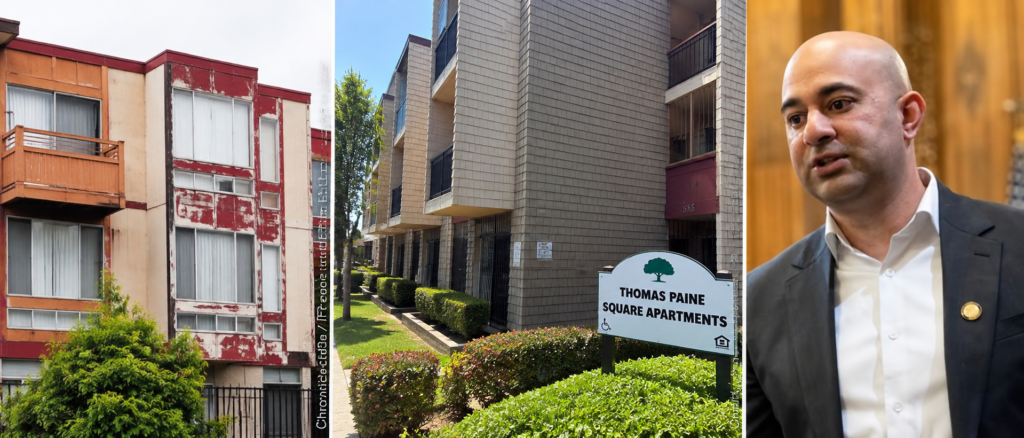
Photo credit: (left) King-Garvey, https://www.sfgate.com/news/article/Co-op-residents-up-against-the-wall-Western-2861268.php?utm_source=chatgpt.com
Photo credit: (middle) Thomas Paine Square, https://missionlocal.org/2026/07/bilal-mahmood-announce-thomas-paine-apartments-domus-hearing/?utm_source=chatgpt.com
Photo credit: (right) District 5 Supervisor, Bilal Mahmood, https://sfstandard.com/2026/08/31/san-francisco-bilal-mahmood-letter-growsf-seiu-rafael-mandelman/?utm_source=chatgpt.com
Destination Freedom Media Group as well as numerous community members want to extend their sincere gratitude to District 5 Supervisor, Bilal Mahmood for calling for this hearing and listening to the voice of the people
SAN FRANCISCO — Samuel Broadnax did not come before the San Francisco Board of Supervisors on Thursday to debate housing policy in the abstract.
He came in a wheelchair.
Broadnax told the Government Audit and Oversight Committee that he is 80 years old and has lived at the Martin Luther King–Marcus Garvey Square Cooperative for nearly four decades. He remembers when the development was a place where he believed he could live safely and grow old.
Now, he said, navigating his own home has become dangerous.
Broadnax testified that he recently fell on stairs. He described difficulty accessing parts of his home and said he cannot properly use his kitchen or patio. He said he had been moved to what was supposed to accommodate his disability, yet fears that barriers on the windows could leave him trapped in a fire.
“So you tell me we’re treated fairly?” Broadnax asked the supervisors. “No. We are not treated fairly.”
His testimony lasted only minutes.
But it captured what hours of testimony at City Hall revealed: This is no longer simply a dispute between tenants and a property management company.
It is a fight over whether some of San Francisco’s historically Black affordable-housing institutions can still fulfill the purpose for which they were created—and whether the government agencies, boards, owners and private companies entrusted with those properties can be compelled to account for what is happening inside them.
The October 1 hearing was called to investigate what the City formally described as “mass evictions” and concerns involving habitability, affordable-housing recertification, payment processing and resident safety at King-Garvey, Thomas Paine Square Apartments and other properties currently or previously managed by Domus Management Company. The official hearing file requested appearances from Domus representatives, attorney Mercedes Gavin, the King-Garvey board, officers of the Allen Community Development Corporation, HUD’s Northern California office and the San Francisco Human Rights Commission.
Residents came.
Their attorneys came.
The Human Rights Commission came.
But when supervisors asked whether anyone from Domus was present to respond to the testimony, no representative came forward.
And that empty space at the witness table may have said as much about San Francisco’s affordable-housing accountability problem as anything heard during the hearing.
This Is About More Than Rent
King-Garvey is not an ordinary apartment complex.
Residents repeatedly reminded supervisors that it is a cooperative—a housing institution rooted in an era when Black San Franciscans were struggling to retain a foothold in a Western Addition devastated by redevelopment and displacement.
Daniel Landry told the committee that his family moved into King-Garvey in 1976. He remembered residents coming together, raising money and eventually establishing the cooperative.
Other speakers described parents, churches and community members investing money and labor into affordable housing because Black families needed something redevelopment had systematically stripped away: permanence.
That history is what makes today’s eviction proceedings so difficult for residents to reconcile with what they believed cooperative ownership represented.
D.D. Hewitt, a longtime King-Garvey resident and former board member, reduced that contradiction to one question:
“We are a co-op, which means we own it. So when we say we’re facing eviction, how do you evict somebody that don’t rent property?”
The legal answer is more complicated. Cooperative shareholders generally hold an interest in the cooperative rather than individual title to their apartments, and their continued occupancy can be governed by agreements containing enforceable obligations.
But Hewitt’s question goes to the heart of the crisis.
What exactly do King-Garvey shareholders own?
What equity have they accumulated?
What rights accompany that ownership?
And under what circumstances can the people who collectively own an affordable-housing cooperative lose the right to live there?
Those questions become considerably more urgent when the eviction proceedings themselves involve disputed accounting.
From a $6,000 Eviction Notice to a $47,000 Ledger
An attorney, Tuesday Thornton, with the Eviction Defense Collaborative told supervisors that she represents two King-Garvey residents in unlawful-detainer proceedings.
Ms. Thornton’s testimony was among the most consequential of the hearing because it moved the discussion from general allegations into figures that can be tested against court records, notices and accounting ledgers.
Ms. Thornton said the nonpayment notices in her two cases sought approximately $5,000 and $6,000.
Yet in one case, she testified, the landlord’s ledger reflected approximately $47,000 in claimed debt.
Ms. Thornton further testified that residents had spent months or years trying to determine what they actually owed and that management had acknowledged during an earlier meeting that it did not possess records supporting some of the historical arrears appearing on resident ledgers.
If accurate, that raises an obvious question:
How does an alleged debt that cannot be substantiated become part of the ledger used against a cooperative shareholder facing eviction?
Ms. Thornton told supervisors that her organization had attempted to resolve the cases but had instead been drawn into unusually intensive litigation.
That produces another irony.
San Francisco is spending public money to fund attorneys defending low-income residents against eviction while those attorneys say they are spending extraordinary amounts of time trying to reconcile financial claims that should have been accurately documented before an eviction case was filed.
The hearing did not determine whether the debts are valid.
But it made the underlying records—rent ledgers, payment histories, recertification records, notices and court filings—central to determining what happened.
“Where Are the Books?”
Again and again, testimony returned to a different question.
Where are the financial records?
Hewitt told supervisors that King-Garvey is a limited-equity cooperative and that shareholders historically received information concerning their financial interests.
She testified that she has not received the relevant annual equity information for approximately four or five years.
Landry raised similar concerns about financial transparency.
At another Domus-managed cooperative discussed during the hearing, resident representative Harriet Morgan said shareholders were told at a board meeting that financial statements could be obtained from Domus. When residents went to Domus, she said, they were directed back to the board.
The documents were then supposed to be emailed, Morgan testified.
They still had not received them.
Then Hewitt raised a far larger financial issue.
She alleged that King-Garvey underwent approximately $54 million in rehabilitation financing around 2010 and that the cooperative has now taken on approximately $59 million in additional debt.
“I’m calling for a legal investigation,” Hewitt told the committee, “a forensic investigation into the books of Domus and the Board of Directors at Martin Luther King Marcus Garvey.”
Those figures and the circumstances surrounding any new financing require independent verification.
But if the financing is confirmed, shareholders deserve straightforward answers.
Who authorized the debt?
What does it finance?
What property or revenue secures it?
What approvals were required?
Were shareholders entitled to vote?
What work was completed with the earlier rehabilitation money?
And what financial disclosures have shareholders received?
Those are not rhetorical questions.
They are questions that contracts, audited financial statements, board minutes, loan agreements and HUD records can answer. Furthermore, these allegations of wrongdoing fall squarely within the realm and jurisdiction of San Francisco Inspector General, Alexandra “Alex” Shepard. On more than one occasion during the hearing, I heard the words fraud, waste and mismanagement. After the hearing, I spoke with an employee of the Human Rights Commission who asked to remain anonymous. They said they were curious why no one from the City Attorney’s Office was present.
More Than 500 Social Security Numbers?
Landry raised another allegation that demands documentary investigation.
While serving on the King-Garvey board, he said, he and another board member encountered a box containing applicant or waiting-list files in a boardroom area.
Landry estimated that the records contained more than 500 Social Security numbers and other confidential information.
“What kind of management agent” handles confidential information that way, he asked.
The allegation has not yet been independently substantiated, and the hearing did not establish that a data breach or crime occurred.
But it should not disappear into a hearing transcript.
If those files existed as Landry described them, photographs, board records, witnesses and management policies should establish where the information was stored, who had access to it and whether applicable privacy safeguards were followed.
At Thomas Paine, Some Conditions Are Already in the Public Record
Not everything heard Thursday depends solely on resident testimony.
At Thomas Paine Square, residents described rodents, water damage, mold, security failures and unsafe conditions.
City records document at least some of those underlying problems.
An April 2024 San Francisco Department of Building Inspection notice of violation for a Thomas Paine unit ordered correction of missing smoke and carbon-monoxide detectors, rodent infestation, water damage and mold or mildew.
And residents had been sounding alarms long before Thursday.
Mission Local reported in 2025 that residents complained about rent overcharges, eviction notices, mold and asbestos, while describing a housing arrangement in which HUD subsidized the property, Bethel AME Church owned it and a church-appointed board oversaw it. The publication reported that 39 DBI complaints had been filed since 2002, with two active at the time of its reporting.
In January, the San Francisco Standard reported that Thomas Paine resident Au’janie McAllister was hospitalized with a concussion and fractured eye socket following a violent attack. Residents told the publication that security and management had failed to adequately respond to repeated safety concerns.
The Standard subsequently reported on the overlapping business relationships surrounding Thomas Paine, including that W.S.B. & Associates—the security contractor serving Thomas Paine and other church-affiliated housing—was owned by Bobby Sisk, who also held leadership roles connected to the church’s housing operations.
Thursday’s testimony therefore did not introduce Thomas Paine’s problems to San Francisco.
It raised a more troubling question:
Why are residents still coming to City Hall describing them?
“Nothing Has Gotten Better”
A longtime Thomas Paine resident identified during the hearing as Deborah described management turnover, missing paperwork, repeated recertification demands, unanswered telephone calls and ineffective security.
She also described an eviction dispute of her own.
According to her testimony, she had paid her rent using money orders, but management eventually stopped accepting them. She sought legal assistance and said records ultimately supported her position.
The dispute stretched for more than a year, she said.
When Supervisor Bilal Mahmood asked whether conditions had improved following earlier meetings between residents and leadership, her response was immediate:
“Nothing has gotten better. I mean, if anything has gotten worse.”
That statement carries additional weight because Thursday’s hearing did not emerge suddenly.
When Mahmood announced the hearing earlier this year, his office said it followed multiple meetings with Thomas Paine residents concerning dangerous housing conditions, violent incidents, harassment, security failures and alleged management misconduct. The City Attorney’s Office had also been made aware of complaints.
At the time, the Mayor’s Office of Housing and Community Development emphasized that the property is privately owned HUD-subsidized housing and that the City’s direct authority is limited.
That jurisdictional gap became one of Thursday’s central problems.
Everybody Has a Piece of the Problem. Who Owns the Solution?
Representatives of the San Francisco Human Rights Commission testified about complaints from residents and attempts at mediation.
HRC officials explained that jurisdictional limitations prevent the agency from formally adjudicating some housing-discrimination complaints. It can, however, attempt mediation.
According to testimony Thursday, HRC contacted Domus concerning resident complaints. The company responded, officials said, but the engagement did not produce sufficient discussion of the residents’ specific allegations to resolve the disputes.
That distinction matters.
For years, residents have complained that management would not meaningfully respond to them.
Now a City civil-rights agency was describing limitations in its own ability to force a resolution.
Landry seized on that problem.
Government cannot simply say an issue falls outside its jurisdiction and send residents elsewhere, he argued. He urged supervisors to strengthen oversight and create mechanisms capable of intervening before residents reach the point of eviction, dangerous housing conditions or a City Hall hearing.
His testimony exposed perhaps the most fundamental problem of the day:
HUD has authority over one part of the housing system.
The City has authority over another.
Property owners and nonprofit boards exercise another layer of control.
Management companies run day-to-day operations.
Civil-rights agencies may mediate some disputes but lack jurisdiction over others.
Tenant attorneys can defend an eviction—but often only after the machinery of displacement has already started moving.
When everybody has jurisdiction over a piece of the problem, residents can be left wondering whether anybody is responsible for the whole thing.
An 80-Year-Old Man Should Not Be the Oversight System
Broadnax’s testimony brought that institutional maze back to its human consequences.
He should not have to understand HUD handbooks, cooperative corporate law, City building codes, reasonable-accommodation requirements, management contracts and overlapping government jurisdictions simply to safely enter his home.
Nor should a 96-year-old resident have to become a housing-law expert to obtain a reasonable accommodation.
Hewitt testified that an elderly longtime King-Garvey resident, Miriam White, had been unable to secure a requested move despite what Hewitt described as repeated medical documentation.
That allegation requires verification.
But Broadnax was physically present.
In his wheelchair.
Telling City Hall what his life had become.
His story is precisely why this hearing cannot be reduced to a bureaucratic dispute over who has jurisdiction.
The Empty Chairs
The people who felt the consequences showed up.
Residents showed up.
Elderly shareholders showed up.
People with disabilities showed up.
People whose families had been connected to these developments since the 1960s and 1970s showed up.
Lawyers defending residents from eviction showed up.
The Human Rights Commission showed up.
But several of the institutions and individuals the City formally requested to appear were absent from the witness table.
HUD did not appear.
Representatives of the King-Garvey board did not publicly answer the allegations during the portion of the hearing reviewed for this report.
And Domus did not come forward when specifically invited from the dais to respond.
Their absence does not prove the allegations made against them.
It does, however, leave serious questions unanswered.
Before the hearing, Mahmood had already said the committee could consider its subpoena authority if necessary to obtain participation from key stakeholders.
Thursday made clear why that may matter.
Because this hearing cannot be the end of the inquiry.
It must be the beginning of the accounting.
They Built It
There is a danger in describing what is happening in the Fillmore merely as an affordable-housing crisis.
It erases the history.
These developments exist in a neighborhood where Black families already know what government-sanctioned displacement looks like.
Urban renewal tore through the Fillmore. Homes disappeared. Businesses disappeared. Churches and social networks were disrupted. Thousands of Black residents were displaced.
The affordable developments and cooperatives that survived or emerged from that era were not simply buildings.
They became part of the infrastructure through which Black San Franciscans attempted to remain in San Francisco.
That is why Brenda Backland’s brief testimony mattered.
She recalled attending Bethel A.M.E. Church as a child and contributing her Sunday-school money to a credit union connected to the effort to create affordable housing.
Maxine Jones told supervisors that her mother moved into King Square in 1967.
Landry remembered his family arriving in the 1970s and residents organizing to establish their cooperative.
These aren’t people arriving decades later and demanding control of someone else’s institution.
Their families helped build the institutions.
And now some are asking City Hall to help them understand how those institutions are being governed, how their money is being handled and why some of the people they were created to protect are facing displacement.
“Where Is the City Government?”
One sentiment echoed through the hearing:
The Black community is under attack—and where is City government?
That assertion is a community judgment, not a finding established by Thursday’s hearing.
But the facts underlying the question deserve investigation.
Why are residents facing eviction over amounts their attorneys dispute?
Why do shareholders say they cannot obtain basic financial information?
What happened to their accumulated equity?
What is the basis for the financing residents described?
What oversight exists over cooperative boards and their management companies?
What recourse exists when residents allege retaliation?
Why are elderly and disabled residents describing unresolved accessibility problems?
Why do serious habitability complaints continue after years of meetings, inspections and media coverage?
And when the City summons the people with the power to answer those questions, what happens when they simply do not come?
Those questions extend beyond Domus.
They extend to cooperative boards.
Property owners.
HUD.
City departments.
Contractors.
Attorneys.
And ultimately San Francisco itself.
The City’s challenge now is not merely to determine whether another hearing should be scheduled.
It is to determine whether an accountability structure exists that is capable of protecting these communities before another elder falls, before another disputed ledger becomes an eviction case, before another family leaves the city and before another historically Black housing institution becomes Black only in its history.
Samuel Broadnax should not have had to come to City Hall in a wheelchair to explain that.
But he did.
Now San Francisco has heard him.
The question is what it will do next.
Destination Freedom Media Group will continue reviewing the financial, court, inspection and cooperative-governance records underlying allegations raised at the October 1 hearing. Domus Management Company, the relevant cooperative boards, property owners, HUD and individuals named during the hearing should be given an opportunity to respond to specific allegations before additional investigative findings are published.
NEXT MEETING OF THE BOARD OF SUPERVISORS IS SCHEDULED FOR DECEMBER 3, 2026 – TIME TBD
Our song/video for this article is:
The O’Jays – Give the People What They Want (Official Audio)