At Providence Baptist Church, the candidates for District 10 supervisor arrived with speeches. The community arrived with decades of unanswered questions — and a single test that outlasted the evening: how, exactly, will we measure you?
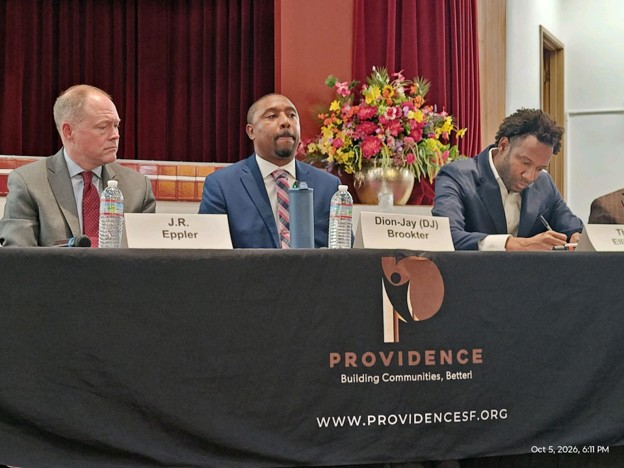
SAN FRANCISCO — The warning came before the politics. “Tonight is about information, not intimidation,” the audience at Providence Baptist Church was told. “Tonight is about dialogue, not division. Tonight is about community, not conflict.” For much of Monday evening, Oct. 5, that was precisely what unfolded. The applause was polite. The questions were not.
Inside Providence Baptist Church — where generations of Bayview-Hunters Point residents have gathered for worship, for organizing and for civic life — the people seeking to become San Francisco’s next District 10 supervisor have spent this campaign season standing before a community that has waited decades for promises to become policy. This fall, they have been measured twice in that same sanctuary: first at a wide coalition forum organized by the District 10 Coalition of Accountability, which placed seven contenders before the neighborhood, and again at Monday evening’s more intimate Providence forum, where three of the race’s leading candidates — Brookter, Eppler and Ellington — were granted something a crowded ten-candidate stage rarely permits: time to probe.
Moderator Dexter Hall, executive director of the Providence Foundation, made clear that probing was exactly the point. The community, Hall said, had already heard the campaign speeches. Every major question had been submitted by residents themselves, and together they painted a portrait of a district still wrestling with the consequences of disinvestment, redevelopment, environmental contamination, transportation inequities, housing instability and economic exclusion. This time, residents wanted to know: How will you do it? Who will you hold accountable? How will you keep us informed?
By the end of the evening, one reality had become unmistakable. District 10 was not searching for the perfect speech. It was searching for evidence that someone seeking public office understood the weight of its history.
A Neighborhood With a Long Memory
Political campaigns often begin by asking voters to imagine the future. In Bayview-Hunters Point, the conversation repeatedly returns to the past. That is understandable.
This is the neighborhood that became home to wartime shipbuilding, to generations of African American families who migrated during World War II, to heavy industry and public housing — and later, to one of the nation’s most closely watched Superfund sites. Its residents have lived through redevelopment plans, school closures, economic shifts and repeated promises of revitalization, all while continuing to raise questions about environmental health, public investment and equal access to opportunity.
Those realities shaped every topic discussed across both forums. Housing was not simply about constructing units. Transit was not simply about buses and trains. Public safety was not simply about policing. Environmental justice was not simply about contamination. Each issue reflected a larger question: whether District 10 receives the same urgency, resources and governmental attention afforded to other parts of San Francisco.
Three Visions of District 10
Political campaigns often begin by asking voters to imagine the future. In Bayview-Hunters Point, the conversation repeatedly returns to the past. That is understandable.
This is the neighborhood that became home to wartime shipbuilding, to generations of African American families who migrated during World War II, to heavy industry and public housing — and later, to one of the nation’s most closely watched Superfund sites. Its residents have lived through redevelopment plans, school closures, economic shifts and repeated promises of revitalization, all while continuing to raise questions about environmental health, public investment and equal access to opportunity.
Those realities shaped every topic discussed across both forums. Housing was not simply about constructing units. Transit was not simply about buses and trains. Public safety was not simply about policing. Environmental justice was not simply about contamination. Each issue reflected a larger question: whether District 10 receives the same urgency, resources and governmental attention afforded to other parts of San Francisco.
Three Visions of District 10
The opening statements at Monday’s forum immediately revealed three different political identities.
Brookter spoke about faith, community and young people, portraying himself as a candidate whose work in District 10 has centered on employment, opportunity and community-based institutions. Throughout the campaign he has returned again and again to a single theme: implementation. Rather than calling for entirely new strategies, he argues that District 10 already possesses plans, partnerships and community recommendations that require sustained execution and institutional accountability.
Eppler reached further back. He described growing up in a working-class neighborhood divided by a freeway, watching his mother unsuccessfully organize for a sound barrier, and later discovering — after moving to District 10 sixteen years ago — what organized neighborhood power could accomplish. His vision is rooted in the mechanics of neighborhood government: functioning streets, parks, transit, affordable housing, schools and commercial corridors where residents can obtain basic necessities without leaving their community.
Ellington’s opening was intensely personal. “I am the only San Francisco Bayview native standing on this stage,” he told the room. He described his grandfather arriving from Natchez, Mississippi, becoming a laborer and eventually buying a home near Third and Palou. He recalled being raised by a mother earning $18,000 a year, and connected his political motivation to the killing of his cousin in Hunters Point when Ellington was 13. His “North Star,” he said, is ensuring families can afford to remain in San Francisco, feel safe and live in thriving neighborhoods.
Three candidates. Three biographies. Then Hall began asking them to show their work.
The Shipyard: Everyone Wants Oversight. But What Kind?
No subject has carried greater emotional weight this campaign season than environmental justice. When the conversation turns to pollution, the Hunters Point Naval Shipyard, diesel emissions and industrial impacts, the tone in the room shifts — from campaign messaging into the lived experience of a community that has spent decades confronting questions surrounding contamination, cleanup, redevelopment and public health.
At Monday’s forum, the question was direct: What would the candidates do to ensure the cleanup is safe, transparent and completed with meaningful community oversight? The candidates agreed on the need for oversight. They differed on its architecture.
Eppler called for independent verification of testing and more immediate disclosure of environmental results, arguing that the public should not wait months to learn that contamination or anomalous readings have been discovered. Pressed on accountability, he invoked one of the Board of Supervisors’ most important powers — its power of inquiry — proposing continuing oversight hearings in which responsible officials would publicly account for cleanup benchmarks, problems and delays.
Brookter emphasized independent oversight coupled with economic development: public “report cards” tracking cleanup progress, community hearings held outside City Hall, and workforce-development programs that would train District 10 residents to participate in the remediation work itself. For Brookter, cleanup should not merely happen to the Bayview; residents should have the opportunity to participate economically in the work.
Ellington’s answer was more personal. He reminded the audience that he lives at the Hunters Point Shipyard and said he had gone to court after revelations concerning contaminated soil. He called for reliable year-round funding for environmental monitoring, greater capacity for the existing Citizens Advisory Committee and restoration of the Restoration Advisory Board — and said that as supervisor he would use the City Attorney’s Office to pursue bad actors when necessary.
The differences were subtle but real. Eppler emphasized governmental interrogation. Brookter emphasized community-facing oversight and economic participation. Ellington emphasized enforcement and rebuilding institutional oversight.
The discussion unfolds against a broader backdrop. Only days earlier, environmental justice advocates and community organizations had gathered at San Francisco City Hall to call for stronger action regarding ongoing concerns at the Shipyard; several candidates had attended. Yet across an evening devoted largely to the U.S. Navy, contamination and regulatory oversight, there was comparatively little discussion of the role the Mayor’s Office could play in coordinating city agencies and advocating for residents alongside state and federal partners. That omission does not diminish the significant responsibilities of the federal agencies involved. It highlights an additional question that remains relevant to District 10: how City Hall intends to use its own authority to advocate for community health, transparency and accountability.
Development Without Displacement
On housing, the candidates confronted the contradiction that has haunted southeast San Francisco for decades: How do you bring investment into communities that have historically been denied it without allowing that same investment to push existing residents out?
“We can build housing in this neighborhood without displacement. We have the land. We have the space. We just need the political will.”
— THEO ELLINGTON
Ellington proposed what he described as a first-of-its-kind community and economic development plan for District 10, to be initiated within his first 30 days — an effort to coordinate housing, transit, employment, industrial land and economic-development goals instead of making development decisions parcel by parcel. He also used the issue to distinguish his record from his opponents’, criticizing what he viewed as insufficient opposition to plans for an AutoZone at the former Walgreens site.
Eppler approached displacement from the perspective of retention: Certificates of Preference, neighborhood preferences, and affordability levels extending from deeply affordable housing to workforce housing. Success, he argued, should ultimately be measured in people — whether District 10 continues to lose Black residents, or whether government finally creates conditions that allow residents to stay and displaced families to return.
Brookter summarized his housing philosophy in three words: “Build, preserve and finance.” He stressed responsible development, command of zoning, legal protections for existing tenants, and the importance of the next District 10 supervisor playing a strong role in land-use decisions.
Who Gets the Contracts?
The discussion became more concrete when residents asked how the next supervisor would ensure that general contractors actually use community contractors.
Brookter called for stronger enforcement of local-hire requirements and greater opportunities for hyper-local businesses, LBEs and minority- and women-owned businesses. His argument was straightforward: a local-hire policy means little if the people living next to major developments remain excluded from the work.
Ellington offered specific governmental tools. On city-owned property, he said, San Francisco can establish contracting and local-hire requirements; he discussed special-use districts, adjusted contracting thresholds, and a local contracting center at the Southeast Community Facility where contractors could see bids and obtain help with bonding, loans and payroll.
Eppler focused on consequences. Project labor agreements, he said, should expand the pool of jobs while the city increases the percentage flowing to local businesses — and local-hire commitments should not disappear into enormous compliance reports. If contractors repeatedly fail to meet promises made to San Francisco, particularly while benefiting from city contracts, he said, there should be repercussions.
Public Safety After the Gunfire
Eppler argued that District 10 cannot police its way out of every problem. A mental-health crisis requires a mental-health response, he said; problems involving young people may require trusted community intervention. Sworn officers should be concentrated on duties requiring police, while civilian employees assume functions that do not.
Brookter called his approach “community unity.” Prevention, he said repeatedly, must come first — employment, ambassador programs, community-based services, and relief from a cost-of-living crisis that leaves families struggling with rent, food and basic necessities.
“The public safety plan failed us and failed this community… The best way to stop a bullet is a job.”
— THEO ELLINGTON
Ellington delivered one of the evening’s strongest critiques of existing government, citing recent shootings near the Bayview Opera House, West Point and Thomas Avenue and questioning where the promised mental-health response and coordinated community intervention had been. He called for rapid crisis response, mental-health providers in schools and at the scene after shootings, direct services for victims, and a school-to-career pipeline connecting young people to construction, public safety and other careers.
Brookter agreed that the District 10 safety plan had failed, but offered a different diagnosis: the plan, he argued, had been deprived of sufficient resources, with some organizations losing funding under the new administration. Brookter, whose organization housed the District 10 safety plan, contended that government cannot demand results while simultaneously reducing the infrastructure expected to produce them.
That exchange revealed one of the clearest differences of the evening. Ellington questioned whether the existing system is performing. Brookter questioned whether government has adequately funded it to perform. Eppler emphasized a system in which police, mental-health professionals, violence-prevention workers and community organizations perform clearly differentiated roles.
Then Came the Money
Eventually, the forum arrived at a question that has become increasingly important in the District 10 race: outside financial support. “How will you ensure outside financial support does not influence your decisions?” the candidates were asked.
“I got about 500,000 reasons to share what I want.”
— D.J. BROOKTER
Brookter’s light but unmistakable reference was to the $500,000 contributed by Christian “Chris” Larsen to an independent expenditure committee supporting Ellington — money that was not a contribution to Ellington’s candidate-controlled campaign, a distinction that matters under campaign-finance law. Brookter said his agenda comes from the community and pledged that outside interests would not dictate his decisions.
Eppler took another route, noting that more than 60 percent of his fundraising comes from within District 10, and used the controversy over Flock Safety surveillance cameras to argue more broadly that money and political relationships can shape government decisions.
The exchange produced some of the evening’s lightest political sniping, but it remained civil — and it surfaced a legitimate question for District 10 voters. Brookter and Eppler emphasized demonstrating independence from outside financial interests. Ellington, who under independent-expenditure law can benefit from substantial outside spending without controlling the committee making those expenditures, asked voters to evaluate his record, his policy proposals and his accountability to the district.
The exchange also gave air to a quieter current in the race: rumors circulating in recent weeks that Brookter and Eppler had formed a loose partnership — an understanding, fair or not, to train their fire on Ellington, the candidate whose campaign has drawn the district’s largest outside investment. Neither campaign has confirmed any arrangement, and no evidence of coordination surfaced during the forum. What was visible was the pattern: on the money question, the pressure arrived from two directions at once — Brookter’s “500,000 reasons,” then Eppler’s case that voters should weigh where a candidate’s support comes from. Ellington did not engage the rumor directly; he asked instead to be judged on his record. Whether the evening’s choreography reflected strategy, shared conviction or simple coincidence, the room noticed — and in a district that prides itself on holding power to account, so did the voters.
The Wider Field
Ten candidates are seeking the District 10 seat, and the coalition forum offered a glimpse of how wide the field’s theories of governance truly run. Shawn Richards grounds his campaign in decades of violence-prevention work through Brothers Against Guns — mentorship, intervention and youth opportunity as essential components of public safety. Jessica Pessecow approaches policy through the lens of public health, transparency and administrative reform. Pearci “PJ” Bastiany III has presented an expansive agenda spanning housing, transportation, renewable energy, maritime redevelopment and youth programming. Mike Lin emphasizes technology, innovation, entrepreneurship and modernizing public systems.
Only three candidates, however, stood on the Providence stage Monday evening. Among those noticeably absent were Deandra Bryant and Shawn Richards, both of whom have participated in other forums during this campaign. Their absence establishes nothing about why they were not present, and it should not be read as a judgment on their campaigns without knowing the circumstances. But a forum built around implementation rather than slogans offered candidates a rare opportunity to demonstrate how they would govern under pressure. Brookter, Eppler and Ellington took that opportunity.
Candidate forums are not elections, and applause is never the same as a vote. Ellington appeared to draw particularly strong attention when discussing his Bayview roots, the Shipyard, housing and public safety, repeatedly identifying specific administrative and legislative mechanisms rather than stopping at broad aspiration. Brookter demonstrated a strong connection between policy and the network of community organizations operating in District 10. Eppler, less inclined toward rhetorical flourish, returned again and again to the institutional details that matter once campaign promises reach City Hall: hearings, legislative authority, demographic measurements, contract accountability. No single reaction established an undisputed favorite. Each candidate had moments of connection — and more important than the applause was the seriousness with which residents listened to all three.
The Accountability Question
The season’s most revealing exchange may have come not from a policy dispute but from a single challenge Hall posed as the coalition forum drew toward its conclusion. Rather than asking candidates about their values or priorities, he asked something harder: What measurable outcome would they be willing to be judged on within their first two years in office?
The answers varied. Some identified specific policy goals; others emphasized accessibility, community meetings and continued public engagement. But the significance of the question extended beyond the individual responses. For a district that has witnessed decades of redevelopment plans, transportation studies, environmental reviews and political commitments, accountability itself has become the issue. Residents were not simply asking candidates what they hoped to accomplish. They were asking how success — or failure — should be measured.
Beyond the Campaign Speech
The most revealing thing about this forum season may ultimately be that none of the candidates pretended the district’s hardest problems could be solved by a slogan. No one produced a magic solution for the Hunters Point Shipyard. No one explained how San Francisco can build tens of thousands of homes while guaranteeing that displacement disappears. No one could promise that another young person will not be shot in Bayview-Hunters Point. Instead, residents heard candidates explain which governmental levers they would pull: hearings, public dashboards, special-use districts, local-contracting centers, environmental report cards, beat officers, mental-health workers, youth employment and community-development planning.
The questions, meanwhile, remain. Will long-promised housing create lasting opportunity for existing residents? Will public transit become more reliable and equitable? Will small businesses along Third Street see sustained investment? Will young people find expanded educational and employment pathways? Will environmental health concerns receive continued public attention? And perhaps most importantly, will the next supervisor be able to transform decades of planning into measurable progress?
Providence Baptist Church began the evening with a request for information instead of intimidation, dialogue instead of division, community instead of conflict. The candidates largely honored that request. They disagreed, occasionally challenged one another and defended their records, but the discussion remained centered on the people who will live with the consequences of the next supervisor’s decisions.
For District 10 residents, the task now is not simply to decide which candidate offered the strongest vision. It is to decide which candidate has demonstrated the experience, independence, judgment and commitment necessary to turn that vision into measurable results. On Nov. 3, that decision belongs to the voters of District 10.
In a neighborhood with a long memory, promises are remembered.
So are outcomes.
EDITORIAL SOURCE NOTE
Campaign-finance characterization in this article distinguishes between contributions to a candidate-controlled committee and independent expenditures made by a separate committee. The $500,000 referenced during the forum was contributed by Christian “Chris” Larsen to an independent expenditure committee supporting Theo Ellington.