
As advocates push to ban plastic cigarette filters, supporters say the fight is about cleaner streets, environmental justice, and stopping pollution before it starts.
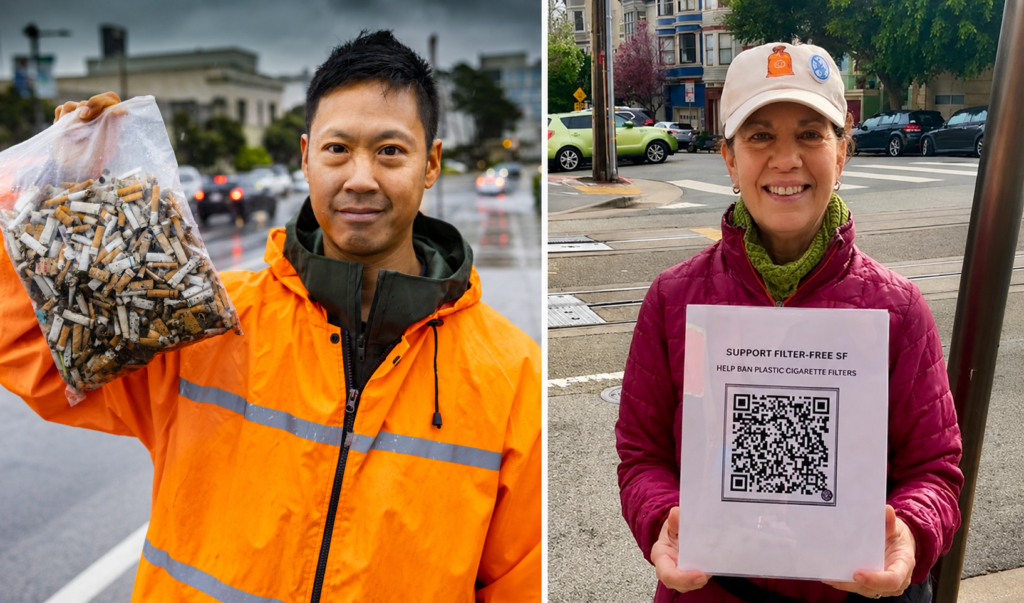
Vince Yuen and Barbara Bella
Refuse Refuse
Every Saturday morning across San Francisco, thousands of residents lace up their shoes, grab buckets and trash pickers, and head into their neighborhoods to clean up a city they love.
They pick up fast-food wrappers.
They pick up discarded bottles.
They pick up illegal dumping left behind in vacant lots and along commercial corridors.
And then they pick up cigarette butts.
Again.
And again.
And again.
For the volunteers of Refuse Refuse, the organization founded by civic activist Vincent Yuen, cigarette filters have become an unavoidable symbol of a larger problem: one of the most common forms of litter in San Francisco is also one of the least discussed.
Now, a growing coalition of environmental advocates, neighborhood leaders, and community organizations is asking a simple question:
If cigarette filters are made of plastic, why are we still allowing millions of them to enter our environment every year?
The answer to that question could soon become the basis for new legislation before the San Francisco Board of Supervisors.
A POLLUTION PROBLEM HIDDEN IN PLAIN SIGHT
According to advocates supporting the proposal, approximately 59.3 million cigarette butts are discarded annually in San Francisco. Those discarded filters generate an estimated 10.7 metric tons of waste every year, releasing billions of plastic microfibers into the environment while leaching nicotine, heavy metals, and other toxic chemicals into streets, storm drains, beaches, and waterways.
Supporters estimate that cigarette filters contribute:
Approximately 7.35 billion microfibers annually
Roughly 356 kilograms of nicotine contamination
Billions to trillions of secondary nanoplastic particles as filters degrade
The public often views cigarette butts as minor litter. Environmental scientists increasingly view them differently.
Most cigarette filters are manufactured from cellulose acetate, a form of plastic that does not biodegrade in the way many people assume. Instead, filters slowly fragment into smaller and smaller plastic particles that persist in the environment long after the cigarette itself has been extinguished.
For cleanup volunteers, the evidence is visible every day.
For environmental advocates, the consequences are becoming impossible to ignore.
THE LIMITS OF CLEANUP
San Francisco has invested heavily in street cleaning, beautification efforts, and neighborhood cleanup initiatives. Organizations such as Refuse Refuse have mobilized extraordinary community participation.
According to organizers, more than 22,000 volunteers representing every supervisorial district have participated in cleanup efforts, collectively removing more than one million pounds of trash from public spaces throughout the city. Those numbers tell a story of civic pride. But they also reveal the limits of cleanup as a long-term strategy.
No matter how many volunteers show up. No matter how many pounds of trash are removed. New cigarette butts continue to appear the next day.
Supporters of the proposed legislation argue that this reality exposes a fundamental flaw in relying exclusively on cleanup-based approaches.
“We are treating the symptom instead of the source,” advocates argue.
The challenge is not simply collecting litter after it appears. The challenge is preventing the litter from entering the environment in the first place.
WHY ENVIRONMENTAL JUSTICE ADVOCATES ARE PAYING ATTENTION
For many supporters, this issue extends beyond aesthetics. It is also about environmental justice.
Neighborhoods already carrying disproportionate environmental burdens often experience the impacts of litter and pollution more intensely than wealthier communities.
In Bayview-Hunters Point and other historically underserved neighborhoods, residents have spent decades confronting environmental challenges ranging from industrial contamination and illegal dumping to poor air quality and neglected infrastructure.
Advocates argue that cigarette filter pollution adds another layer to those cumulative burdens.
While a cigarette butt may seem insignificant on its own, tens of millions of them create a citywide pollution stream that ultimately affects communities already struggling with environmental inequities.
Supporters view the issue through the same lens that has guided other successful environmental reforms: identify preventable pollution, address it at the source, and reduce the burden placed on affected communities.
FOLLOWING SANTA CRUZ’S LEAD
The proposal being advanced in San Francisco is modeled after legislation adopted in Santa Cruz County in 2025, where local officials moved to prohibit the sale of cigarettes containing plastic filters.
Advocates view Santa Cruz as proof that local governments can take meaningful action against cigarette filter pollution without waiting for state or federal intervention.
The San Francisco proposal would similarly focus on regulating the sale of cigarettes containing plastic filters rather than relying solely on enforcement or litter-abatement strategies after the fact.
Supporters describe the approach as practical, prevention-focused, and consistent with broader efforts to reduce plastic pollution.
BUILDING A COALITION
The campaign has steadily gained momentum. According to organizers, the proposal has received endorsements from eight internationally recognized experts on cigarette filter pollution, support from 28 San Francisco neighborhood and community organizations, and signatures from more than 5,400 supporters.
Among those joining the effort is longtime San Francisco activist Russell Long, whose previous advocacy contributed to successful campaigns restricting indoor smoking and eliminating Styrofoam products.
Advocates say the growing coalition reflects a broad consensus that cigarette filter pollution has become a quality-of-life issue, an environmental issue, and a public policy issue. Yet despite that support, organizers acknowledge that converting community momentum into legislation remains a challenge.
WAITING FOR A SPONSOR
Supporters have spent months meeting with members of the San Francisco Board of Supervisors in hopes of securing sponsorship for the proposal. So far, no supervisor has formally agreed to introduce the legislation.
Advocates say they are surprised that a city deeply invested in clean streets, environmental sustainability, and public health has not yet embraced a policy aimed at one of its most persistent litter streams.
To date, Supervisor Danny Sauter has taken the most concrete step by requesting that the Budget and Legislative Analyst’s Office examine potential costs, impacts, and implementation considerations associated with a possible ban. Supporters view that review as an important first step. Whether it becomes a legislative one remains to be seen.
A GROWING REGIONAL MOVEMENT
The conversation is no longer confined to San Francisco.
Recently, Yuen and community activist Barbara Bella participated in a California conference focused on illegal dumping and urban waste reduction, where local officials and environmental advocates discussed strategies for addressing persistent litter streams.
During that gathering, Alameda County Supervisor Nate Miley reportedly expressed interest in pursuing similar legislation within his jurisdiction. Advocates believe that if San Francisco moves forward, it could become part of a broader regional effort to address cigarette filter pollution across the Bay Area.
THE QUESTION BEFORE CITY HALL
The debate ultimately centers on a larger question.
How should cities address pollution that is predictable, preventable, and repeatedly cleaned up at public expense?
For supporters, the answer is straightforward.
Street cleaning matters.
Volunteer cleanups matter.
Public Works crews matter.
But none of those efforts change the fact that millions of plastic cigarette filters continue entering the environment every year. The volunteers who spend their weekends removing litter understand this reality better than anyone. They see it one cigarette butt at a time. And increasingly, they are asking City Hall to see it too.
Our song/video for this article is: Joni Mitchell – Big Yellow Taxi (Official Lyric Video)