The question is not whether the jury was all white. The question is whether Black jurors were excluded for reasons that others survived—and whether the Constitution still knows how to recognize discrimination when it is dressed in neutral language.
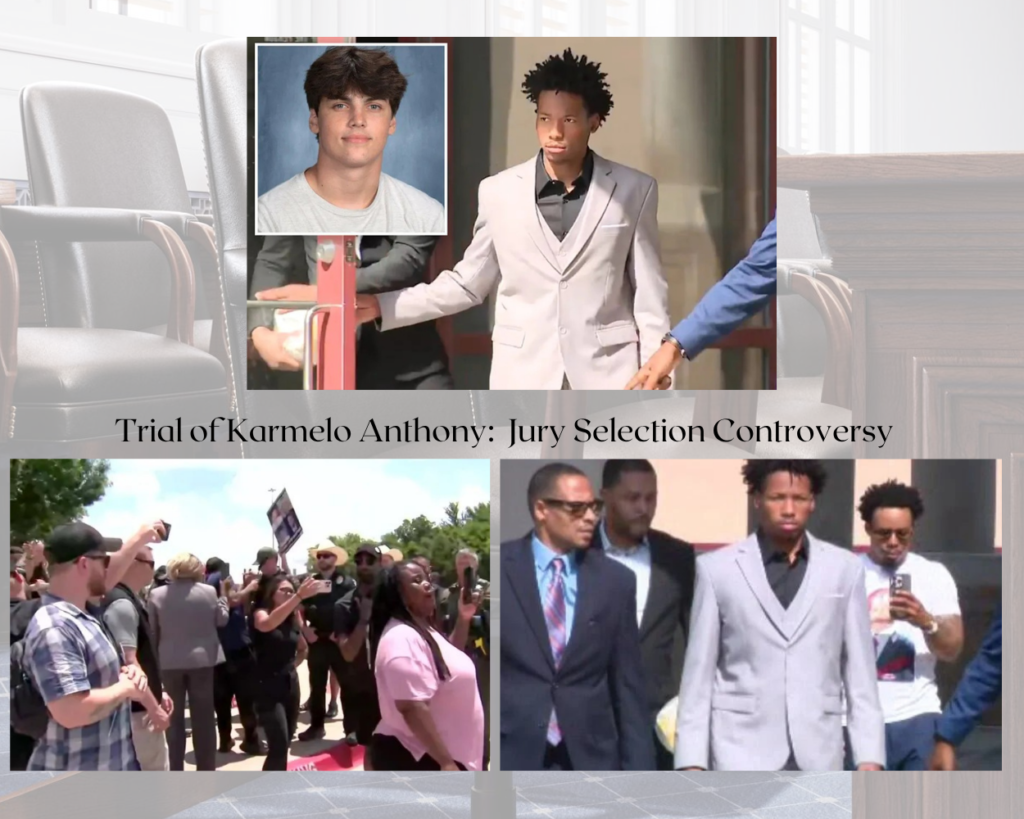
Photo Credits:
https://www.aol.com/articles/jury-selection-karmelo-anthony-murder-145321836.html (top)
https://www.foxnews.com/us/karmelo-anthony-trial-begins-no-black-jurors-racially-charged-case-over-track-meet-stabbing (bottom left)
Supporters of Karmelo Anthony and Austin Metcalf exchanged heated words outside the Collin County courthouse as Anthony’s murder trial got underway. Sheriff’s deputies monitored the scene as demonstrators shouted at one another.
https://www.cbsnews.com/texas/news/jurors-karmelo-anthony-murder-trial/ (bottom right)
There are moments in American courtrooms when the case being tried is not the only thing under judgment. Sometimes the process itself ends up under scrutiny.
Sometimes the public looks at what happened, looks at what the law requires, and asks a simple question:
Was this fair?
The jury-selection controversy in the trial of Karmelo Anthony has become one of those moments. According to public reporting, Black prospective jurors were struck from the panel, the defense raised a Batson challenge, prosecutors defended their strikes as race-neutral, the trial court rejected the challenge, and the final jury was seated without a single Black juror.
Standing alone, that fact does not prove discrimination.
The Constitution does not guarantee a defendant a jury of any particular racial composition. Courts have repeatedly made that clear. But the Constitution does prohibit the State from excluding jurors because of race.
That distinction matters.
Because this controversy is not really about the racial makeup of the jury. It is about the path taken to get there.
And for many Americans—particularly Black Americans—that path looks uncomfortably familiar.
For generations, Black citizens were systematically excluded from jury service.
Sometimes it was done openly. Sometimes it was done through literacy tests, poll taxes, and exclusionary practices that were obvious on their face.
Then the law changed.
Or at least it was supposed to.
In Batson v. Kentucky, the United States Supreme Court held that prosecutors cannot use peremptory strikes to remove jurors because of race. The Court understood something fundamental about discrimination: once society outlawed overt racism, racial exclusion would not necessarily disappear.
It would evolve.
It would become more sophisticated.
It would learn new language.
That is why courts are not supposed to stop their analysis simply because a prosecutor offers a race-neutral explanation.
The real question is whether that explanation is genuine.
And that is where the Anthony case becomes important.
According to media reports, prosecutors argued that certain Black prospective jurors were removed because they were educators and that the State did not want educators serving on a jury involving school-aged children and a school-related event. On its face, that explanation sounds race-neutral. Many explanations do.
The problem is that public reporting has also indicated that at least one juror who performs an educational role remained on the panel. That fact alone does not establish a constitutional violation.
There may be distinctions contained within the voir dire transcript that are not reflected in news coverage. There may be answers, experiences, or circumstances that separate one juror from another. No responsible analysis should ignore that possibility. But no responsible analysis should ignore the constitutional question either.
Because once similarly situated jurors appear to be treated differently, courts are required to look deeper.
That is not political activism.
That is constitutional law.
The Supreme Court addressed precisely this problem in Miller-El v. Dretke, a case that also emerged from Texas. The Court explained that judges cannot simply accept race-neutral explanations at face value. They must compare struck jurors to seated jurors. They must examine patterns. They must determine whether the stated reason actually matches what occurred during jury selection.
In other words, the Court instructed judges to look beyond the label and examine the reality.
That principle was reinforced again in Snyder v. Louisiana, where the Court found that a prosecutor’s explanation could not withstand scrutiny when white jurors with similar characteristics remained on the panel.
And it surfaced once more in Flowers v. Mississippi, where the Court emphasized that discrimination often reveals itself not through a single fact, but through the totality of the circumstances.
Patterns matter.
Comparisons matter.
Consistency matters.
Because discrimination rarely arrives announcing itself. It rarely walks into a courtroom carrying a sign.
More often, it arrives wearing professional language, armed with seemingly neutral explanations, and confident that nobody will look closely enough to notice the difference between what is being said and what is actually being done.
That is why critical legal analysis matters.
Too often, public discussions of jury discrimination focus on intent while ignoring outcome. The law asks whether race motivated the strike. But history teaches us that exclusion can survive long after explicit racial language disappears.
When race-neutral explanations consistently produce racially exclusionary outcomes, courts have a responsibility to ask difficult questions.
Not because every disparity proves discrimination.
But because every disparity deserves examination.
The danger is not merely that discrimination might occur.
The danger is that discrimination becomes invisible because it has learned how to speak the language of neutrality.
That concern extends beyond this case.
It touches the legitimacy of the justice system itself.
Courts derive their authority not from force but from public confidence. People accept verdicts because they believe the process was fair. When significant segments of the public begin questioning whether constitutional protections are being enforced consistently, that confidence begins to erode.
The answer to those concerns is not outrage.
The answer is transparency.
The answer is a record that can withstand scrutiny.
The answer is demonstrating, through facts and analysis, that every juror was treated under the same standard.
For Black Americans, these concerns are not abstract.
They are rooted in memory. They are rooted in generations of watching courtroom doors open for some and close for others. They are rooted in a legal history that too often promised equality while finding new ways to avoid delivering it.
That history does not prove misconduct occurred in Collin County. But it does explain why many people are paying attention. And they should.
Because this controversy is not ultimately about whether one supports Karmelo Anthony or sympathizes with Austin Metcalf’s family.
It is not about guilt or innocence.
It is not about politics.
It is about whether constitutional safeguards still function the way
they were intended to function.
A denied Batson challenge is not necessarily the final word. If the issue was properly preserved, appellate courts may eventually examine the voir dire record, juror questionnaires, strike patterns, and comparative-juror analysis in far greater detail than can occur in the middle of a trial. That process exists for a reason.
Constitutional protections are only meaningful if courts are willing to enforce them. What ultimately matters is not whether prosecutors offered a race-neutral explanation.
What matters is whether the explanation survives scrutiny.
Were similarly situated jurors treated differently?
Were the same standards applied across the board?
Did the reason offered match the facts reflected in the record?
Those questions sit at the center of this controversy. And until they are answered, public concern will not disappear. Nor should it. Because justice does not begin when a verdict is read.
It begins long before that.
It begins with who is allowed to sit in judgment.
I raised this issue in the Kevin Epps Trial and you have to sit and wonder whether anyone was paying attention.
The Kevin Epps Case: Complete Coverage
https://destination-freedom.org/the-kevin-epps-case-complete-coverage/?preview_id=2341&preview_nonce=0ece2aee40&preview=true
And if the official record ultimately shows that Black jurors were excluded for reasons that similarly situated non-Black jurors survived, then this case will become about more than one defendant and more than one trial.
It will become another chapter in America’s unfinished struggle to ensure that equal justice is more than a constitutional promise.
It will become a test of whether our courts can still recognize discrimination when it no longer speaks the language of discrimination.
And that is a question every American should care about.
Because when the integrity of jury selection is called into question, the issue is not simply who is being judged.
The issue is whether the justice system itself can withstand judgment.
and former jailhouse lawyer
Destination Freedom Media Group would like to thank Oliver Eshman Lister, Jr. for contacting us and making us aware of this very important case. Mr. Lister also contributed invaluable legal research materials that helped improve the quality and context of our article. We look forward to future collaborations with this Dallas, Texas native.
Contact information for Mr. Lister
📞 945-350-9102
📞 469-715-2873
📧 benammieshman@gmail.com
Here’s our song/video for this article: Smokie Norful – I Need You Now