
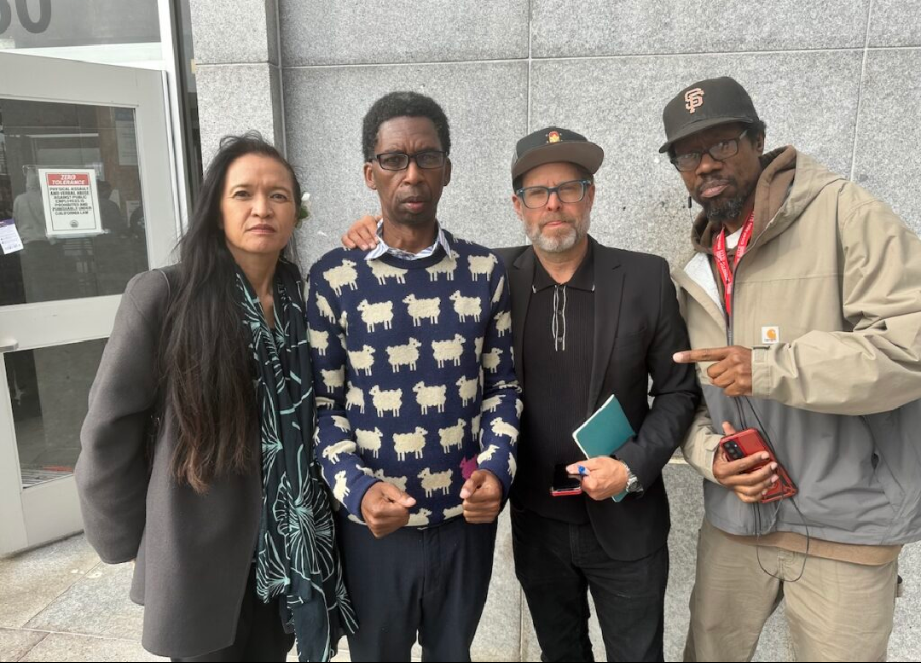
Photo Credit: Justice4KevinEpps – Left to right: Tobee Akahi Vanderwall, Kevin Epps, Andy Blue, and Tabari Morris
As April 8 approaches, a city that prides itself on justice is being called to prove it—inside Department 13, where silence will speak just as loudly as any sentence.
SAN FRANCISCO — Courtrooms do not simply deliver sentences.
They expose truths—about power, about fear, about whose lives are defended and whose are quietly negotiated away.
On April 8, 2026, inside Department 13 at 850 Bryant Street, San Francisco will face a question it has spent years carefully navigating around:
What does justice actually look like when a Black journalist stands before the bench—and the system already appears to have formed its conclusions?
Let the record be clear from the outset.
The most comprehensive reporting on the Kevin Epps case did not originate from institutional pressrooms or detached summaries. It emerged from sustained courtroom coverage published by Davis Vanguard in partnership with Destination Freedom Media Group, documenting the trial as it unfolded in real time. That reporting was later republished by Black Voice News, reflecting a longstanding tradition within Black media: amplifying truth when it risks being minimized, mischaracterized, or ignored.
That distinction matters.
Because this story has never been confined to one defendant or one courtroom.
It is also a story about who documents power—and whose documentation is taken seriously when the official narrative begins to fracture.
A DEFENDANT—AND A SYMBOL OF SOMETHING LARGER
Kevin Epps is not an anonymous figure moving through the criminal legal system. He is the Executive Editor of the San Francisco Bay View National Black Newspaper—a publication with a decades-long history of scrutinizing law enforcement, challenging public institutions, and reporting from the vantage point of communities that have too often been spoken about, rather than listened to.
That history is relevant.
Not as speculation—but as context.
Because institutions, historically, have not always responded neutrally to sustained scrutiny. And while motive must be grounded in evidence—not assumption—the public record already raises legitimate questions about how and why this case has unfolded with the intensity that it has.
This case was revived years after the original incident under contested circumstances. It was pursued with notable persistence. And it has drawn a level of prosecutorial focus that invites comparison to other cases involving violence that did not receive the same degree of attention.
Those observations do not resolve motive.
But they do justify scrutiny.
WHAT THE COURTROOM ACTUALLY REVEALED
For months, this publication did what accountability journalism requires:
It stayed in the room.
Not for headlines. Not for excerpts.
But for the full record.
What emerged was not a case defined by clarity and consistency. It was a record marked by tension, contradiction, and unresolved questions:
A courtroom environment shaped by visible racial imbalance in perception and authority
Witness testimony that shifted under examination and, at times, strained against its own prior statements
A prosecutorial narrative that appeared to narrow context rather than fully engage it
The introduction of digital animation presented as “new evidence,” later challenged within legal proceedings
An atmosphere in which pressure was evident and interpretive framing carried significant weight
The verdict structure only deepened those concerns:
Acquittals on first- and second-degree murder
A conviction on voluntary manslaughter and a firearm enhancement
A second phase in which jurors rejected or deadlocked on most aggravating factors, resulting in a mistrial on three of four
That is not a portrait of overwhelming certainty. It is what a case looks like when the narrative advanced by the state does not fully align with what the jury is willing to sustain.
But this record does not stand alone. Recent reporting by veteran journalist Eric Arnold, published through American Community Media, underscores the broader significance of the case as sentencing approaches. Arnold’s work situates the Epps prosecution within a wider public conversation about justice, perception, and accountability in San Francisco—extending the analysis beyond a single courtroom and into the civic fabric of the city itself.
That convergence matters.
Because when independent reporting across multiple platforms begins to align—when journalists working from different vantage points identify similar concerns—those concerns become harder to dismiss as isolated interpretation.
They begin to form a pattern.
And patterns demand attention.
WHEN A FORMER JUDGE RAISES CONCERNS
The questions surrounding this case have not been limited to journalists or observers. Retired Judge Brenda Harbin-Forte has publicly raised concerns regarding:
The conduct and framing of the prosecution
The use and presentation of digital animation evidence
The handling of Castle Doctrine considerations
Jury instruction modifications that may have affected how legal standards were applied in practice
Her conclusion was direct and unambiguous:
Under these circumstances, Kevin Epps should not have a conviction.
That is not a casual remark. It is a serious critique from someone with deep experience inside the judicial system.
And it warrants serious consideration.
APRIL 8 IS NOT PROCEDURAL—IT IS CONSEQUENTIAL
Sentencing hearings are often treated as administrative endpoints.
This is not one of those moments.
April 8 is consequential.
Because what happens inside Department 13 will not occur in a vacuum.
It will occur in the presence—or absence—of the public.
And presence matters.
Courtrooms are designed to project neutrality.
But anyone who has spent time inside one understands the reality:
The presence of the community changes the dynamics of the room.
It signals attention.
It communicates accountability.
It reminds every actor in that space that the outcome is being witnessed.
THE CALL IS DIRECT
The community has made the call clear through Justice 4 Kevin Epps:
Wednesday, April 8, 2026
8:45 AM
850 Bryant Street, 2nd Floor, Department 13
San Francisco
This is not symbolic.
It is participatory.
Because justice, in practice, is not only determined by legal arguments.
It is shaped by whether the public is engaged—or absent—when those arguments are made.
THIS IS ALSO ABOUT BLACK JOURNALISM
There is another dimension to this moment that cannot be overlooked. Kevin Epps is part of a longstanding tradition of Black journalism—a tradition rooted in documenting realities that are often ignored, challenged, or minimized by mainstream narratives.
And in that same tradition, this case has been documented through sustained, on-the-ground reporting that refused to look away.
That work is not ornamental.
It is archival.
Because long after proceedings conclude, it is the documented record—not official summaries—that will define how this moment is understood.
SAN FRANCISCO’S MOMENT
San Francisco has long positioned itself as a city of progressive values and moral clarity.
But those values are not tested in statements.
They are tested in moments like this:
Inside a courtroom.
Under scrutiny.
When the outcome affects a Black man tied to a historic Black institution.
When the process itself has raised sustained and documented concern.
The question is no longer theoretical.
It is immediate:
Will the city show up—or will it look away?
FINAL WORD
Do not misunderstand the moment.
This is not about spectacle.
This is not about performance.
This is about presence.
Approximately a week ago, I watched the Black community show up—strong—for James Spingola. The Fillmore was in the building, unmistakably so. That kind of turnout does not happen by accident. It reflects unity. It reflects memory. It reflects a community that understands what it means to stand in the gap when it matters most.
Now the moment has shifted.
Now the call is on Bayview Hunters Point.
This is the time for that same level of presence—visible, organized, undeniable—in support of one of its own. Not in theory. Not in conversation. But in real time, inside a courtroom where presence carries weight.
And the truth is simple:
We are about to see who is truly committed to modern-day “Freedom Fighting”—and who is not.
Because on April 8, Kevin Epps will not walk into Department 13 alone.
Or he will.
And whichever of those becomes true will say more about San Francisco than any official statement ever could.
PACK THE COURTROOM.
Here’s our song/video for this article:
Michael Jackson – They Don’t Care About Us (Prison Version) (Official Video)