
A review of public documents, engineering design, and oversight findings raises key questions about scope, structure, and delivery
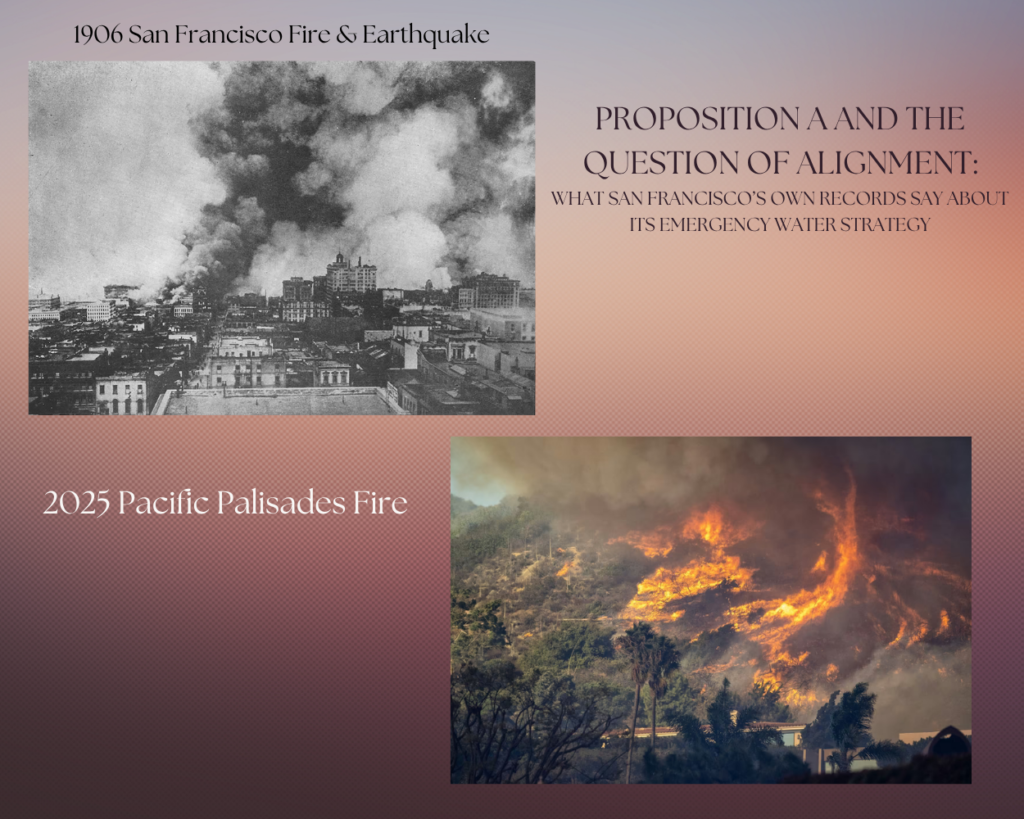
Photo credits:
https://www.conservation.ca.gov/cgs/earthquakes/san-francisco (top)
https://www.theatlantic.com/photo/2025/01/photos-palisades-fire-los-angeles-california/681241/ (bottom)
San Francisco’s relationship with fire is not abstract.
The destruction that followed the 1906 earthquake—and the fires that spread when water infrastructure failed—directly led to the creation of the City’s Auxiliary Water Supply System (AWSS), a high-pressure, seismically resilient firefighting network designed to operate independently of the potable (drinking) water system. That design principle—separation between emergency firefighting capacity and domestic supply—has been consistently referenced in City planning and oversight materials for more than a century.
Proposition A, the 2026 Earthquake Safety and Emergency Response (ESER) bond, is now presented to voters within that historical context. Public materials describe the measure as strengthening emergency response infrastructure, including firefighting water systems, across San Francisco.
A review of official documents—including bond reports, SFPUC project descriptions, Civil Grand Jury findings, and status reports—indicates that while the measure includes funding for emergency water infrastructure, it also reflects a broader capital program and a more complex system design than the general public-facing summaries alone may convey.
BOND STRUCTURE AND ALLOCATIONS
According to the City’s 2026 ESER bond report and related materials, Proposition A authorizes $535 million in general obligation bonds. The allocation of those funds includes:
Approximately $130 million for the Emergency Firefighting Water System (EFWS)
Approximately $100 million for fire station improvements
Approximately $72 million for police facilities
Approximately $33 million for other public safety infrastructure
Approximately $200 million for replacement of the Potrero Yard bus facility
These figures are drawn from official City documentation. The inclusion of multiple infrastructure categories within a single bond measure is consistent with prior ESER bonds (2010, 2014, 2020), which also funded a range of earthquake and emergency-response projects.
Infrastructure analyst John Crabtree, whose work has focused on municipal capital planning and risk alignment, has noted in similar contexts that multi-purpose bond structures can present challenges for voters attempting to evaluate specific programmatic outcomes within broader funding packages. His analysis emphasizes the importance of examining allocation detail alongside summary descriptions.
FINANCIAL OBLIGATIONS
The San Francisco Controller’s Office estimates total repayment costs for the bond at approximately $933 million, including principal and interest, to be repaid through property taxes over time.
City officials have stated that the bond is expected to remain within existing debt management policies and not exceed established tax rate benchmarks. Those statements are reflected in official voter information materials.
At the same time, the Controller’s report confirms that the measure represents a long-term financial obligation supported by tax revenue, a standard feature of general obligation bonds.
SYSTEM DESIGN: INDEPENDENT VS. POTABLE SUPPLY
A central issue identified in public documents concerns the design of the Westside Emergency Firefighting Water System expansion.
According to the San Francisco Public Utilities Commission (SFPUC):
The proposed Westside system utilizes potable water as part of its supply
It is designed for dual use, including both firefighting and drinking water service
It is intended to function during emergency conditions, including earthquakes
These descriptions appear in SFPUC project materials and ESER bond documentation.
This design differs in a key respect from the historic AWSS model, which was engineered as a separate, high-pressure system with independent water sources, including seawater intake points.
The distinction between these approaches—independent system versus potable-integrated system—has been noted in both City materials and external technical commentary. Public documents do not characterize the potable-based expansion as a replacement for the AWSS, but rather as an extension of emergency water capacity in areas not currently served by the high-pressure system.
OVERSIGHT FINDINGS AND HISTORICAL WARNINGS
San Francisco Civil Grand Jury reports have addressed emergency water system resilience in multiple findings over time.
The 2002–2003 Civil Grand Jury reported that, following a major earthquake, the City’s water system could face significant service disruptions and noted the potential strain on potable water supplies during large-scale firefighting operations.
The 2018–2019 Civil Grand Jury recommended that the City develop a “high-pressure, multi-sourced, seismically safe emergency water supply” and warned that, at then-current funding and construction rates, expansion of such systems to unserved neighborhoods could take decades.
The 2018–2019 report also identified several neighborhoods lacking high-pressure AWSS coverage, including areas in the western and southern parts of the city.
These findings remain part of the public record. The reports do not evaluate Proposition A specifically, but they provide context regarding long-standing infrastructure considerations.
PROJECT STATUS AND IMPLEMENTATION TIMELINE
The City’s June 2024 ESER status report indicates that portions of the Westside EFWS pipeline projects were in design phases, with contracts reported at approximately 35% and 65% completion at that time.
SFPUC materials also describe completed improvements from prior ESER funding cycles, including:
Installation of additional cisterns
Upgrades to pump stations and storage facilities
Expansion and reinforcement of pipeline infrastructure
Integration of seawater supply capabilities in certain areas
These projects represent documented progress in expanding emergency firefighting capacity.
However, the combination of completed work and ongoing design phases indicates that system expansion remains in progress rather than fully realized citywide.
COMPARATIVE CONTEXT: SYSTEM PERFORMANCE UNDER EXTREME CONDITIONS
Post-incident analyses from other jurisdictions provide additional context. Following the 2025 Palisades Fire in Los Angeles, reports from the California Natural Resources Agency and the Los Angeles Fire Department found that:
Water system pressure loss occurred under extreme demand conditions
Damage to residential plumbing systems contributed to pressure drops
Infrastructure designed primarily for potable use encountered limitations when required to support large-scale firefighting simultaneously
These findings are specific to Los Angeles and are not directly predictive of San Francisco system performance. However, they are relevant to broader discussions about system design and capacity under catastrophic conditions.

@jbcrabtree (Substack); @johncrabtree46 (Instagram)
San Francisco-based journalist, John Crabtree, has devoted an enormous amount of time and energy in regard to Proposition A. I interviewed him recently and this is what he had to say:
“Simply put, City Hall has a responsibility in these bond measures to tell the voters how they will spend bond dollars when asking them to approve borrowing against future taxpayers’ dollars.“
He further stated:
“City Hall has broken their promises again and again over the last 16 years. The western and southern neighborhoods have been passed over for emergency firefighting water supply, repair of neighborhood fire stations and everything promised in 16 years of the ESER bond program. ESER desperately needs a reset, which is why voting No on Prop A is the only course that makes sense.”
CAMPAIGN SUPPORT AND PUBLIC DISCOURSE
Public reporting, including from Mission Local, indicates that Proposition A has received financial support from major donors, alongside broader support from City leadership.
Campaign contributions are publicly disclosed and regulated. The presence of financial support does not determine the technical merits of a measure but is part of the broader context in which voters evaluate ballot initiatives.
KEY CONSIDERATIONS FOR VOTERS
Based on the public record, several considerations emerge:
Scope of the Bond
Proposition A funds multiple categories of infrastructure, including but not limited to emergency water systems.
System Design Approach
The Westside expansion incorporates potable water into its design, differing from the fully independent AWSS model.
COVERAGE AND TIMELINE
Expansion of emergency firefighting infrastructure is ongoing, with some projects still in development stages as of the latest available reports.
HISTORICAL OVERSIGHT CONTEXT
Civil Grand Jury findings have repeatedly emphasized the importance of robust, independent, and seismically resilient firefighting water systems.
FINANCIAL COMMITMENT
The bond represents a long-term tax-supported obligation, consistent with general obligation financing.
CONCLUSION
Proposition A presents voters with a decision about how San Francisco should continue investing in earthquake and emergency preparedness infrastructure.
The City’s own documents reflect both substantial progress and ongoing development, as well as a system design that combines multiple approaches to water supply.
Understanding those details—particularly the distinctions between independent and potable-based systems, the allocation of funds across categories, and the timeline for implementation—may be essential for voters seeking to evaluate how the measure aligns with long-standing public safety objectives.
Sources
1.) San Francisco Department of Elections — June 2026 Voter Information Pamphlet
2.) San Francisco Controller — Proposition A Financial Analysis
3.) San Francisco Public Works — 2026 ESER Bond Report
4.) San Francisco Public Works — ESER Status Report (June 2024)
5.) San Francisco Public Works — 2020 ESER EFWS Fact Sheet
6.) San Francisco Public Utilities Commission — Emergency Firefighting Water System Overview
7.) SFPUC — Westside EFWS Project Page
8.) San Francisco Civil Grand Jury (2002–2003) — Keeping the Faucets Flowing
9.) San Francisco Civil Grand Jury (2018–2019) — Act Now Before It Is Too Late
10.) California Natural Resources Agency — Palisades Fire Analysis
11.) Los Angeles Fire Department — After-Action Report
12.) Mission Local — Campaign Finance Reporting
13.) Ballotpedia — San Francisco Measure A Overview