Special Report — August 10, 2026
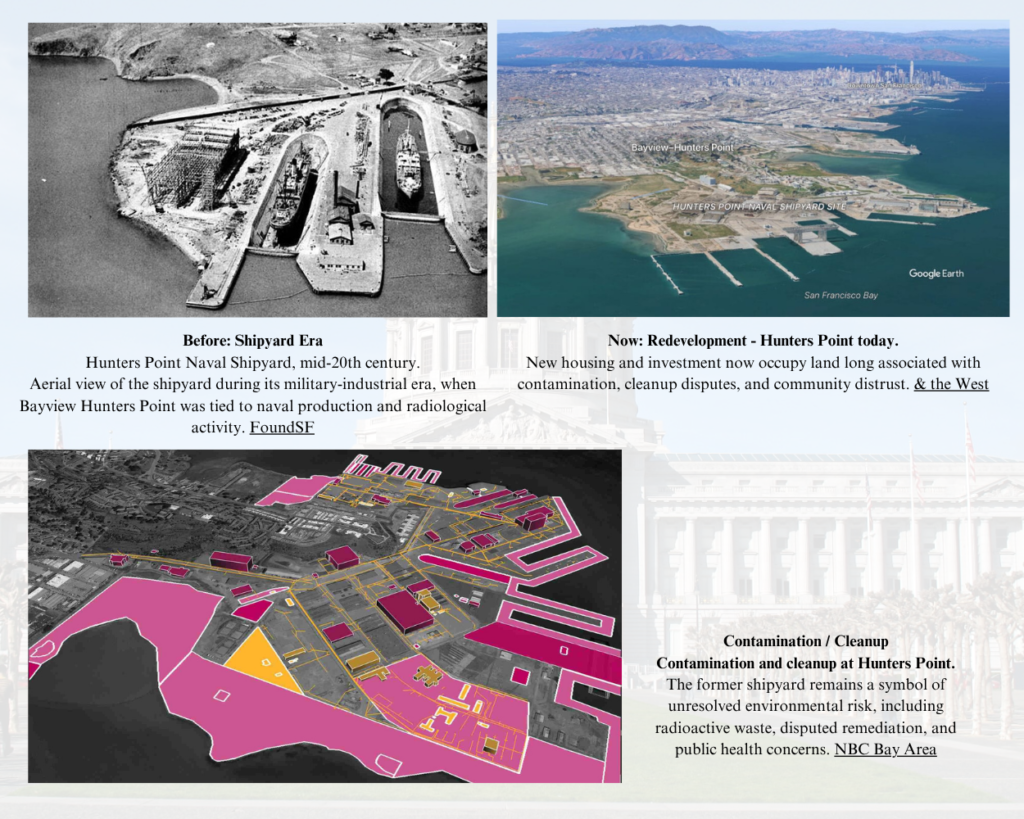
(top left)Hunter’s Point in 1941, Avisadero Point at top left of photo before its demolition
(top right) After Decades of Environmental Cleanup, Rebuilding Can Cement Inequalities
(bottom) Hunters Point Shipyard Contamination, Cleanup and Development
There are rulings that surprise a city, and there are rulings that confirm what a community has been telling America for eighty years: that Black life in Bayview–Hunters Point is negotiable, and that when the paperwork gets uncomfortable, the law will find a way to look the other way.
On August 4, 2026, U.S. District Judge James Donato — an Obama appointee sitting in the Northern District of California — handed down a nine-page summary judgment order that ends an eight-year legal battle in favor of Tetra Tech EC. The homeowners of Parcel A at the former Hunters Point Naval Shipyard, more than 300 families, will receive nothing. Not one dollar for the diminished property values. Not one dollar for the fear of cancer. Not one dollar for the eight years they spent trusting that the American legal system would eventually side with the truth.
The instrument Donato used to bury their case is called the Price-Anderson Act (“PAA”) — a 1957 nuclear liability statute signed by Dwight D. Eisenhower during the atomic age, designed to encourage the growth of a fledgling nuclear power industry by shielding it from catastrophic financial exposure in the event of a reactor meltdown. It was written for Three Mile Island. It was written for Chernobyl. It was not written to protect a private contractor accused of committing fraud against a Black community.
And yet, that is exactly what it just did. San Francisco Chronicle
The Ruling: A Statute Weaponized Against Its Own Purpose
Let us be precise about what Judge Donato did, because precision matters when you are watching a community be told, in legal language, that their suffering is not the correct “kind” of suffering.
Donato ruled that the homeowners’ claims constitute a “public liability action” under the PAA, and that the PAA therefore preempts California state law. Under the federal statute — specifically 42 U.S.C. § 2014(q) — plaintiffs may recover only for “bodily injury, sickness, disease, or death, or loss of or damage to property, or loss of use of property.” The Parcel A homeowners, the judge observed, “fully acknowledge having disclaimed physical injury to themselves or to their properties.” Their claims — fear of cancer, emotional distress, diminished property values, loss of the enjoyment of a home purchased in good faith — fall, in Donato’s reading, outside what a 1957 nuclear indemnification statute permits. Courthouse News
The judge himself could not fully conceal his discomfort. In an extraordinary passage, he wrote that “Why Tetra Tech was asleep at the switch for so long is not explained in its papers,” noting that the contractor waited years before ever invoking the Price-Anderson Act as a defense — years in which hundreds of families were forced to litigate on the assumption that state law governed. Donato called this “advocacy” into question. And then he ruled for Tetra Tech anyway. Courthouse News
That is not justice. That is a judge writing his own dissent inside his own majority opinion.
Anne Marie Murphy of Cotchett, Pitre & McCarthy — one of the attorneys who has fought for these families for the better part of a decade — put it plainly. “The Price-Anderson Act is designed for a Three-Mile Island incident or Chernobyl — not a fraudulent cleanup.” Her co-counsel Bradley Bowles condemned the ruling and said his team is “evaluating all available legal options.” San Francisco Chronicle | Courthouse News
They are right. And here is why the law is on their side, even if this one ruling is not.
The Gorsuch Precedent Donato Ignored
The homeowners’ attorneys pointed Judge Donato to a 2015 opinion from the U.S. Court of Appeals for the Tenth Circuit — a ruling in *Cook v. Rockwell International Corp.* that permitted homeowners near the Rocky Flats nuclear weapons plant in Colorado to pursue a full range of state-law damages for the mishandling of nuclear waste. The author of that opinion? Then–Circuit Judge Neil Gorsuch — now a sitting Justice of the United States Supreme Court, appointed by President Donald Trump.
Read that again. A conservative Trump-appointed Supreme Court Justice, when he was on the Tenth Circuit, held that homeowners *can* seek broad damages under state law when nuclear waste has been mishandled. Judge Donato, an Obama appointee, ruled the opposite way — citing a 2008 Ninth Circuit precedent that reads the Price-Anderson Act narrowly to permit damages only for direct physical radiation injury.
This is what lawyers politely call a circuit split. In May 2026, the Supreme Court declined to resolve it — leaving the country in a situation where a Black family in San Francisco has fewer legal rights against a fraudulent nuclear contractor than a family in Denver. Arnold & Porter Advisory
Same statute. Same facts pattern. Different zip code. Different outcome.
If that is not the textbook definition of unequal protection under the law, I do not know what is. And if the reader will indulge one uncomfortable observation: the Denver plaintiffs at Rocky Flats were majority white. The Hunters Point plaintiffs are majority Black and brown. I do not believe that is a coincidence. I do not believe you should either.
What Tetra Tech Actually Did
Let us not lose the underlying facts in a fog of statutory interpretation. This case was never about a Chernobyl-style accident. It was about a deliberate, criminally prosecuted fraud perpetrated against a specific community.
Between 2002 and 2018, Tetra Tech EC held a roughly $1 billion contract from the U.S. Navy to perform radiological cleanup at the Hunters Point Naval Shipyard — a former Naval Radiological Defense Laboratory site where ships returning from hydrogen bomb tests at Bikini Atoll were decontaminated between 1946 and 1969. The contaminants at issue include plutonium-239, cesium-137, and strontium-90 — radioisotopes that do not care whether the paperwork says the soil is clean. Carleton College — History and Legacy of Environmental Racism in Bayview Hunters Point
In 2018, the U.S. Environmental Protection Agency determined that much of Tetra Tech’s cleanup data across several parcels was unreliable. Two former Tetra Tech supervisors pleaded guilty in federal court and were sentenced to federal prison for a scheme in which contaminated soil samples were destroyed and replaced with clean fill hauled in from elsewhere on the site — a practice known internally as “soil-swap.” The United States Department of Justice subsequently joined *qui tam* actions alleging that Tetra Tech had submitted false claims to the federal government. U.S. Department of Justice — Press Release
In my own comment before the California Office of Environmental Health Hazard Assessment on the draft CalEnviroScreen 5.0, I noted a technical estimate that has appeared in the public record: Tetra Tech EC fabricated or falsified radiological measurements at approximately 90 to 97 percent of survey units on portions of the shipyard. OEHHA Public Comment Docket
Ninety to ninety-seven percent. Read that sentence and then explain to me — with a straight face — why a statute meant to encourage responsible nuclear industry operations should be permitted to launder that conduct into immunity.
Tetra Tech has consistently blamed “rogue” employees. But when 90 percent of a company’s survey units are compromised, the company is not the victim of a rogue faction. The rogues are the ones telling the truth.
What the Community Has Endured — And the Fraud Continues in Real Time
Judge Donato’s ruling does not sit in a vacuum. It arrives in the middle of an active, ongoing crisis.
-
- In November 2024, an air sample collected at Hunters Point contained plutonium-239 above the project’s action level. The Navy did not inform City of San Francisco officials for approximately eleven months. Read DFMG: What Latest Radioactive Finding Means
-
- In March 2025, a separate air sample again registered plutonium-239 above dust-monitoring action levels. The Navy attributed the reading to “laboratory contamination.” Perhaps. Perhaps not.
-
- In March 2026, 732 soil samples, most associated with Parcels B and C, were flagged for reanalysis due to laboratory data-validation concerns.
-
- In April 2026, investigators entered a Navy building known as Building 400A and found radiological materials, calibration sources, liquid scintillation cocktails, electron-capture detector components, and roughly 70 chemical containers — a discovery that has triggered three parallel criminal investigations: by the Naval Criminal Investigative Service (NCIS), the EPA Criminal Investigation Division, and the California Department of Toxic Substances Control’s Office of Criminal Investigation. Read DFMG: Open Questions: Criminal Investigations, Radioactive Materials
-
- This is not a closed chapter. This is not “an old scandal from 2018.” This is a live, breathing, unresolved public-health emergency happening in a Black neighborhood in one of the wealthiest cities on earth. And on August 4, a federal judge told the people who live on top of it that the courtroom door is closed.
Environmental Racism: The Word Nobody Wants to Use in the Ruling
Now let us name it. Because if we do not name it, the next community will not see it coming.
Bayview–Hunters Point (BVHP) is a historically Black neighborhood in Southeast San Francisco. Its Black population arrived during the Second Great Migration, drawn by wartime shipyard employment. When the shipyard closed to civilian work and turned to decommissioning ships used in Pacific nuclear tests, those same Black workers and their families were left living beside a Naval Radiological Defense Laboratory that operated from 1946 until 1969 — while the city’s white affluent neighborhoods were spared the byproduct. Carleton College
The health record is grim and it is not disputed:
-
- Hospitalizations for asthma in BVHP are in the 96th percentile in California and the 99th percentile in the United States.
-
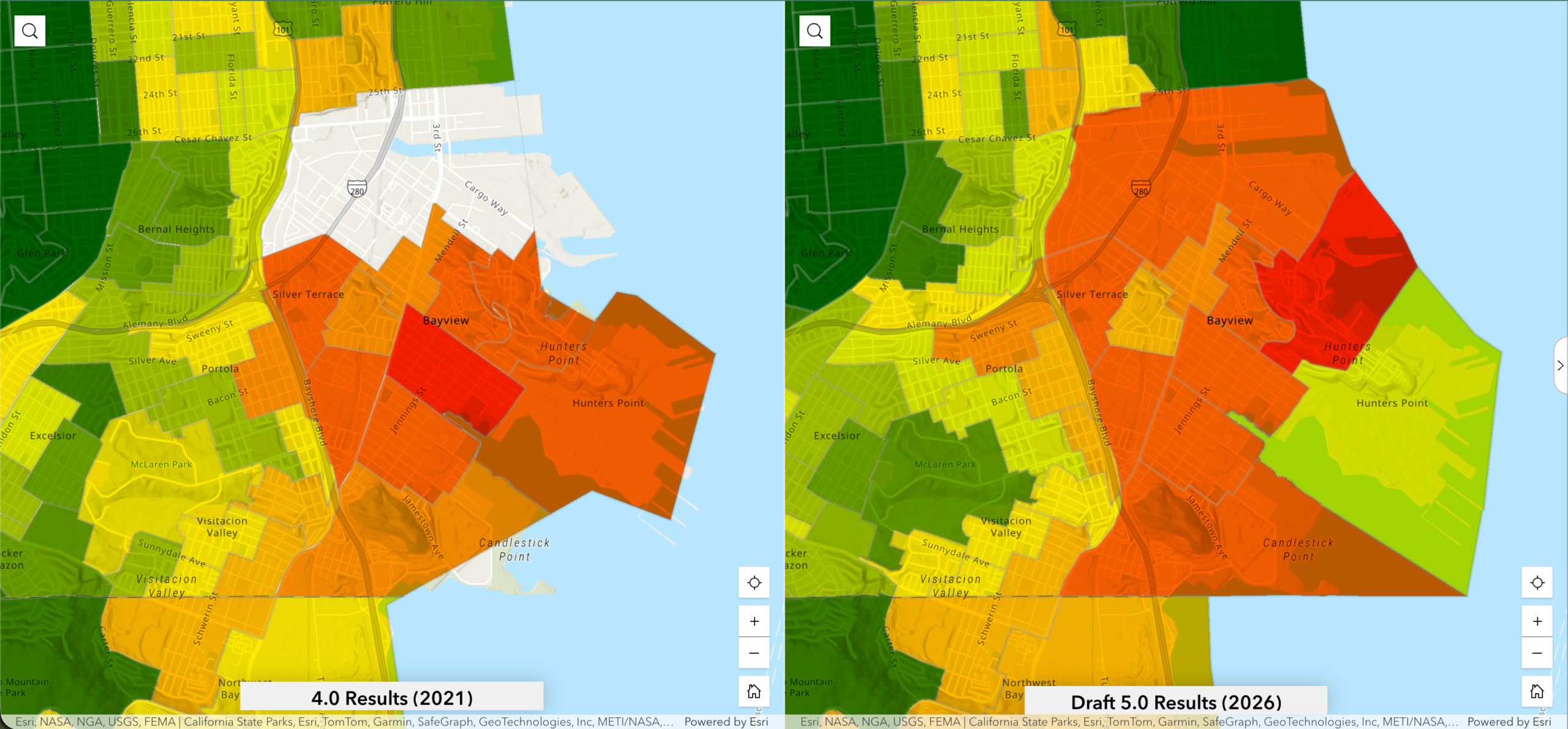
- The CalEnviroScreen 4.0 analysis ranks the Hunters Point Shipyard tract near the very top of the state for low birth weight — a devastating marker of maternal and infant health inequity.
-
- The area contends with lead, mercury, PG&E power plant legacy emissions (over 600 tons of pollutants annually until the plant was shut in 2006), leaking underground fuel tanks, and layered radiological hazard.
Arieann Harrison, CEO of the Marie Harrison Community Foundation and daughter of the late Marie Harrison — the woman we called the Mother of Environmental Justice — put it in words I cannot improve upon:
“For decades, our community has lived beside radioactive waste while being denied the health protections, investments, and truth we deserve. Toxic exposure in Bayview Hunters Point is real, and the health outcomes in our district speak for themselves. Asthma, respiratory illness, and other chronic conditions continue to burden both youth and adults in District 10… The people of Bayview Hunters Point are owed more than an apology — we are owed reparations, healing, and a future free from environmental harm.”
Read DFMG: What Latest Radioactive Finding Means
Her mother Marie Harrison — who died in 2019 of Idiopathic Pulmonary Fibrosis, a rare lung disease in a woman who never smoked — said something in her lifetime that I want carved above every federal courtroom in this country:
“We have the right to live, work, play, and worship on land that is clean. We have a right to breathe air that doesn’t have all of the contaminants in it that our air does. Clean land and clean water and clean air is a God-given right. Environmental justice is the free access to that.”
Read DFMG: Marie Harrison Legacy – Can We Live?
Marie Harrison did not die of a Price-Anderson-covered “nuclear incident.” She died of a lifetime of breathing what a wealthier, whiter neighborhood would never have been asked to breathe. And on August 4, a federal judge ruled that this — this pattern, this history, this deliberate fraud on top of a century of neglect — does not qualify as an injury the federal courts are prepared to remedy.
Environmental racism is not a slogan. It is a statutory outcome. It is what happens when a 1957 nuclear indemnity law, drafted for utilities in white-flight suburbs, gets pointed at a Black community in 2026 and used as a shield.
Why Judge Donato Is Wrong — On the Law, Not Just on the Morals
Let me argue this on the merits, so that no reader can dismiss what follows as advocacy untethered from doctrine.
On the statute’s purpose: The Price-Anderson Act was designed to encourage the peaceful development of nuclear energy by capping liability for accidents — unplanned releases from lawfully operating facilities. Tetra Tech’s conduct was neither an accident nor a lawful operation. It was a prosecuted, admitted criminal fraud in the performance of a federal cleanup contract. Treating fraud as a “nuclear incident” reads a moral hazard into federal law that Congress never intended: it tells every future contractor that if you fake the cleanup thoroughly enough, the same statute that was meant to protect the *public* will end up protecting *you.*
On the circuit split: The Ninth Circuit’s 2008 reading of § 2014(q) — that recoverable damages are limited to bodily injury, sickness, disease, death, or physical property damage — is itself a contested reading. The Tenth Circuit, under then-Judge Gorsuch, went the other way in the Rocky Flats litigation. The Supreme Court has declined to resolve the split. Donato was not obligated to choose the most restrictive reading; he chose it anyway. Arnold & Porter
On “loss of use”: The homeowners’ claims include diminished property value — a category of loss that is “loss of or damage to property” or “loss of use of property” in any commonsense reading of the statute. A home whose value has been demonstrably impaired by proximity to admitted radiological fraud has suffered “loss of use” in every meaningful economic sense. Donato read that phrase to require physical damage. That reading is defensible only if you begin from the presumption that the statute should be construed to shield the defendant.
On the waiver Donato refused to enforce: Donato himself acknowledged that Tetra Tech “was asleep at the switch” — that is, waived, or arguably waived, the Price-Anderson defense for years. He declined to enforce waiver, essentially forgiving Tetra Tech’s litigation strategy. That is a discretionary choice, and it went in one direction. It could have gone the other. Courthouse News
Every close call in this ruling broke against the community. Every one. That is not law. That is a pattern.
What Must Happen Now
Theo Ellington, a Parcel A homeowner, plaintiff, and candidate for District 10 Supervisor, said this after the ruling: *”This decision feels like a profound miscarriage of justice. It sends a troubling message that powerful corporations can commit fraud, evade accountability and further marginalize communities.”* San Francisco Chronicle
He is correct. And that message must be answered. Here is what accountability looks like from here:
-
- Appeal to the Ninth Circuit. The plaintiffs’ attorneys are evaluating options; an appeal is the next logical step. The circuit split with the Tenth Circuit is now sharper than ever, and this case is a strong vehicle for the Supreme Court to finally take up the question of whether Price-Anderson preempts state-law fraud claims. If Justice Gorsuch is the swing vote, so be it — his own words in *Cook v. Rockwell* remain the law of the Tenth Circuit.
-
- Congressional amendment of the Price-Anderson Act. The statute is nearly seventy years old. Congress must add an explicit fraud carve-out: no immunity when a contractor’s conduct has been the subject of a criminal conviction or a Department of Justice False Claims Act intervention. Representative Nancy Pelosi, Senator Alex Padilla, and Senator Adam Schiff represent the affected constituency. They should introduce that carve-out.
-
- A federal environmental-justice review of the Navy’s ongoing cleanup. The plutonium-239 exceedance concealed for eleven months, the 732 soil samples now under laboratory re-review, the criminal materials found in Building 400A — none of this can be allowed to proceed under the same regulatory posture that produced Tetra Tech in the first place. The EPA, DTSC, and NCIS investigations must be independent, transparent, and community-supervised.
-
- A municipal reparations framework. The City of San Francisco has already adopted a reparations advisory framework. Bayview–Hunters Point residents living on or adjacent to Parcel A must be included as a specifically enumerated class. Property-value restoration, medical monitoring, and priority in redevelopment economic opportunities are not charity — they are remedy.
-
- A moratorium on further residential development at Parcels B, C, D, and E until independent verification of cleanup integrity is complete. Building more homes on land whose data is being re-reviewed by three criminal investigative agencies is not development. It is delivery of more victims to the same fraud.
A Closing Word
I have been writing about Bayview–Hunters Point for years. I have interviewed the mothers whose children have asthma at rates approaching the 99th percentile in the country. I have stood with Dr. Ahimsa Porter Sumchai, Dr. Veronica Hunnicutt, and Dr. Carolyn Scott — three Black women who have carried this fight when the government would not. I have read the CalEnviroScreen data, I have read the EPA’s 2018 findings, I have read Judge Donato’s ruling twice, and I have read the plea agreements of the Tetra Tech supervisors who admitted, in open court, to soil-swap fraud.
And I will tell you the truth, because that is what a journalist is supposed to do:
A statute written in 1957 to indemnify the nuclear industry from the possibility of catastrophic accident should not be the last word on whether a Black community, defrauded by a federal contractor, has a right to be made whole. If it is the last word, then the law itself is the injury — and every subsequent generation of Black San Franciscans will read this ruling and know exactly what their government thought their homes were worth.
Justice delayed is painful. Justice denied is something no community should ever be asked to accept. We were not asked. We were told.
We say back to Judge Donato, to Tetra Tech, to the Navy, and to every institution that spent eight years running out the clock on 300 families: not this time.
The appeal begins now. The reparations conversation begins now. The next chapter of the Marie Harrison legacy begins now.
Malik Washington is a freelance journalist, former editor of the San Francisco Bay View National Black Newspaper, and coordinator with the Marie Harrison Community Foundation. He has been reporting on the Hunters Point Naval Shipyard Superfund site for over five years.
Editor’s Note and opinion (Gale Washington):
The difference between the Denver and San Francisco cases shows why so many people in Bayview Hunters Point see this not just as a legal defeat, but as part of a larger pattern of racial injustice. In the Denver Rocky Flats case, the court, in an opinion by then-Judge Neil Gorsuch, allowed residents to keep using broader state-law claims to seek justice for contamination that harmed their property and lives, which helped lead to a major settlement. In the Hunters Point case, Judge Donato took the opposite path: he treated the claims as controlled by the federal Price-Anderson Act and then ruled that the residents’ main harms — lost property value, fear, and stigma — did not fit neatly enough into the narrow categories the statute recognizes. For a historically Black and Brown community long burdened by toxic exposure, that contrast can reasonably fuel the inference that race and power still shape whose injuries the system is willing to recognize, and that corporate money and legal resources can buy the time, delay, and technical defenses that working families do not have. So, in Denver, the courthouse door stayed open long enough for residents to pursue relief, while in San Francisco many residents will understandably see the door as having been shut on a community already carrying the weight of environmental racism. Berger Montague; Arnold Porter; Carlton College; and DFMG Latest Radioactive Findings
Tetra Tech’s late reliance on the Price-Anderson Act was prejudicial because it changed the rules of the case only after the families had already spent years fighting under a different understanding of what had to be proven. For most of this lawsuit, the residents were pursuing what ordinary people would recognize as a fraud, nuisance, and property-value case: they were saying their homes lost value, their community was harmed, and they were misled about whether the land was truly safe. But near the end, Tetra Tech was allowed to lean heavily on a federal nuclear-law defense that carries very different injury requirements. By that point, the residents had already structured their case, their evidence, and even their stipulations around a non-personal-injury theory. In plain terms, the prejudice is this: the families spent eight years building one kind of case, only to be told at the finish line that they needed a different kind of case altogether. That is why critics can argue Judge Donato abused his discretion — because he recognized the delay and confusion but still allowed Tetra Tech to benefit from a vague defense in the beginning of the case that may have deprived the residents of a fair chance to prove their claims under the legal standard the court ultimately applied. Courthouse News; Donato order PDF; Plaintiffs’ Opposition to Motion for Summary Judgment; Exhibit G to Tetra Tech’s Memorandum of Points & Authorities
Bayview Hunters Point’s environmental racism claims are historically strong and supported by evidence of segregated siting, cumulative toxic burden, health disparities, cleanup failures, and displacement. Corporate money influenced outcomes there most clearly through politics, redevelopment approvals, public narrative, and settlement leverage—not through proven direct control of judges. But those indirect forms of influence still matter enormously, because they help determine whose risk is tolerated, whose voice is heard, and whether cleanup becomes justice for existing residents or merely value creation for future ones. Carleton College; Ballotpedia; The Real Deal; KQED What Bayview Hunters Point exposes is not simply environmental neglect, but a profound gap between the Constitution’s promise of equal justice and equal protection and the way justice is actually experienced by underserved Black and Brown communities. The Fourteenth Amendment is supposed to guarantee that ALL PEOPLE receive equal protection of the laws, yet Bayview Hunters Point residents have lived for generations with a concentration of toxic industry, radioactive contamination, chronic health burdens, cleanup failures, and redevelopment pressures that wealthier and whiter neighborhoods were never asked to bear. When the very community that carried that burden placed on them by local, county, state, and federal agencies, then are faced with years of costly litigation, a late-breaking federal defense, and a ruling that treats fraud, contamination stigma, and diminished home value as legally insufficient harms, residents can reasonably see not equal justice, but a system in which their injuries are easier to discount and harder to remedy just because of the color of their skin. Carleton College; KQED; Courthouse News
Sources & Further Reading
Our song/video for this article is:
Demi Lovato – Anyone (Official Lyric Video)

2 Responses
Good article – makes u sad & angry at the same time…
Absolutely. Thank you for reading the article