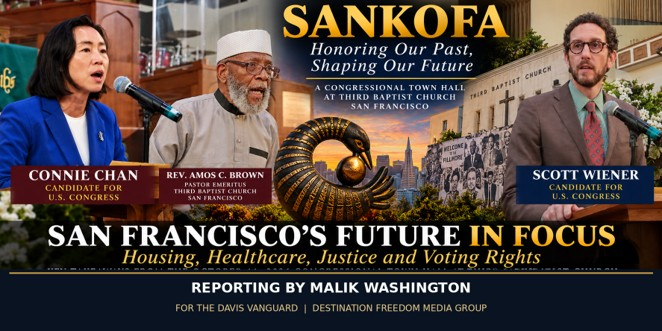
At Third Baptist Church, Connie Chan and Scott Wiener confronted questions about reparations, displaced residents, Black youth, surveillance and the obligations of the next member of Congress.
A church that remembers
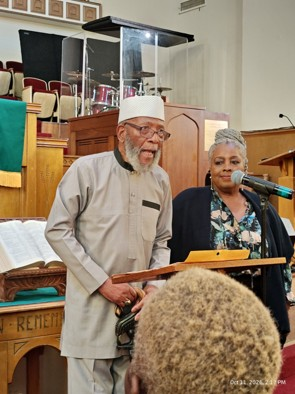
The wooden walking stick carried a lesson before the candidates offered a single promise. I attended the October 11, 2026, congressional candidates town hall in person at historic Third Baptist Church in San Francisco’s Fillmore District. At the gathering, the Rev. Dr. Amos C. Brown described the Sankofa bird, a Ghanaian symbol of looking backward to retrieve what is necessary to move forward. For a community whose history includes the destruction of Black-owned homes, businesses and social networks through urban renewal, the metaphor was more than ceremonial.
Brown, pastor emeritus of Third Baptist, president emeritus of the San Francisco NAACP branch and a longtime civil rights leader, reminded those assembled of the congregation’s roots in the nineteenth century and of the connections among struggles for Black freedom, immigrant rights, women’s rights and LGBTQ equality. The church was not endorsing a candidate, he said. Its responsibility was to make room for difficult questions about what public officials owe the people they seek to represent.
Those questions fell to two Democrats competing to succeed retiring Rep. Nancy Pelosi in California’s 11th Congressional District: District 1 Supervisor Connie Chan and state Sen. Scott Wiener. The setting made the stakes unusually concrete. Rather than debating national politics in the abstract, speakers repeatedly returned to the same neighborhoods, families and institutions that have experienced generations of unequal investment.
Different paths to the same congressional seat
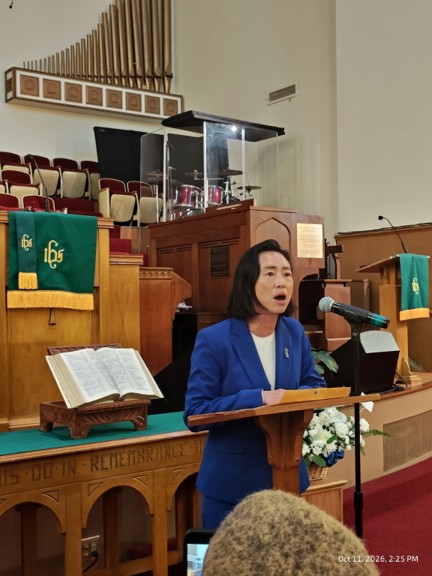
Chan and Wiener arrived with markedly different professional histories. Born in Hong Kong, Chan immigrated to San Francisco at age 13 with her mother and younger brother. She attended Galileo High School and earned a bachelor’s degree from the University of California, Davis. Her early public-service career included community organizing and work as a legislative aide to former District 10 Supervisor Sophie Maxwell. Chan also worked for then-District Attorney Kamala Harris, Supervisor Aaron Peskin and in city agencies before winning election to the Board of Supervisors in 2020. She has chaired the board’s Budget Committee since 2023. Her work with Maxwell included advocacy connected to closing the polluting Potrero Power Plant — an important Bayview environmental justice fight.
Wiener grew up in New Jersey, earned a bachelor’s degree from Duke University and a law degree from Harvard Law School, and moved to San Francisco in 1997. He also spent a year in Chile as a Fulbright scholar conducting historical research. A former deputy city attorney, he served on the Board of Supervisors before winning a state Senate seat in 2016. His legislative record includes housing-production measures, protections for LGBTQ residents, healthcare legislation and transportation policy.
His SB 35 streamlined approvals for qualifying housing projects in jurisdictions falling short of state housing targets; critics of his broader housing approach argue that relaxing development restrictions can privilege production over neighborhood protections. Wiener and his supporters argue that California cannot resolve its housing shortage without building substantially more homes.
The contest has drawn attention beyond San Francisco. Both candidates have significant political support, and both say the next representative must confront federal threats to healthcare, immigrant rights and democratic participation. Their competing approaches to housing and neighborhood preservation have also drawn scrutiny.
District 10 candidates in attendance. The town hall also drew candidates from San Francisco’s District 10 supervisorial race. Shawn M. Richard attended and posed questions during the discussion; fellow candidate Dion-Jay “D.J.” Brookter was also present. Their attendance connected the congressional discussion to the city’s local contest over representation and neighborhood priorities. The precise wording of Richard’s questions is not reproduced here because it has not been independently confirmed against a complete recording.
The question Black youth put to both candidates
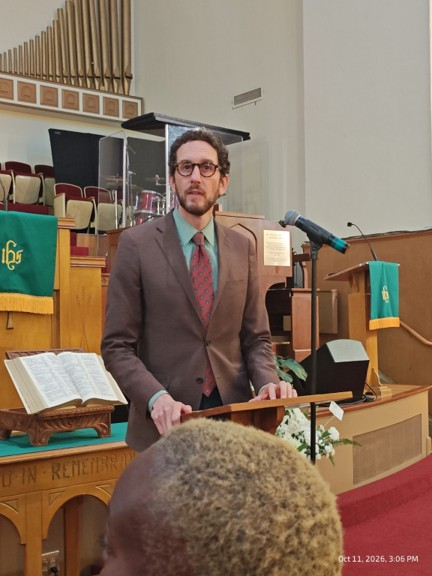
A question from the church’s Youth Council asked what federal investment would improve life for Black young people confronting violence, unstable housing, under-resourced schools and unequal access to healthcare and economic opportunity. It was a test of whether sweeping commitments to affordability could become neighborhood-level policy.
Chan emphasized public education and the adults and services that allow students to succeed: teachers, school nurses, social workers, meals, before- and after-school programming and access to career pathways. She advocated affordable childcare, tuition-free community college and training that could lead to jobs in healthcare, emergency services and the trades. Her answer framed education as both a civil right and an economic-development strategy.
Wiener began with housing stability. Overcrowding, poor housing conditions and excessive rent, he argued, affect every other part of a young person’s life. He called for major federal investment in mixed-income housing and expanded rental assistance. He then described the need for neighborhood clinics, school-based nurses, stronger special-education funding and easier access to CalFresh food benefits. He noted the loss of grocery stores serving the Fillmore and Bayview as examples of how neighborhood-level access can disappear.
I was among those dissatisfied with Wiener’s initial response. Reverend Amos C. Brown and I, journalist Malik Washington, pressed for a more direct accounting of what federal action would mean for Black youth facing neighborhood violence, housing insecurity and unequal educational opportunities. I raised the killing of a young Black woman in the community as part of that concern. It was Reverend Brown—not me—who specifically raised the need for culturally relevant schooling and proposed Afrocentric schools that would affirm Black students’ history, identity and educational needs. This was not an anonymous audience objection: Brown and I wanted a response that went beyond general housing proposals to address the immediate needs of Black children and families.
In his extended reply, Wiener described community-based mentoring, including programs where people returning from prison guide young people away from violence and incarceration. He also advocated housing and continued support for young adults leaving foster care, and culturally competent healthcare delivered through schools and neighborhood clinics. The exchange was pointed, but it produced a fuller account of his proposed investments. Neither candidate supplied a detailed federal appropriation or implementation timetable for the Youth Council’s priorities.
Reparations, with the details still unresolved
Reparations were not treated as a rhetorical checkbox. A questioner asked both candidates about relief for descendants of people enslaved in the United States, presenting specific California proposals: exemption from state personal income taxes for eligible adult descendants, exemption from property taxes for qualifying older homeowners, and continuation of the property-tax benefit for eligible heirs.
Chan endorsed reparations in principle and acknowledged the leadership of former District 10 Supervisor Shamann Walton in advancing the issue locally. She expressed support for relief addressing historical economic harms, but her response did not establish a specific legislative plan for all three proposed exemptions.
Wiener also expressly supported reparations and cited work alongside the California Legislative Black Caucus. He discussed the long-term effects of slavery, discriminatory housing policy and barriers to generational wealth. He pointed to his past proposal to restore a California estate tax to support children facing economic disadvantage, while acknowledging that this was not a descendants-only reparations measure. On the specific exemptions raised, he said he was willing to examine the ideas and expressed concern about homeowners being taxed out of their homes. He did not clearly endorse the complete package, particularly the proposed inheritance provision.
The distinction matters. Both candidates are seeking federal office, while the tax exemptions described would primarily require action in California. A congressional representative could advocate, convene partners or introduce federal reparations measures, but could not unilaterally rewrite California’s income- and property-tax laws. The audience asked for mechanisms, not simply sympathy. That question remains open.
The Fillmore is more than a plaque
Brown returned the discussion to the Fillmore’s history of displacement, when urban renewal uprooted thousands of Black residents and dismantled an extraordinary center of Black commerce and culture. He challenged the candidates to think beyond commemorative markers toward institutions, gathering places and a renewed cultural destination that Black residents could actually use and shape.
Chan spoke of rebuilding community as well as housing, arguing that historic recognition without a living place for families and young people is insufficient. Her answer stressed the importance of preserving Black cultural identity in decisions about the neighborhood’s future.
Wiener acknowledged the injury caused by redevelopment and the unfulfilled promises associated with it. He pointed to state legislation he said he helped pass to create a renewed mechanism for housing investment in the Western Addition. He argued that federal resources should be designed with residents rather than imposed through a uniform national formula.
Their responses underscored an unresolved issue: What would community control mean in practice? A housing appropriation, a cultural institution, a locally governed development project and a guarantee that displaced families can return are not interchangeable commitments. The neighborhood has heard promises before. The measure of future action will be whether residents can identify the funding, decision-makers, timelines and beneficiaries.
Data centers, cameras and the right to consent
The candidates also faced questions about the rapid expansion of data infrastructure and the surveillance technologies appearing in neighborhoods. Chan called for a nationwide pause on data center development while government addresses environmental, privacy and labor consequences. She warned against surveillance that can be turned toward protesters or communities already subject to disproportionate scrutiny.
Wiener said he opposes the proposed data center in Dogpatch, arguing that the site would be better used for housing or mixed-use development. He backed the 45-day citywide data center moratorium championed by Walton and approved by the Board of Supervisors on October 6. That measure, which Chan co-sponsored, directs attention to the impacts of data centers and the adequacy of city land-use rules. A local temporary moratorium and a proposed nationwide moratorium are distinct policies, even when they arise from similar concerns.
On automated license plate readers, Wiener supported stronger federal privacy rules and rapid deletion of data not needed for an investigation. He described an earlier state legislative effort to limit retention and said federal support for such technology should come with strict safeguards. Chan similarly raised concerns about surveillance and civil liberties. The question for both is how privacy protections would be enforced when local agencies and private vendors hold enormous amounts of information about ordinary people.
Immigration, healthcare and the cost of living
Immigrant families asked Chan about legal defense, long waits and the uncertainty of federal immigration proceedings. She pointed to city support for immigration legal services and argued for stronger protections, including a pathway to citizenship. The question about measurable results was not answered with a specific count of families assisted or cases resolved. An immigration question was also posed during Wiener’s appearance, but his substantive response was not captured clearly enough in the available proceedings to characterize it fairly.
Wiener used his opening remarks to advocate universal healthcare independent of employment, restoration of federal Medicaid and nutrition assistance funding, affordable childcare and national paid family leave. He also discussed public transit investment, including Muni, BART and Caltrain, and more stable construction employment with local hiring. Chan emphasized maintaining education, health and social-service investments while protecting immigrant communities and working families. Both linked the affordability crisis to federal policy choices.
Their records offer context but do not substitute for specific congressional commitments. Chan has served as chair of the Board of Supervisors Budget Committee and has supported city funding for immigrant legal-defense services. Wiener has authored major state legislation involving housing, healthcare and civil rights. Voters still must evaluate how either candidate would translate those records into results in a closely divided Congress.
Voting rights and the democratic stakes
Both candidates called for stronger federal voting-rights protections and condemned efforts to suppress participation. Chan defended broad access to registration and voting. Wiener cited California’s vote-by-mail system and same-day registration and proposed independent redistricting nationwide to curb partisan gerrymandering. He argued that restrictions on voting and manipulation of district boundaries can particularly harm Black representation.
The two candidates also criticized President Donald Trump’s policies. Wiener argued that defeating the administration would be insufficient without addressing the underlying failures that have left many Americans unable to afford housing, childcare and healthcare. Chan emphasized coalitions across racial and immigrant communities and the importance of protecting vulnerable residents now. Neither offered a detailed roadmap for securing every proposed reform through Congress.
The questions that outlast the candidates
The strongest moment of the afternoon did not belong exclusively to either candidate. It came when community members refused to let familiar policy language replace specific answers. The Youth Council asked what investment would reach Black children. Reparations advocates asked who would qualify, which taxes would change and whether families could pass protected homes to their descendants. Residents asked whether the Fillmore would again become a place where Black life could flourish, rather than a district whose history survives mostly in memorials.
Chan and Wiener each offered substantive priorities, and their differences are visible: Chan placed particular weight on public services, community preservation and a nationwide data center pause; Wiener emphasized large-scale housing production, federal benefit expansion, local control over data center siting and specific privacy safeguards. They also shared substantial ground on healthcare access, civil rights, voting protections and community investment.
Brown’s Sankofa lesson supplies the final standard. Looking backward is not enough if the past is acknowledged but its consequences remain unchanged. The next representative for San Francisco will inherit more than a congressional seat. The office will carry questions from the Fillmore about restitution, safety, opportunity and whether the people most affected by policy will help write it. Those questions were asked plainly on Sunday. Their answers will have to be measured after the campaign ends.
Sources
Connie Chan for Congress — Biography
https://www.conniechansf.com/about
Third Baptist Church — Congressional Town Hall announcement
https://www.thirdbaptist.org/events/congressional-town-hall
KQED — Connie Chan congressional campaign profile
https://www.kqed.org/news/12064891/san-francisco-supervisor-connie-chan-runs-for-nancy-pelosis-congressional-seat
California State Senate — Senator Scott Wiener biography
https://sd11.senate.ca.gov/biography
California State Senate — Scott Wiener housing and transportation record
https://sd11.senate.ca.gov/biography/senator-wieners-work-transportation-housing
San Francisco Board of Supervisors — Data center moratorium legislative record
https://sfgov.legistar.com/LegislationDetail.aspx?GUID=AF7EB213-B55E-4BC5-9F8F-0F965226CB04&ID=8217305
Los Angeles Times — Congressional race reporting (September 30, 2026)
https://www.latimes.com/california/story/2026-09-30/race-to-replace-pelosi-divides-democrats-in-san-francisco
CBS Bay Area — Connie Chan congressional campaign profile (November 20, 2025)
https://www.cbsnews.com/sanfrancisco/news/san-francisco-supervisor-connie-chan-launches-campaign-nancy-pelosi-seat-congress/
Mission Local — San Francisco data center moratorium (October 6, 2026)
https://missionlocal.org/2026/10/sf-supervisors-pass-data-center-moratorium/