
Honoring Sharen Hewitt and Marie Harrison Through the Living Work of Dede Hewitt and Arieann Harrison

In San Francisco, Black mothers do not die when they leave this earth.
They remain in the struggle, in the daughters they raised, in the people they taught to fight and in every room where somebody still has the courage to speak for the poor, the displaced and the poisoned.
Mother’s Day has just passed. The flowers have begun to wilt. The brunches are over. The social media tributes are fading into the scroll. But some mothers do not belong to the calendar. Some mothers belong to the movement.
That is why this story is not merely about remembrance. It is about continuation. It is about political inheritance. It is about how two mighty women of San Francisco — Sharen Hewitt and Marie Harrison — built legacies so durable that even in death they are still organizing this city through the women who carry their names, their fire, and their unfinished assignments.
Sharen Hewitt was remembered as a “grandmother for social change,” a woman who mentored organizers, comforted grieving families and built structures of care through the Community Leadership Academy and Emergency Response Project. She was not simply an activist. She was a political elder whose love came with instructions: fight hard, protect your people and never allow power to become comfortable with injustice.
Marie Harrison was one of Bayview-Hunters Point’s clearest moral voices, a woman who spent decades warning San Francisco about environmental racism, toxic contamination and the deadly fraud surrounding the Hunters Point Shipyard cleanup. She fought for Black residents whom the city too often treated as expendable. Greenaction would later remember her as a warrior who “spoke truth to power and never sold out or compromised her principles.”
And now, in the days after Mother’s Day, the daughters continue the work.
Not as ceremony.
Not as symbolism.
But as organizers, advocates and protectors moving through the machinery of government carrying entire communities with them.
On Wednesday, May 6, 2026, I spent the day with Arieann Harrison and Dede Hewitt as we moved through three separate meetings across San Francisco — three centers of power, three different forms of accountability and one common mission: advocating for Black residents too often ignored until crisis becomes catastrophe.
And by the end of that day, it became impossible not to feel the presence of their mothers in every room we entered.
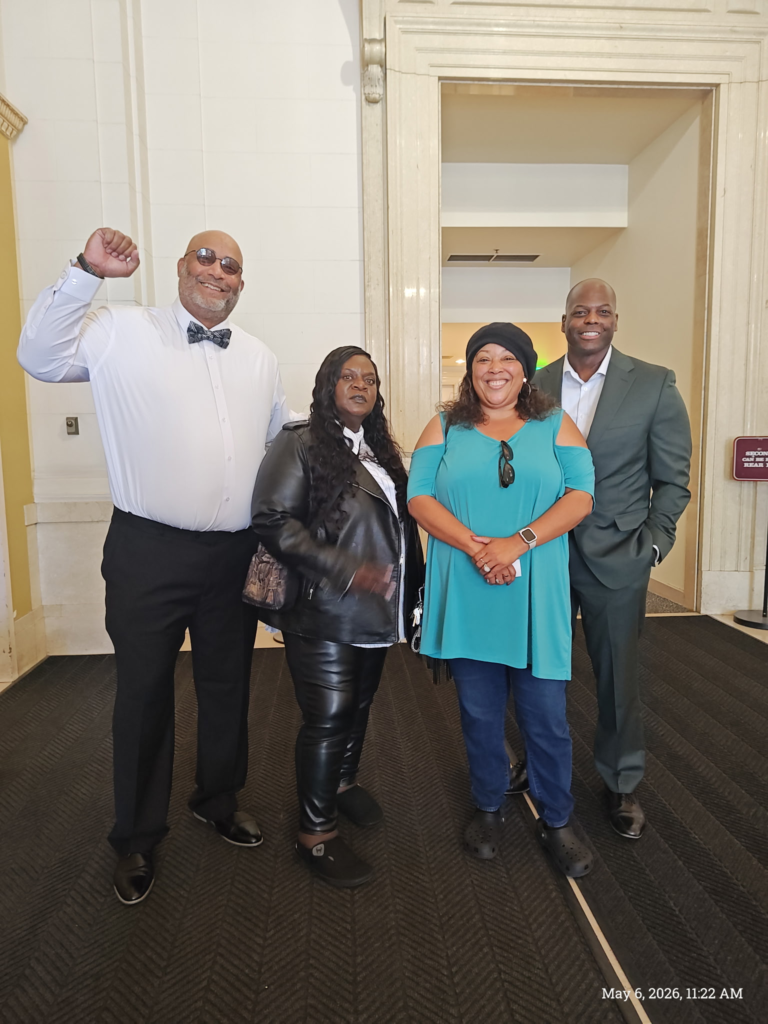
Malik Washington, Arieann Harrison, Dede Hewitt and Mawuli Tugbenyoh (Executive Director of the Human Rights Commission)
At the Human Rights Commission, the daughters carried Black elders into the room
Our first stop was the San Francisco Human Rights Commission, where we met with Executive Director Mawuli Tugbenyoh and his colleague Phil Kim.
Officially, the Human Rights Commission exists to investigate and mediate discrimination complaints in housing, employment and public accommodations. But for Black San Franciscans facing displacement, survival itself increasingly feels like a civil-rights issue.
The meeting centered on the proposed eviction of approximately 16 African American seniors at the Martin Luther King-Marcus Garvey Square cooperative in the Fillmore — longtime Black residents, many elderly or disabled, now facing displacement amid allegations of accounting confusion, subsidy failures, and administrative breakdowns.
Public reporting has already documented the growing crisis and Dede Hewitt’s visible role in helping organize residents, connect tenants to legal support, and defend elders who fear losing not just housing, but community itself.
We came into that meeting advocating zealously for those seniors. And what stood out immediately was that Tugbenyoh and Kim listened with seriousness.
There was no bureaucratic indifference.
No cynical minimization.
No attempt to frame elderly Black displacement as routine administrative fallout.
One of the immediate recommendations raised in the meeting was that affected residents should consider filing complaints with the Human Rights Commission itself — a significant point because it reframed the issue from a mere housing dispute into a possible civil-rights concern.
But the conversation did not remain confined to King-Garvey. It widened quickly to Bayview-Hunters Point, to Alice Griffith, to Shoreview, to LaSalle and to the broader pattern of instability facing Black tenants across San Francisco.
At one point, Tugbenyoh reflected that one of the earliest tenant-rights struggles he encountered in San Francisco was “up on the Hill” in Hunters Point. In that single sentence, the geography of Black San Francisco came into focus: the Fillmore and Bayview-Hunters Point — different neighborhoods connected by familiar patterns of neglect, displacement and institutional tolerance for Black suffering.
And it was there that Dede Hewitt revealed herself as more than the daughter of a beloved organizer.
She revealed herself as a continuation of political tradition. Because what Sharen Hewitt understood long ago was that when a community is under attack, you do not merely memorialize it.
You organize its defense.
And today, Dede Hewitt is doing exactly that.
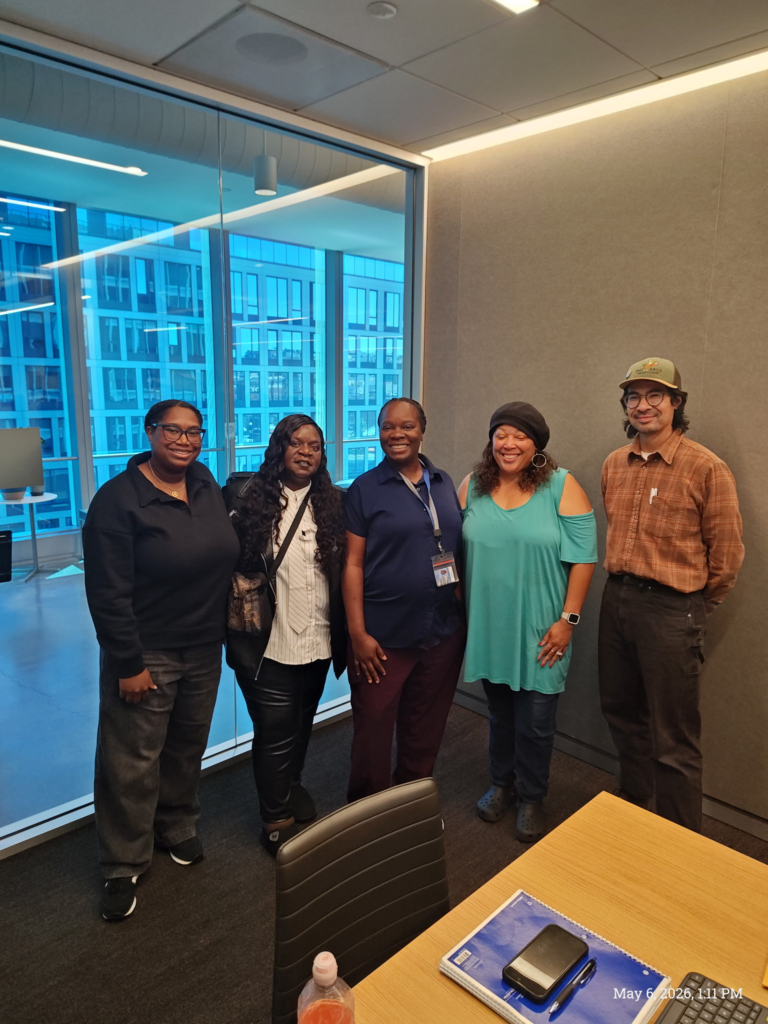
Adrienne Blaylock (SF-DPH), Arieann Harrison, Adaku Ude (SF-DPH), Dede Hewitt, and Erving Tu (SF-DPH)
At the Department of Public Health, the fight moved from rights to survival. By noon, we arrived at 49 South Van Ness for our meeting with Adaku Ude and members of the Department of Public Health’s Environmental Health Branch. Officially, the branch exists to protect residents from environmental hazards, unhealthy housing conditions and vermin infestations. But for tenants living inside properties plagued by neglect, those definitions become painfully concrete.
The focus of this meeting was Alice Griffith Apartments, a property that has increasingly become emblematic of the contradiction at the heart of San Francisco’s affordable housing crisis: multimillion-dollar developments promoted as progress while residents report conditions many describe as dangerous and degrading.
Arieann Harrison and I conveyed what tenants and community members have been reporting for months: rodent infestations, broken elevators, unsafe conditions for seniors and disabled residents and persistent fears that residents are being forced to endure conditions wealthier neighborhoods would never tolerate. Those concerns are not speculative. Public reporting has already documented broken elevators, uncollected trash, failed inspections, electrical hazards, mouse infestations, broken smoke detectors and prolonged maintenance failures at Alice Griffith.
What we learned in the meeting was equally important.
The city’s Healthy Housing Inspection Program inspects apartment buildings for vermin and health hazards in common areas — but gaining access to private units often depends heavily upon tenant cooperation and consent. Which means the visible problems may only represent part of the story.
If hallways, garages and common areas already reveal signs of deterioration, what remains unseen behind closed apartment doors may be even more severe. We also learned that the Department of Public Health had already compiled an extensive file regarding Alice Griffith.
There was no shortage of documentation.
No shortage of records.
No shortage of warning signs.
Public records already show Alice Griffith appearing on multiple Director’s Hearing agendas — evidence that the property’s problems have entered the city’s formal administrative process. But what affected me most that afternoon was not merely the bureaucracy.
This is Dede Hewitt speaking at a Fillmore Action Plan meeting at the San Francisco African American Art and Culture Complex
Video courtesy of Marvellus Lucas of Booker T. Foundation
We encourage our readers to read the article by Malik Washington about the Black seniors being evicted to provide context to Dede’s inspiring and fiery speech
https://destination-freedom.org/black-seniors-targeted-for-eviction-at-martin-luther-king-marcus-garvey-square-co-op/
It was the humanity.
Too often, Black communities encounter government agencies that respond to suffering with procedure, delay and legal insulation. Yet in that room there was attentiveness.
There was compassion.
There was recognition that these were not abstract compliance metrics, but elderly people living with vermin, fear, immobility and uncertainty.
And where Dede Hewitt carried the instinct to defend communities from displacement, Arieann Harrison carried something equally necessary: the insistence that housing conditions are inseparable from public health, environmental justice and the right to live with dignity.
That is Marie Harrison’s legacy alive in real time.
The daughter does not merely remember the mother.
She carries her analysis into the room.
At City Hall, the day ended where accountability begins. Our final meeting took place at San Francisco City Hall with Inspector General Alexandra Shepard, the city’s first Inspector General and a former federal prosecutor with extensive experience in corruption, fraud and civil-rights investigations.
It would not be appropriate to detail that conversation in full. But what can be said publicly is this:
The discussion reflected serious concern regarding systems of accountability involving major affordable-housing operators and entities connected to the City and County of San Francisco.
For communities long forced to watch powerful institutions shield themselves behind contracts, consultants and fragmented responsibility, that matters. Because too often the people who profit from community suffering behave as though they are untouchable.
Too often the poor are investigated while the powerful are insulated. Too often Black tenants are told to wait while others continue collecting subsidies, contracts, salaries and influence.
And so the significance of that meeting was not in what can be quoted. It was in what could be felt. That there are individuals inside City Hall who understand that harm can become structural.
That systems can be manipulated.
That accountability delayed eventually becomes accountability demanded.
And that some truths refuse to remain buried forever.
The mothers were still there. Throughout the day, I kept thinking about the way these daughters move through the world. Dede Hewitt carries the communal ethic of Sharen Hewitt — defend the vulnerable, protect elders, confront displacement and never allow the city to normalize Black suffering. Arieann Harrison carries the analytical fire of Marie Harrison — expose contamination, challenge environmental racism, demand accountability and insist that Black life is worthy of protection.
And together they teach us something Mother’s Day advertisements never will:
A mother is not honored merely by flowers.
A mother is honored when her values become public action.
A mother is honored when the children she raised continue showing up for the people.
A mother is honored when elders still have defenders.
When tenants still have advocates.
When poisoned communities still have witnesses.
When somebody still walks into rooms of power and says:
Not on our watch.
That is what I witnessed on May 6.
I witnessed lineage in motion.
I witnessed Black motherhood transformed into governance pressure.
I witnessed memory converted into advocacy.
I witnessed two daughters refusing to let San Francisco forget the women who taught this city how to fight.
So let San Francisco understand this clearly. Sharen Hewitt is gone from this earth, but she is still in the struggle through Dede. Marie Harrison is gone from this earth, but she is still in the struggle through Arieann.
And if this city possesses any wisdom left at all, it will stop treating Black women’s warnings as background noise and begin recognizing them for what they truly are:
instructions for survival.
SOURCE LIST
[1] 48 Hills — “Sharen Hewitt, force of nature and grandmother to hundreds of activists, dead”
https://48hills.org/2018/02/sharen-hewitt-force-nature-grandmother-hundreds-activists-dead/
[2] Mission Local — “Marie Harrison, tireless fighter for environmental justice, dies at 71”
https://missionlocal.org/2019/05/marie-harrison-tireless-fighter-for-environmental-justice-dies-at-71/
[3] Greenaction for Health and Environmental Justice — “Greenaction Mourns the Passing of Marie Harrison” (PDF)
https://greenaction.org/wp-content/uploads/2019/05/Greenaction-Mourns-the-Passing-of-Marie-Harrison-2-1.pdf
[4] Fog City Journal — “City officials to promote Bayview-Hunters Point redevelopment amid concerns over displacement”
https://www.fogcityjournal.com/news_in_brief/bcn_bayview_redevelopment_070404.shtml
[5] Bay Area Air Quality Management District (BAAQMD) — Arieann Harrison Official Biography
https://www.baaqmd.gov/en/about-the-air-district/community-advisory-council/harrison
[6] Marie Harrison Community Foundation / Can We Live — “Environmental Justice”
https://www.canwelive.org/environmental-justice
[7] Marie Harrison Community Foundation / Can We Live — “Our Team”
https://www.canwelive.org/our-team
[8] KQED — “From The Soil: A Family Tree on Toxic Terrain”
https://www.kqed.org/arts/13925787/from-the-soil-a-family-tree-on-toxic-terrain
[9] San Francisco Public Press — “Remembering the Bayview Activist Who Fought for Community’s Health and Dignity”
https://www.sfpublicpress.org/remembering-the-bayview-activist-who-fought-for-communitys-health-and-dignity/
[10] San Francisco Bay View — “Expert panel inextricably links Treasure Island and Hunters Point”
https://sfbayview.com/2022/06/expert-panel-inextricably-links-treasure-island-and-hunters-point/
[11] KQED — “For These Black Bayview-Hunters Point Residents, Reparations Include Safeguarding Against Rising, Toxic Contamination”
https://www.kqed.org/science/1979614/for-these-black-bayview-hunters-point-residents-reparations-include-safeguarding-against-rising-toxic-contamination
[32] YouTube / San Francisco City Hall Archive — “Marie Harrison – Tetra Tech Fraud – San Francisco City Hall – May 14, 2018”
https://www.youtube.com/watch?v=xvMKEme1LEE
[33] San Francisco Bay View — “Earth Day 2021 in San Francisco!”
https://sfbayview.com/2021/04/earth-day-2021-in-san-francisco/
Housing, Tenant Rights & Displacement
[12] The Davis Vanguard — “Black Seniors Targeted for Eviction at Martin Luther King–Marcus Garvey Square”
https://davisvanguard.org/2026/04/gentrification-displacement-black-seniors-fillmore/
[13] The San Francisco Standard — “A Fillmore co-op was a refuge for Black families. Now it’s evicting them”
https://sfstandard.com/2026/05/07/fillmore-housing-coop-eviction-crisis/
[14] Dean Preston Official Statement — “Elected Officials, Community Leaders Rally Against Evictions of Long-Term Black Residents”
https://www.deanprestonsf.com/press-releases/osji4u1l67urxktl789ucai7wfkjta
[20] SF.gov — “Healthy Housing Inspection Programs”
https://www.sf.gov/information–healthy-housing-inspection-programs
[21] SF.gov — “Healthy Housing Conditions”
https://www.sf.gov/topics–healthy-housing-conditions
[22] SF.gov — “Report a Health Nuisance or Hazards”
https://www.sf.gov/report-health-nuisance-or-hazards
[23] SF.gov — “Get Help Reporting Substandard Living Conditions”
https://www.sf.gov/get-help-reporting-substandard-living-conditions
[24] 48 Hills — “Conditions at a Hunters Point housing project are disgraceful — and the private operators duck”
https://48hills.org/2025/04/conditions-at-a-hunters-point-housing-project-are-disgraceful-and-the-private-operators-duck/
[25] Mission Local — “Alice Griffith failed more than 100 housing inspections in the past year”
https://missionlocal.org/2025/06/alice-griffith-failed-more-than-100-housing-authority-inspections-in-the-past-year-each-failure-sinks-the-complexs-finances-deeper-in-the-hole/
[26] SF.gov — Director’s Hearing (Housing Inspection), April 17, 2025
https://www.sf.gov/meeting-20250417-directors-hearing-housing-inspection
[27] SF.gov PDF — Director’s Hearing Agenda, February 5, 2026
https://media.api.sf.gov/documents/DIR_Hearing_2-5-2026_Housing_Inspection_Services.pdf
[28] The Davis Vanguard — “The Bayview-Hunters Point Housing Crisis”
https://davisvanguard.org/2026/03/bayview-hunters-point-housing-crisis/
Government, Oversight & Civil Rights
[15] SF.gov — Mawuli Tugbenyoh Official Biography
https://www.sf.gov/mawuli-tugbenyoh
[16] SF.gov — “File a Discrimination Complaint”
https://www.sf.gov/file-discrimination-complaint
[17] SF.gov — “Get Help for Discrimination in Housing”
https://www.sf.gov/information–get-help-discrimination-housing
[18] SF.gov / Human Rights Commission Minutes — Phil Kim Staffing Reference (PDF)
https://media.api.sf.gov/documents/DRAFT_HRC_Commission_Minutes_5_8_25.pdf
[19] SF.gov — Environmental Health Branch Staff Directory
https://www.sf.gov/reports–january-2025–environmental-health-branch-staff-director
[29] SF.gov — Alexandra Shepard Official Biography
https://www.sf.gov/alexandra-shepard
[30] SF.gov — “Attorney Alexandra Shepard Named San Francisco’s First Inspector General”
https://www.sf.gov/news-attorney-alexandra-shepard-named-san-franciscos-first-inspector-general
[31] SF.gov — “San Francisco’s Inspector General”
https://www.sf.gov/establishing-san-franciscos-inspector-general
Original Reporting & Field Documentation
[34] Original Reporting by Journalist Malik Washington — Firsthand observations, contemporaneous reporting, and participation in meetings held May 6, 2026 with:
San Francisco Human Rights Commission
San Francisco Department of Public Health — Environmental Health Branch
San Francisco Inspector General Alexandra Shepard
(No public URL; author’s firsthand reporting, notes, interviews, and observations retained by the author.)
Our song/video for this article is:
Mama Made a Man (On My Own) – Lyric Video l Butter Knife Shawty