
Lurie’s Cleanliness Crackdown on Nonprofits — While Publicly Subsidized Housing Tenants Keep Living With Sewage, Garbage, Mold, Broken Elevators, and Rats!!
Special Investigative Commentary
San Francisco is preparing to hold hundreds of City-funded service providers to a new neighborhood-cleanliness standard. The question is whether City Hall will show the same urgency and accountability when low-income tenants report sewage, mold, pests, failed elevators, piled up garbage, and other habitability hazards inside publicly subsidized housing.
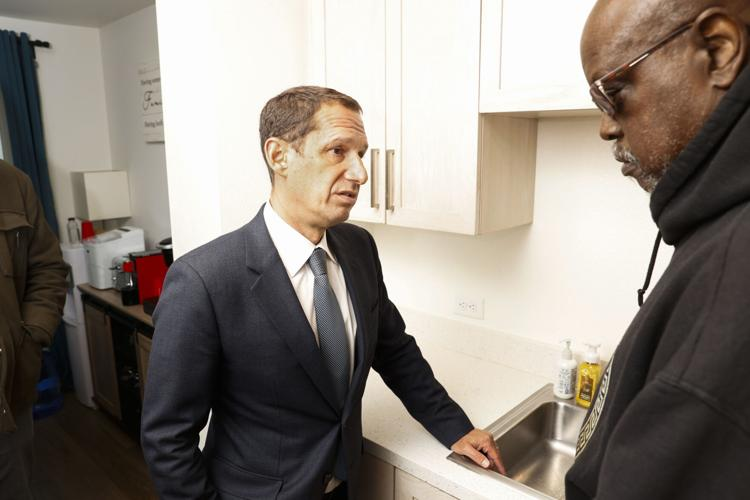
Photo Credit: https://www.sfexaminer.com/news/urban-development/affordable-housing-residents-bend-mayor-s-ear-over-living-conditions/article_47aeba49-47f8-41c5-b1cc-873b697ca8eb.html
SAN FRANCISCO — The city has decided that accountability can be measured in footsteps.
Under San Francisco’s updated Citywide Good Neighbor Policy, City-funded housing, health, shelter, transitional-housing, and social-service sites are being placed under a common compliance framework. Providers are expected to conduct and document at least three perimeter checks a day, respond to neighborhood concerns, address litter where legally and operationally permitted, keep entrances and sidewalks reasonably clear, and coordinate with City agencies when conditions require a government response.
There is nothing inherently wrong with that standard. A publicly-funded organization should be accountable for the conditions it controls. Neighbors should be able to call someone. Sidewalks should be passable. Trash should be addressed. Complaints should not disappear into a bureaucratic black hole.
But after nearly a year of investigating habitability failures in San Francisco’s publicly-subsidized housing, I am left with a question City Hall can no longer avoid:
If the City can build a monitoring system to make sure a nonprofit checks its sidewalk three times a day, why has it struggled to produce an equally visible, equally disciplined system for publicly-subsidized property management companies for tenants who say sewage is entering their homes?
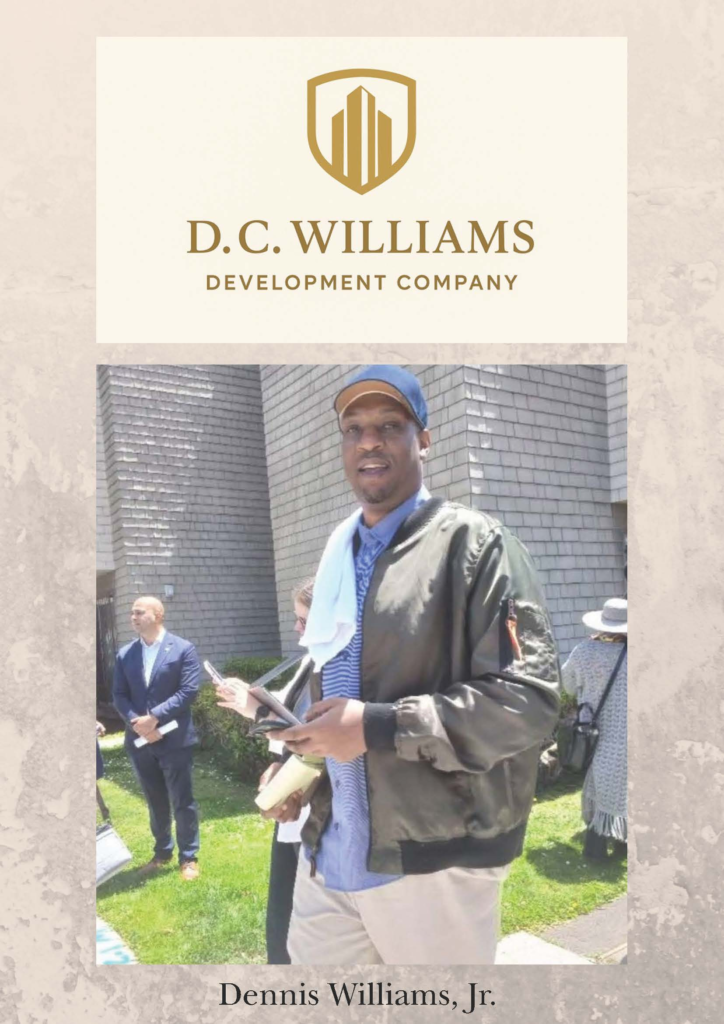
I interviewed Dennis Williams, the President and Founder of D.C. Williams Development Company. He also lives in housing managed by private property managers that are supposed to be supervised by the City and County of San Francisco. Here’s what he had to say:
“I support clean and safe neighborhoods, but Mayor Lurie’s ‘Good Neighbor’ policy raises a fundamental question of fairness: Who is holding the landlords, private management companies and major development corporations receiving public dollars to the same standard?
“In the Historic Fillmore, families in subsidized and public housing have lived with recurring sewage and plumbing failures, deteriorating buildings and serious habitability concerns. I know because I live it, document it and have spent years organizing residents around these conditions.
“It is difficult to hear City Hall demand that nonprofit and social-service providers keep the sidewalks surrounding their facilities clean while lower-income families are fighting to keep sewage out of their homes. Cleanliness and accountability cannot stop at the front door.
“And there is an economic justice issue here as well. San Francisco continues entrusting enormous publicly supported redevelopment opportunities to established development corporations while community-rooted private developers who live in and understand these neighborhoods struggle to obtain meaningful ownership and co-development opportunities.
“If we are going to have a ‘Good Neighbor’ standard in San Francisco, then let’s have one standard for everybody: nonprofits, landlords, property managers, developers and City agencies alike.
“Lower-income residents deserve clean sidewalks—but they also deserve clean, safe and habitable homes.”
That is not a rhetorical flourish. It is the central contradiction.
A New Standard for the Nonprofit Sector
Mayor Daniel Lurie’s administration has expanded a Good Neighbor framework that reaches across programs funded or operated by the Department of Homelessness and Supportive Housing, the Department of Public Health, and supportive-housing sites funded by the Mayor’s Office of Housing and Community Development.
Public materials describing the policy establish a straightforward expectation: covered providers must pay attention not only to what happens inside their facilities, but also to the immediate conditions outside them. The updated framework calls for documented perimeter checks, accessible channels for community concerns, prompt responses to routine complaints, attention to litter and blocked entrances, and coordination with the City when a problem exceeds the provider’s authority.
Recent reporting indicates the administration intends to use a more formal monitoring and compliance structure as implementation proceeds. That matters because San Francisco is not merely asking providers to be courteous. It is attaching documentation, oversight and corrective action to the receipt of public money.
And that is precisely why the policy raises a larger question about housing.
I Have Been Following the Other Side of This Story
For months, my reporting series, “The Price of Being Poor,” has documented a different San Francisco — one that exists behind apartment doors, inside elevators that do not work,
beneath ceilings damaged by water, and in bathrooms where residents say sewage has backed up through plumbing systems.
The Price of Being Poor Series
This reporting did not begin with the Good Neighbor Policy. It began with tenants.
I have interviewed residents, reviewed complaints, attended public meetings, moderated a meeting in which tenants presented testimony directly to a Special Assistant Attorney General from the California Department of Justice, and repeatedly asked why companies participating in publicly subsidized housing continue to receive public support while residents describe conditions that would provoke immediate outrage in wealthier neighborhoods.
The record has included Alice Griffith Apartments in Bayview–Hunters Point; LaSalle, Shoreview and other Hunters Point properties; Plaza East in the Western Addition; and additional subsidized developments where residents have described mold, rodents, plumbing failures, unsafe electrical conditions, elevator outages, piled up garbage, and delayed repairs.
At Alice Griffith, my March investigation reported that San Francisco Housing Authority inspection records documented more than 129 deficiencies in a single year. Residents described sewage backups, pest infestations, broken elevators, and other hazards. The property is managed by the John Stewart Company. At Hunters Point properties associated with Related Affordable, residents have separately described defective doors and appliances, asbestos concerns, construction defects and conditions they say remain unresolved after rehabilitation.
The Price of Being Poor – Part 1
These are distinct properties with distinct ownership and management structures. They should not be casually collapsed into one corporate entity. What connects them is the public-policy question: when public money, public subsidies, public redevelopment programs and public regulatory agreements are involved, what level of accountability does San Francisco demand from the private entities participating in that system?
Plaza East: Sewage Is Not a New Warning
Then there is Plaza East.
Dennis Williams Jr., a longtime Plaza East resident and community advocate, has been sounding alarms about conditions at the Western Addition development for years. This is not a newly invented controversy. Public reporting from 2021 documented sewage bubbling along the baseboards of Williams’s apartment, mold on the walls, plumbing problems, pests, and a door that did not properly secure. City inspectors found housing-code violations in his unit. In 2022, Williams told 48 Hills that raw sewage leakage had persisted for years and had affected his ability to safely raise his children in the apartment.
Tenants later sued over alleged health and safety failures. The John Stewart Company managed Plaza East beginning in 2021 after the prior manager and owner faced litigation; Mission Local reported in 2025 that John Stewart would leave the property while a separate tenant lawsuit against the company remained pending. The allegations in litigation are allegations, not judicial findings, but the history matters because it demonstrates how long residents have been trying to force the system to respond.
Now, Williams has reported another sewage-water spill at Plaza East. That recent report, relayed to Destination Freedom Media Group, still requires the same thing every serious habitability complaint requires: prompt inspection, documentation, remediation, and a transparent explanation of what failed and who is responsible. I am not presenting that newest report as a completed government finding. I am saying the history makes it impossible to dismiss as background noise.
When sewage has been part of the documented history of a property for years, another reported spill should trigger urgency — not institutional fatigue.
The Price of Being Poor – Part 4 and The Price of Being Poor – Part 6
Fillmore District – Raw Sewage Spill onto Sidewalk (video)
The City Says Its Hands Are Limited. Its Own Documents Tell a More Complicated Story.
During my earlier reporting, Mayor Lurie told me that the City has limited authority over private property-management companies. Mission Local separately reported a similar dynamic during the Mayor’s 2025 visits to low-income housing, where City representatives emphasized the limits of municipal control over privately owned properties.
Those limits are real in some circumstances. San Francisco cannot simply operate every privately owned building as if the Mayor was the landlord. Ownership, financing, federal housing programs, state law, contractual relationships and regulatory jurisdiction all matter.
But “limited authority” is not the same thing as “no leverage.”
MOHCD’s own published rules show that City-supported affordable housing can be governed by regulatory agreements, declarations of restrictions, development agreements, loan documents, property-management requirements and monitoring procedures. The City also has building and housing-code enforcement tools, while subsidized projects may be subject to additional federal, state and program-specific obligations.
That means the serious policy question is not whether the Mayor can personally order a private manager to fix a toilet. The question is whether every available lever — inspection, code enforcement, loan covenants, regulatory agreements, funding conditions, management standards, referral for legal enforcement, and future contracting decisions — is being used with the same institutional intensity now being directed at nonprofit providers.
The Double Standard Is About Administrative Urgency
This is where the contrast becomes impossible to ignore.
A nonprofit provider can now be expected to create logs proving that someone walked the perimeter. A neighbor’s complaint can be documented, timed and escalated. City departments can train providers, monitor performance and demand corrective action.
Good. Keep that standard.
But build its equivalent for the people living inside publicly-subsidized housing.
If a resident reports raw sewage, the City should know when the complaint was received, who inspected it, what the inspector found, which entity was ordered to correct it, the deadline for correction, whether the work was verified, whether the condition recurred, and what consequence followed if the responsible party failed.
If an elevator strands an elderly or disabled resident, that should generate a compliance record every bit as visible as a missed perimeter check.
If mold repeatedly returns after superficial repairs, the system should track the underlying moisture source, not merely the repainting of a wall.
If a publicly-supported housing operator develops a pattern of unresolved health-and-safety complaints, that record should follow the operator into the next request for City financing, the next management agreement, the next development approval and the next public hearing.
Accountability that stops at the sidewalk is not accountability.
This Is Bigger Than Related or John Stewart
I have named Related Affordable and the John Stewart Company because tenants in properties connected to those firms have repeatedly appeared in my reporting. They are not the only companies operating in San Francisco’s affordable-housing ecosystem, and the legal and factual responsibility for any particular condition must be determined property by property.
But the larger issue is structural.
San Francisco spent decades moving public housing into complex public-private arrangements on the theory that private development expertise and professional management would deliver better outcomes. The public, however, did not surrender their interest when ownership and management became more complicated. Public money remained. Public subsidies remained. Public land and redevelopment authority remained. Regulatory agreements remained. Most importantly, the residents remained.
When a system uses public resources to house low-income people, “private company” cannot become a magic phrase that dissolves public responsibility.
The Price of Being Poor – Part 9 and The Price of Being Poor – Part 10
What Equal Accountability Would Look Like
A citywide habitability compliance dashboard: for publicly-subsidized developments receiving City financing or subject to City regulatory agreements, showing serious open violations, age of unresolved work orders, elevator outages and repeat health-and-safety failures, while protecting tenant privacy.
A formal escalation ladder: for recurring or severe habitability failures: notice, corrective-action plan, technical assistance where appropriate, enhanced monitoring, financial or contractual remedies where legally available, and referral for enforcement.
Funding consequences tied to performance: so that a company seeking new City loans, grants, contracts or approvals must disclose unresolved serious violations and its record of correcting prior deficiencies.
Independent verification: of repairs involving sewage, mold, electrical hazards, accessibility failures, fire safety and other conditions capable of causing serious harm.
A public response protocol for tenant complaints: that tells residents who have jurisdiction, what happens next, and when they can expect a decision — rather than simply sending them back to the same property manager they are complaining about.
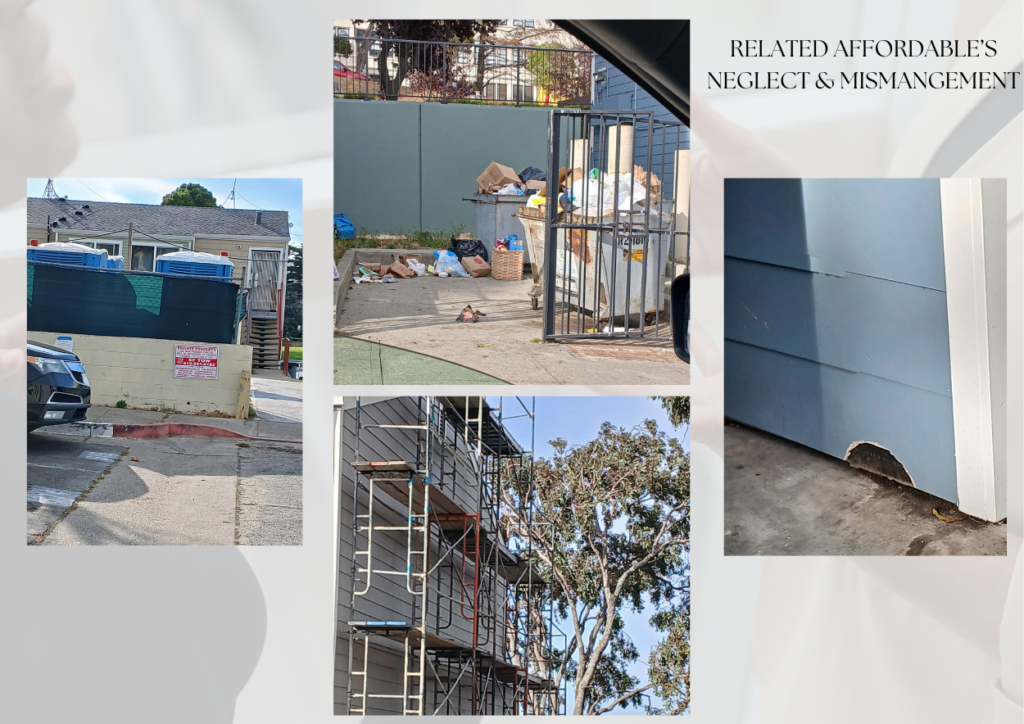
The above photos were recently sent to us by a tenant in Hunters Point who lives in apartments that are managed by Related Affordable. The tenant asked to remain anonymous because they have been subjected to retaliation tactics by local property managers who work for Related Affordable in San Francisco.
What has been happening is that Related Affordable has continued to be neglectful in not just trash removal but by not taking down or removing construction and building items which sometimes create a hazard for apartment dwellers and their young children. Destination Freedom Media Group and the Davis Vanguard ask that more community members in San Francisco come forward and tell us about your experience with private property management companies.
From these images, it appears that there has been a double standard created by Mayor Daniel Lurie and the City of San Francisco.
Mayor Lurie, Apply the Principle Consistently
The Good Neighbor Policy rests on a principle I agree with: public money should come with public responsibility.
So, apply it consistently.
Do not tell a shelter worker that the City can measure whether a candy wrapper was removed from the sidewalk while telling a mother that the City has little power when wastewater enters her home.
Do not build a digital compliance culture for nonprofits and leave low-income tenants to assemble photographs, inspection reports, lawsuits, petitions and public testimony just to prove that their living conditions deserve attention.
Do not confuse the complexity of public-private housing with helplessness.
The City may not possess the same legal tool in every building, but it possesses tools. It possesses money. It possesses inspection authority. It possesses contracting power. It possesses regulatory agreements. It possesses the ability to condition future public support. And it possesses a bully pulpit powerful enough to make clear that habitability is not optional.
District 10 Supervisor Shamann Walton has repeatedly pressed for accountability around Alice Griffith and other housing conditions. Residents and organizers across Bayview–Hunters Point and the Fillmore have built a record that is increasingly difficult to dismiss. State officials have heard tenant testimony. Independent newsrooms have documented the same broad pattern of deterioration and frustration.
The issue is no longer whether San Francisco has been warned.
The issue is whether the City will create one standard of accountability for everyone who receives the benefit of public resources.
The Measure of a Good Neighbor
A clean sidewalk matters.
But so does the floor on the other side of the apartment door.
A quiet entrance matters.
But so does the bedroom where a child is expected to sleep.
A documented perimeter check matters.
But so does a documented sewage complaint.
If Mayor Lurie wants a Good Neighbor Policy to become a symbol of accountable government, then City Hall should carry that principle all the way through the front door of San Francisco’s publicly-subsidized housing.
Because the poorest residents of this City should not have to prove, year after year, that sewage is more serious than litter.
They should not have to organize a movement to establish that mold, broken elevators, unsafe electrical systems, and failed plumbing are matters of public concern.
And they should not be told that government is powerless while government continues financing, regulating, approving and partnering in the system that houses them.
The standard should be simple: if you accept public money to serve the public, you accept public accountability.
Editorial Note
This article distinguishes documented facts, publicly reported allegations, and newly reported tenant claims. The most recent sewage-water spill reported by Dennis Williams Jr. is attributed as a report to Destination Freedom Media Group and is not characterized here as a completed City finding. The article also distinguishes among the ownership and management structures of Alice Griffith, Plaza East, and Related Affordable properties rather than treating them as a single corporate entity.
One city. One standard.
Anything less is not a Good Neighbor Policy.
It is a tale of two San Franciscos.
I have been a Black journalist for a couple decades, but I’ve been a Black man all of my life. I have always tried to keep my body and the place where I live clean. We are clean people and it is a form of high disrespect for anyone or any entity to try to force us to live in filth and squaller. But for the City of San Francisco to ignore those conditions is a horse of a totally different color. I am asking with the utmost respect that Mayor Daniel Lurie and the proper agencies and departments of the City of San Francisco get serious about holding private property management companies accountable in regard to the treatment of our community members and the properties that they live in.
Sources and Further Reading
The following sources support the factual framework of this article. Links are clickable.
1. San Francisco Department of Public Health — June 2026 Director’s Report (Citywide Good Neighbor Policy) — Official City description of the updated policy and its cross-department scope.
2. San Francisco Chronicle — S.F. expands ‘good neighbor’ guidelines for homeless shelters to minimize complaints — Recent reporting on three daily perimeter inspections, complaints, implementation and enforcement.
3. Mission Local — S.F. leaders closing Sixth Street center to ‘revitalize’ the corridor — Reports policy language requiring documented perimeter checks and reasonable efforts to address routine concerns.
4. Mission Local — SF public housing tenants sued property manager. Now it’s leaving. — Reports the John Stewart Company’s departure from Plaza East and pending tenant allegations.
5. San Francisco Public Press — With Mayor’s Backing, Developer Asks to Demolish, Rebuild 20-Year-Old Public Housing — Documents Dennis Williams’s sewage and mold complaints and City housing-code findings at Plaza East.
6. 48 Hills — Tenants fight to save affordable homes at Plaza East — Documents Williams’s account of years of sewage leakage and other resident habitability complaints.
7. Mission Local — Mayor Lurie visits SF low-income housing. But what can he do? — Reports the City’s stated limits and MOHCD’s response to tenant concerns at privately owned affordable housing.
8. San Francisco MOHCD — Inclusionary Affordable Housing Monitoring and Procedures Manual — Official City manual describing monitoring, enforcement and regulatory documents applicable to affordable housing.
9. San Francisco MOHCD — Multifamily Securities Program Manual — Official framework referencing regulatory agreements, management requirements and City financing conditions.
Here’s our song/video for this article:
Outkast – So Fresh, So Clean (Official HD Video)