A life lost. A process demanding scrutiny.
Austin Metcalf was 17. He went to a high school track meet in Frisco, Texas, and never came home. His death on April 2, 2025, is not a rhetorical device. It is a family’s permanent wound. Nothing in this appeal for scrutiny asks anyone to diminish his life or excuse his killing.
Karmelo Anthony was also 17 when the confrontation happened. In June 2026, a Collin County jury convicted him of murder and sentenced him to 35 years. His claim of self-defense did not persuade the jury. That verdict remains in force.
But a verdict does not place the process that produced it beyond examination. It makes examination consequential.
The interview: testimony from inside the system
I return to this case because the questions I raised in my first article, “Struck Black, Tried White,” have not lost their urgency. Were Black prospective jurors excluded for reasons that comparable non-Black jurors survived? Did the courtroom remain meaningfully open? Did an unwritten agreement help determine whether the accused would testify? These are questions about the administration of justice, not a substitute verdict.
Ayala introduced me as a journalist who had sat at the defense table in Texas and served time in its prisons. In the full interview, I described serving 12 years on a 20-year sentence and moving through 19 facilities. These are my recollections, not findings about Anthony’s case.
I described a Harris County bank-robbery prosecution arising from my addiction. I said I used a note, not a gun, and resisted pressure to accept an aggravated charge. Eventually, I recalled, a prosecutor presented the choice this way: take 20 years or go to trial, where she would seek 99. I signed.
People can debate plea bargaining in an academic seminar. The person facing that choice experiences it in the body: fear, exhaustion, uncertainty, the knowledge that insisting on trial may carry a terrible price.
My experience is not evidence that Anthony’s prosecutors coerced him. He went to trial; I accepted a plea. The connection is narrower and more important: consequential choices require clear terms, competent advice and a reliable record. No person’s liberty should rest on ambiguity.
Ayala and I also discussed the distinction at the center of my June article. A defendant is not guaranteed jurors of his own race. But prosecutors may not exclude prospective jurors because of race. The first proposition does not erase the second.
I urged a closer look at the educator explanation used in Anthony’s jury selection. Ayala pressed the same concern: a neutral description must be tested against how it was actually applied.
The interview’s value is not that two commentators agreed. It is that lived experience and legal analysis pointed toward a task outsiders can verify: compare the struck jurors with those permitted to serve. That inquiry belongs in the record, not in speculation.
Watch the complete interview: Legal View with Michael Ayala
Oliver Lister: the person who told us to look
In my recent full-length interview with Michael Ayala on Legal View, “12 Years An Inmate: Doing Time in the Same Texas System,” we connected those questions to the human being who must live with their consequences. The 38-minute conversation is central to this article—not an incidental link.
Before this story became part of my reporting, someone took the trouble to bring it to my attention.
That person was Oliver Eshman Lister Jr.—a formerly incarcerated paralegal, former jailhouse lawyer and Dallas community advocate. Oliver contacted Destination Freedom Media Group about the Anthony case and supplied legal research that informed our first article. Our June publication acknowledged his contribution. I want that acknowledgment inside this article, where readers cannot miss it.
Oliver, thank you, brother. You recognized that a jury-selection dispute deserved more than a passing mention. You helped turn concern into questions grounded in law.
Formerly incarcerated people are too often treated as subjects of reporting rather than contributors to it. Yet people who have navigated prison law libraries and fought to understand their own cases can recognize the significance of a denied objection, an unexplained distinction or a missing record.
Their experience is not a substitute for licensed counsel. It is not proof that any particular conviction is wrong. It is a reason to listen carefully instead of dismissing a messenger because of his past.
My own journalism grew from that same insistence on being heard. PBS NewsHour reported my allegation that Texas officials put me in solitary confinement before the 2016 prison strike and sought to silence my writing. Years later, First Amendment Watch reported my lawsuit alleging retaliation after I communicated with a journalist about a COVID-19 outbreak at a privately operated halfway house. Those were allegations, not findings I can claim here.
Those experiences inform my scrutiny of institutional power. They also impose a discipline: the harder a question is, the more carefully it must be documented.
Oliver helped us ask. The next responsibility belongs to everyone with the skill or authority to obtain answers.
Three educators struck. A distinction to test.
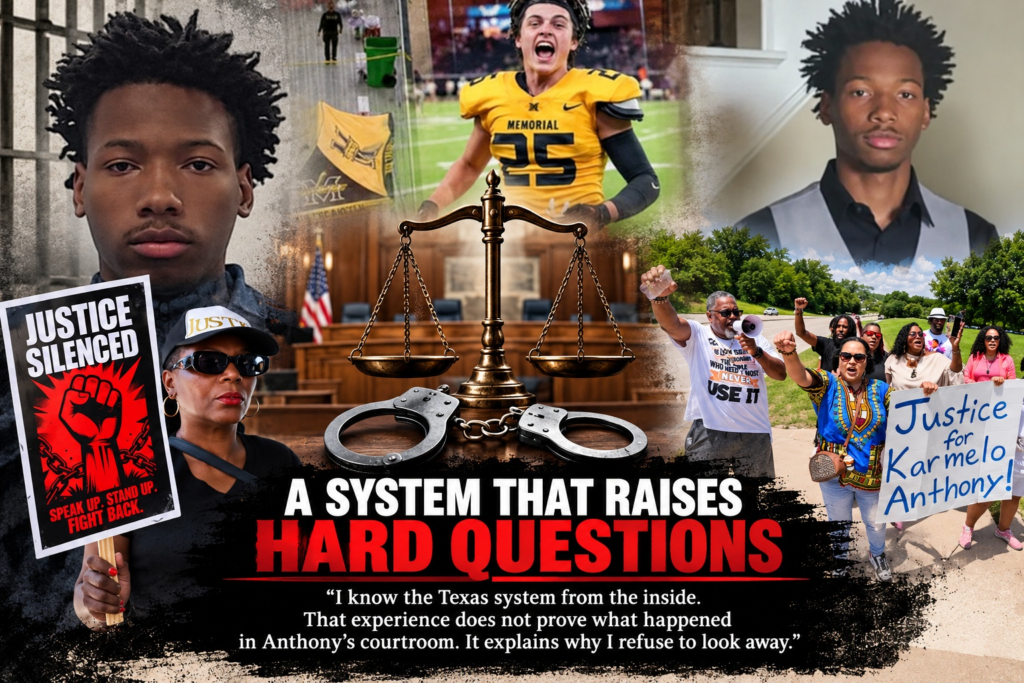
I know the Texas system from the inside. That experience does not prove what happened in Anthony’s courtroom. It explains why I refuse to look away.
Contemporaneous reporting describes prosecutors striking the final three Black prospective jurors in Anthony’s strike zone. All three were women identified as educators. The defense raised a Batson challenge, arguing that they were similarly situated to a white woman allowed to remain. The challenge was denied. The seated jury included no Black members.
The State denied that race motivated its strikes. Its explanation was occupational: the case concerned school-aged children at a school event, and prosecutors did not want traditional educators on the jury.
There is an important qualification. One account reports that the seated white juror was an esthetician who taught adults at a trade school. That is not identical to teaching school-aged children. Responsible advocacy must acknowledge the distinction rather than pretend the occupations were interchangeable.
The distinction could explain the different treatment. Or a complete comparative analysis could show that it did not. News accounts alone cannot decide.
Legal experts should examine the precise explanation offered at the Batson hearing, the questionnaires, the questioning of each juror, and the treatment of every comparable panel member. Was the category defined consistently? Did prosecutors ask comparable follow-up questions? Were additional concerns expressed about the struck women? What credibility findings did the judge make?
The purpose is not to reverse-engineer a conclusion from the jury’s racial composition. It is to determine whether race played an impermissible role in individual strikes.
My June 2026 article expressly recognized that the voir dire transcript might reveal distinctions missing from public coverage. That caution remains essential. The latest interview sharpened my concern; it did not eliminate the need for evidence.
Neither “there were no Black jurors” nor “the State offered a neutral reason” completes the analysis. One identifies a reason to investigate. The other supplies an explanation to test.
Neutral language is the beginning—not the end
To lawyers, scholars, journalists and citizens of conscience: do not accept my conclusions on faith. Examine the record. Test the explanations. Ask whether the constitutional safeguards we invoke so proudly were actually enforced.
Batson v. Kentucky forbids purposeful racial discrimination in prosecutors’ use of peremptory strikes. Its practical importance lies in requiring scrutiny of explanations that may appear neutral. The constitutional inquiry is not satisfied merely by replacing racial language with professional vocabulary.
Miller-El v. Dretke emerged from Dallas County, next door to Collin County. The Supreme Court examined comparative treatment and the broader evidence surrounding jury selection. Its words supply a precise method, not simply a slogan:
“If a prosecutor’s proffered reason for striking a black panelist applies just as well to an otherwise-similar nonblack who is permitted to serve, that is evidence tending to prove purposeful discrimination to be considered at Batson’s third step.”
Snyder v. Louisiana likewise demonstrates why an explanation must withstand comparison with the treatment of other jurors. Flowers v. Mississippi emphasizes the totality of the circumstances and states that “even a single instance of race discrimination against a prospective juror is impermissible.”
These decisions do not establish that discrimination occurred in Anthony’s case. Different facts and procedural histories matter. They establish why the educator rationale should be examined against the actual record rather than celebrated or condemned in the abstract.
The question is not whether teachers must be seated. The question is whether a stated occupational concern was genuine and applied consistently rather than used to conceal a racial choice.
Nor should anyone promise that an appellate court will reach a particular issue. Preservation, the record and the claims counsel actually presents matter. The new-trial motion I reviewed addresses public access, the disputed evidentiary agreement, the provocation instruction and cumulative error; it does not list Batson as a separate ground.
Constitutional advocacy is strongest when it distinguishes the issue worth investigating from the issue actually before the court.
A handshake where a record was needed
At the post-trial hearing, an oral agreement became central. Prosecutors and Anthony’s original defense lawyers had agreed to keep potentially damaging character evidence about both teenagers away from the jury. The disagreement concerned whether the arrangement would still protect Anthony if he testified about the confrontation.
Former defense lawyers Mike Howard and Toby Shook testified that they understood the arrangement to permit that testimony within limits. The prosecution maintained that the agreement did not cover a testifying defendant. Anthony ultimately did not testify.
There are qualifications no fair account should conceal. Howard acknowledged that the lawyers never expressly agreed on that point and said he could not determine that prosecutors acted in bad faith. Shook acknowledged that the sides could have understood the agreement differently.
Those concessions prevent an honest journalist from declaring a proven deception. They do not make the consequences trivial.
In a self-defense case, the accused’s decision whether to testify can be pivotal. It remains his decision, made with counsel’s advice and the risks of cross-examination in view. What deserves examination is whether uncertainty about the agreement improperly shaped that decision, as the new defense argues.
Ayala and I discussed this in our full interview. Our criticism was direct: an agreement affecting fundamental trial choices should not depend on later recollections of an informal understanding. That is commentary about sound practice, not a judicial finding of ineffective assistance.
Shook and prosecutor Bill Wirskye also had a documented professional history. They previously worked together as lead special prosecutors and were recognized together by the Texas District & County Attorneys Association. That history is not proof of collusion or divided loyalty.
The serious question is what the lawyers agreed, what Anthony was told, and what the court could enforce—not whether professional acquaintances are inherently incapable of opposing one another.
An open court. A sealed clerk’s record.
A criminal courtroom must balance security with public accountability. Threats, doxxing and swatting described by prosecutors were serious concerns. They deserve acknowledgment, not dismissal. But invoking security does not answer every question about access.
Anthony’s new-trial motion alleged a restrictive admission window, limited public seating and withdrawal of an overflow alternative after jury selection. Invoking Waller v. Georgia, it argued that the restrictions violated the public-trial guarantee. Those are the defense’s legal claims; their inclusion here is not a ruling that an unconstitutional closure occurred.
Post-trial proceedings also brought judicial recusal. Courthouse News reported that visiting Judge Sid Harle removed Judge John Roach Jr. from the case after a post-verdict interview in which Roach said the jury “got it right.” The report describes Harle acting out of an abundance of caution, not finding that the verdict itself was invalid.
Another judge subsequently denied the motion for a new trial. That denial stands. The appeal is a further stage of review, not a new trial already granted.
The latest substantive update reviewed for this revision is NewsNation’s October 16 report. It says the Fifth Court of Appeals rejected an objection to blanket sealing of the clerk’s record and again abated the appeal while reporter’s-record issues were addressed. The report relies on The North Carolina Beat’s account of court documents. I have not independently inspected the appellate order.
That distinction matters. The clerk’s record and the reporter’s record are not interchangeable. Blanket sealing of one does not justify asserting that every transcript or item of trial evidence is unavailable. Nor does a procedural abatement decide the appeal’s merits.
My appeal is therefore specific: seek lawful access, protect genuinely sensitive information and explain the scope of any sealing. Public confidence is served by precision, not by overstating what is hidden.
Inside the prison gate, the case continues
The full Ayala interview does something legal commentary too often fails to do: it follows the person beyond the verdict. We discussed Anthony’s reported placement at the Wallace Pack Unit and the implications of protective custody and isolation. Those housing details were discussed by the speakers; I have not independently confirmed his current classification.
I described two realities that can coexist inside prison. Predators may try to exploit a young, high-profile prisoner. Other incarcerated men may offer protection, guidance, stamps, encouragement or a quiet reminder that he has not been forgotten.
This is not a prediction about what will happen to Anthony. It is testimony about a world the public rarely sees except through the language of punishment.
In the interview, I urged people to send a card or something that would lift his spirit. That request was an appeal for human contact, not a declaration that a conviction should disappear. Anyone choosing to correspond should first verify the current unit, identification number and applicable mail rules through TDCJ.
The same conversation addressed what I called cultural intelligence: how lived experience can shape the interpretation of an encounter. I recalled racist harassment while growing up near Pittsburgh. Those recollections explain my perspective; they do not establish what Anthony perceived under the tent or whether deadly force was legally justified.
The task of a jury is not to assume that all Black people think alike, or that all white people misunderstand fear. It is to evaluate evidence with an open mind. Excluding citizens because of race is incompatible with that task.
We can insist on Anthony’s humanity while respecting Metcalf’s life. We can acknowledge a bereaved family without demanding that appellate scrutiny stop. A humane society does not have to choose between grief for a victim and concern for a prisoner.
What experts and citizens can do now
I ask legal experts to begin with the primary documents, not with my rhetoric. Read the motion for new trial. Identify what was alleged, what was supported at the hearing, what was rejected and which issues are actually presented on appeal.
For jury-selection specialists, the useful contribution is a disciplined comparative-juror analysis. Obtain the materials lawfully. Test every reported similarity and every reported distinction. A sound analysis should be capable of changing its conclusion when the record changes.
For appellate practitioners and law-school clinics, consult counsel about useful research or any appropriate amicus participation. Respect filing rules, preservation questions and strategic decisions. Public attention should assist legal work, not substitute for it.
For press-freedom and access lawyers, examine the precise sealing orders and the available means of challenging overbroad restrictions. Defend justified confidentiality while asking whether narrower measures can protect sensitive material. The argument for transparency gains strength when it takes legitimate security seriously.
For journalists, name the sources. Separate testimony from findings. Do not turn allegations about either teenager into a character verdict. Do not repeat a damaging claim merely because it attracts an audience.
For citizens, reject harassment of both families. Do not contact jurors or threaten officials. Follow public proceedings respectfully. Share links to full reporting rather than cropped quotations that remove the qualifications.
The source list at the end of this document identifies the interview, the original article, the court filing, case reporting and the controlling jury-selection decisions. It also identifies what was independently read and where verification remains limited.
No one should promise Anthony release, a new trial or a particular appellate outcome. The promise we can make is less dramatic and more useful: we will keep asking questions that evidence can answer, and we will correct ourselves when the evidence requires it.
The light must stay on
I have reported from places where people are easiest to ignore: prison cells, halfway houses and communities whose complaints do not arrive with institutional power behind them. San Francisco Public Press documented my transition from prison contributor to editor of the San Francisco Bay View. The Davis Vanguard has published my work and reported my return to the community.
That history is not a credential of infallibility. It is a responsibility. If I demand accountability from institutions, I must practice it in my own reporting.
The Karmelo Anthony case deserves scrutiny because identifiable questions remain—not because my life story proves a wrongful conviction. The educator distinction must be tested. The disputed agreement must be understood. The access restrictions and sealing decisions must be examined on their own terms.
In the full interview with Michael Ayala, I said: “We might not see Karmelo come home overnight, but at the same time, we want him to get a fair and just trial by a jury of his peers.” That was an appeal for fair process, not a promise about an appellate result.
Austin Metcalf’s death demands seriousness. Karmelo Anthony’s liberty demands seriousness. Neither is served by racism, rumor or a rush to declare that the system must be either flawless or wholly corrupt.
Oliver Lister brought the case to my attention. Ayala helped bring the conversation to a wider audience. Now the invitation extends to everyone with the expertise to inspect the record and the conscience to care about what it shows.
A constitutional guarantee is not self-enforcing. It requires people willing to insist that explanations be tested, decisions be recorded and power answer questions.
Let the evidence withstand examination. Let the law be applied without favoritism. Let neither family’s pain become a reason to abandon the truth.
The record is sealed. Our conscience cannot be.
Sources
Latest full-length interview — Legal View with Michael Ayala, “12 Years An Inmate: Doing Time in the Same Texas System” (38:07).
Host’s accompanying account — Michael Ayala, “12 Years An Inmate: Doing Time in the Same Texas System,” JusticeHoundz411. Read source
Original Washington article — Malik Washington, “Struck Black, Tried White: Why Karmelo Anthony’s Jury Fight Should Alarm Every American,” Destination Freedom Media Group – June 9, 2026
Verdict and sentence — Associated Press report carried by CNN, June 9, 2026, on Karmelo Anthony’s conviction and 35-year sentence. Read source
State’s educator rationale — FOX 7 Austin, “Karmelo Anthony Trial: State rests after jurors hear testimony,” June 2026. Read source
Reported seated-juror distinction — Emerald Book, “How Karmelo Anthony Got an All White Jury,” June 2026. Read source
Primary new-trial filing — Defendant’s Motion for New Trial and Brief in Support, State v. Karmelo Sincere Anthony, Cause No. 296-83565-2025. Read source
Recusal reporting — Courthouse News Service, “Judge removed from Karmelo Anthony murder case during bid for new trial,” August 2026. Read source
Agreement hearing reporting — The Dallas Express, “Karmelo Anthony Defense Rests In New Trial Hearing As Lawyers Dispute Unwritten Agreement,” August 2026. Read source
Denial of new trial — Courthouse News Service, “Judge denies Karmelo Anthony’s motion for a new trial,” August 2026. Read source
Controlling law: Batson — Batson v. Kentucky, 476 U.S. 79 (1986), Cornell Legal Information Institute. Read source
Controlling law: comparison — Miller-El v. Dretke, 545 U.S. 231 (2005), Cornell Legal Information Institute. Read source
Controlling law: pretext — Snyder v. Louisiana, 552 U.S. 472 (2008), Cornell Legal Information Institute. Read source
Controlling law: totality — Flowers v. Mississippi, No. 17-9572, Supreme Court slip opinion, June 21, 2019. Read source
Documented professional history — Texas District & County Attorneys Association, “Lone Star Prosecutor award presented to 12,” March–April 2016. Read source
Washington’s prison reporting — PBS NewsHour, “From media cutoffs to lockdown, tracing the fallout of the prison strike,” December 2016. Read source
Washington’s retaliation litigation — First Amendment Watch, “Incarcerated Journalist Claims Prison Officials Punished Him for Reporting on COVID-19 Outbreak,” 2021. Read source
Latest substantive case update reviewed — NewsNation, “Karmelo Anthony appeal: Texas court keeps murder case records sealed,” updated October 16, 2026. Read source
Editor and prison contributor — Laura Wenus, San Francisco Public Press, “San Francisco Bay View National Black Newspaper Becomes a Cooperative,” 2021. Read source
Return to the community — The Davis Vanguard, report on Malik Washington’s release after nearly four years of incarceration, September 2025. Read source
Verification limits: The full voir dire record, juror questionnaires, strike sheets and underlying appellate sealing order were not independently reviewed. The October 16 NewsNation report is attributed secondary reporting. The full interview’s plea and prison accounts are Washington’s recollections; Anthony’s current housing classification was not independently confirmed. No finding of discrimination, collusion, ineffective assistance or factual innocence is asserted.
Our song/video for this article is:
J. Cole – MIDDLE CHILD