Under Brittany Ford’s leadership, a San Francisco community collaborative carries Jeff Adachi’s vision forward—with backpacks, belonging, and young people learning to give back.
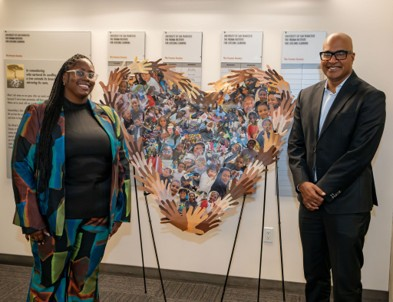
Before there is a courtroom, there is a childhood.
There are books to discover, friendships to build, talents waiting for an audience. There is the question of whether a young person will find adults who recognize possibility—not just problems.
At the San Francisco Public Defender’s Office’s MAGIC programs, that question is answered through the work of bringing people together. In Bayview–Hunters Point and the Fillmore/Western Addition, the collaborative connects neighborhood organizations, families, educators, and public agencies around a purpose larger than any single event: helping children grow up with opportunities, support, and a place to belong.
One of the clearest explanations of what that can mean came from a young woman who had lived it.
At MAGIC’s twentieth-anniversary celebration in December 2024, Brittani Mitchell, who became involved in Mo’MAGIC in middle school, spoke as a freshman attending a historically Black college in Maryland. According to the Public Defender’s Office’s account of the celebration, she described a lesson that extended well beyond academics.
“They showed me how powerful it is when people come together to support one another, and now I want to be that same source of light for someone else.”
That is a different kind of legacy: not simply receiving help but carrying it forward.
A promise that began before the courtroom
MAGIC—Mobilization for Adolescent Growth in our Communities—began in 2004, when the late Public Defender Jeff Adachi and Bayview community leaders established an initiative to address the effects of trauma, poverty, and violence on young people. Its purpose included interrupting the school-to-prison pipeline by improving access to community resources. The work expanded into the Fillmore/Western Addition in 2006. The neighborhood programs became known as B’MAGIC and Mo’MAGIC.
There is an important idea in that history. A public defender’s commitment to a community need not begin when someone is accused of a crime. It can also mean helping build the conditions in which children have more choices long before a courtroom enters the picture.
Under Public Defender Mano Raju, the two programs were consolidated in 2022, with Brittany Ford as executive director. Ford had led Mo’MAGIC since joining the office in 2019; in September 2022, she took responsibility for both programs.
Raju has articulated the connection between this neighborhood work and the office’s larger mission. “Our MAGIC programs work to strengthen communities that are historically under-resourced and over-policed,” he said in the office’s December 2024 anniversary announcement. “Ensuring that youth and families have access to opportunities and feel empowered is how we can create lasting community safety and break the intergenerational cycles of system involvement.”
In that commitment, Adachi’s founding vision remains a living responsibility—not merely a name recalled at an anniversary, but work that must be renewed for another generation.
Brittany Ford and the work of showing up
For Ford, the most important work can be the least visible: bringing organizations and people into relationship with one another. In a statement provided for this article, she described the distinction that defines MAGIC.
“Many people see MAGIC programs as a program itself, but our bread and butter is actually through forging partnerships with and between City Departments, Community Based Organizations, private entities and neighborhood residents.” Ford said.
“These partnerships, especially now more than ever with budget reductions across the board, ensure that youth and communities stay safe by making sure there are strong programs, resources, jobs, as well as family support for those who need it.”
Her description makes the stakes clear. MAGIC is not simply a calendar of activities; it is the work of keeping a network connected, so that an organization’s resources can become a family’s opportunity. Its practical tools include monthly convenings, resource guides, weekly community calendars, and shared events.
At the June 2025 Summer Kickoff, Ford put the purpose plainly: “It’s all about creating safe spaces for kids to build friendships, keep learning throughout the summer, and most importantly, have fun.” Her words appeared in the Public Defender’s Office’s announcement of the gathering, which brought hundreds of campers to City Hall and Civic Center Plaza.
That final word matters. Children deserve joy without having to justify it as a crime-prevention strategy.
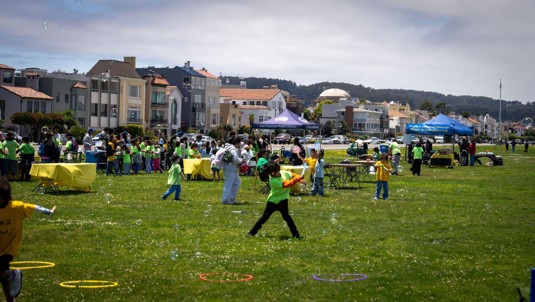
The 2025 annual report describes a summer of basketball, tennis, soccer, hands-on learning, outdoor play, and a youth showcase at the Marines’ Memorial Theatre. It reports twelve summer events. Behind the calendar is a deliberate effort to bring learning and recreation into the same community experience—to make room for children to explore who they are, not just what they need.
A University of San Francisco account offers a close look at one longstanding literacy partnership. Writing in 2021, professor Helen Maniates described teachers working with community youth-development staff to make reading accessible, culturally relevant, and connected to art, science, and social justice. “A typical day always begins with Community Circle to welcome and recognize every child,” she explained. It is a small practice with a substantial message: you belong here before you are asked to perform.
Ford also points to traditions that bring whole families together. At the annual Black and White Ball in February, young people showcase their performing arts talents before families, program leaders, and neighbors, with dinner and dancing completing the Black History Month celebration. The annual Easter Eggstravaganza offers another invitation to gather, this time around a community egg hunt. These occasions make belonging something families can share.
A backpack—and a community behind it
A backpack is an ordinary object. Making sure a child has one, filled with supplies and ready for school, is an act of attention.
MAGIC reports helping supply more than 2,100 backpacks to young people in Districts 5 and 10 for the 2026–27 school year. Mo’MAGIC’s own Instagram account reported more than 300 distributed at its August 1 celebration at Gateway High School, thanking community partners, sponsors, volunteers, and the families who attended. These are program-reported figures, but they describe a concrete undertaking: getting useful resources into children’s hands.
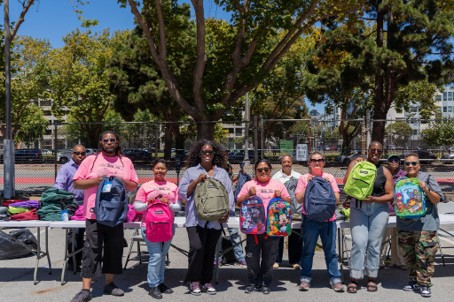
The partnerships can expand what a back-to-school celebration offers. The San Francisco Bicycle Coalition describes working with B’MAGIC since 2018, distributing hundreds of donated and refurbished bicycles over that relationship and providing learn-to-ride instruction. Its account shows how a gathering around school supplies can also become a place to learn a skill and discover a new way to move through the neighborhood.
The work continues beyond summer. MAGIC’s 2025 report records a holiday food-box partnership that provided 700 chickens and bags of fresh produce for families in the Fillmore/Western Addition and Hayes Valley. It also describes a holiday collaboration distributing more than 500 toys. Different seasons bring different needs; the underlying commitment is continuity.
When young people become the helpers
Perhaps the most revealing detail in the annual report is not something adults distributed. It is something teenagers decided to do.
MAGIC reports hosting more than forty-five teen interns through Opportunities for All in 2025. The young people helped lead activity tables, support field trips, and manage games and food distribution. During the school year, interns identified food insecurity in their neighborhood and organized a response. Working through partnerships with Booker T. Washington Community Service Center and SF-Marin Food Bank, they helped provide groceries and fresh produce to more than one hundred families.
That is not a story about young people waiting to be rescued. It is a story about young people recognizing a need and being supported to act.
The next summer, MAGIC’s published 2026 update described four college interns and fellows supporting activities involving sixty teen participants. Their work included professional-development activities, mental-health awareness, and educational workshops, alongside activities for younger children.
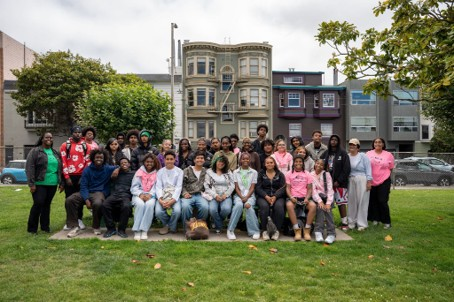
The numbers document participation, not proof that any particular arrest was prevented or educational outcome changed. But they help make the work visible. Alongside Mitchell’s testimony, they also reveal the possibility at its heart: a young person can receive encouragement, develop confidence, and become someone another child looks to for support.
Keeping the fire burning
The word Ford returns to is not magic. It is mobilization.
“This is the essence of MAGIC programs which many may not know stands for, Mobilization for Adolescent Growth in our Communities. For us, the MOBILIZATION is not only the very first word, it is the MOST IMPORTANT aspect of our work.” she said.
“The various city governments, community, and private partners we work with share that understanding, which is why we have been able to make and see the impact on youth and young adults in San Francisco although more can and should be done.”
That giving back is where this story turns toward the rest of us.
Adachi helped begin the work with community leaders. Raju has carried its mission forward within the Public Defender’s Office. Ford, her team, and their partners give that commitment practical form. Its future also depends on people willing to contribute resources, share skills, and support the organizations that show up for families.
Not everyone can lead a collaborative. Someone can help equip it. Someone can offer a workshop, introduce a potential partner, or ask what supplies are needed next.
The question is not whether one program can solve every challenge facing San Francisco’s children. It cannot. The question is whether we will help sustain the relationships and opportunities that give those children more room to grow.
MAGIC began with a commitment to young people’s futures. Keeping that promise is community work.
And there is room for more of us to take part.
How to support MAGIC
Start with MAGIC’s official donation and support page or contact info@magic-sf.org. The program invites inquiries about donations and lists school supplies, books, hygiene products, laptops, workshops, and enrichment opportunities among the resources that support its work.
- Give: Ask the team how to make a financial contribution or arrange a useful in-kind donation.
- Share a skill: Ask about offering a workshop, a career introduction, or another partnership matched to current needs.
- Show up: Ask about upcoming events and volunteer opportunities before making plans.
Contact the team first to confirm current priorities and arrangements. A thoughtful offer begins with listening.
Our song/video for this article is: Nas – I Can (Official HD Video)