A disabled father’s federal appeal and nearly eight years of headlines show a gap in New York’s accountability system: the state can find that an officer engaged in a pattern of misconduct, and no law requires anyone to look at the arrests he made.
WESTCHESTER COUNTY, N.Y. — Marc Fishman says he showed the officer his card.
It was a brain-injury identification card, the kind people carry so that a stranger, a medic or a police officer will know right away that the person in front of them may not hear, process or remember the way others do. Fishman lives with a traumatic brain injury, tinnitus-related hearing loss and post-concussion memory problems. On December 15, 2018, after a court-ordered supervised visit with his son broke down, he and his disability aide went to the New Rochelle Police Department to make a complaint. According to his lawsuit, he asked that the aide be allowed to help him communicate. He says Officer Lane Schlesinger would not consider the card and would not let the aide help.
The encounter ended with Fishman under arrest. Schlesinger concluded that Fishman had violated a family-court order. Fishman disputes that and says the interview could have gone differently if his aide had been allowed to take part.
Since then, his case has been covered by weekly papers, talk radio, Substack newsletters, petitions and op-ed pages, including this reporter’s own earlier work. Most of that coverage has argued that he was wronged. Very little of it has included a response from the officials it accused. And the numbers it reported, such as how many complaints the officer had and how he left the force, often didn’t match from one story to the next.
This story tries to separate what the records show from what has been claimed, because the most important point in the Fishman case doesn’t depend on whether he is right about his own arrest.
Two systems, one officer
The first accountability process is in federal court. On September 24, the U.S. Court of Appeals for the Second Circuit heard oral argument in Fishman v. City of New Rochelle (No. 25-423), his appeal of a January 22, 2025 district court judgment that dismissed his claims under the Americans with Disabilities Act and the Rehabilitation Act. (Justia Dockets)
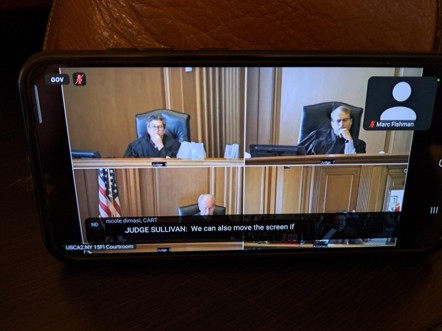
The city disputes his account. It has argued that Fishman communicated clearly with officers and did not appear to need help. U.S. District Judge Nelson S. Román granted summary judgment to the city. (Court, Explained)
According to Fishman’s representatives, the ruling did not settle the facts. They say the judge found that a jury could conclude Fishman has a qualifying disability and recognized a genuine dispute over whether he asked for an accommodation, but held that he had not shown the kind of injury federal law requires. The appeals panel did not rule from the bench, and the case is still pending.
The second process ran through the office of New York Attorney General Letitia James, and it ended with a finding about the officer. In a report dated May 24, 2024, the Attorney General’s Law Enforcement Misconduct Investigative Office (LEMIO) concluded that Schlesinger “engaged in a pattern of misconduct involving abuse of authority.” The report cited a 2021 traffic stop of a Black woman driving a van, which LEMIO found lacked reasonable suspicion; an off-duty visit to a hospital emergency room that was closed to visitors, where security reported that he showed his badge and told a guard to “lay hands on me”; improper use of his body-worn camera to record a supervisor; and conduct toward a motorist that his own department called “dismissive, condescending, disrespectful.” Talk of the Sound, which published the report, said Schlesinger had been disciplined for 25 complaints of misconduct and minor infractions since 2008, and that he retired on July 20, 2024 with a $90,653 annual pension. (Talk of the Sound)
The finding said nothing about the people Schlesinger arrested, and the law didn’t require it to.
What the review left out
Fishman says it should have. In April 2025, he wrote to the LEMIO investigator assigned to the Schlesinger referral and asked why his case was missing from the report. His letter, which Christopher provided to Destination Freedom, says the 2022 referral fell within the two-year window of Schlesinger’s testimony at his January 2020 trial. Fishman also alleges that Schlesinger brought only two pages of a three-page order of protection into the interview room, leaving out the page marked “party not served.” He says Schlesinger also left blank the question on the arrest report asking whether police recorded audio or video. Fishman says about 9.5 hours of station-house video exist. None of those allegations has been tested in court.
On April 23, 2025, LEMIO chief Tyler Nims replied. The office had concluded its investigation of the referral, he wrote, and “the incidents that you describe below were not part of the referral or our investigation.” He added: “We are not able to fully investigate and resolve every allegation of misconduct that we receive, and at this point, we are not taking further action on the allegations that you have described. To pursue those issues, you may consider consulting a private attorney.”
Records the Attorney General’s office released to Fishman under the Freedom of Information Law show how the department itself saw the officer. In October 2023, as LEMIO prepared to subpoena Schlesinger, the head of New Rochelle’s Internal Affairs Unit, Detective Lt. Robert Wenzler, told the investigator that “in addition to the concerns regarding his performance while here, he is also unreliable in merely showing up to work.” The subpoena was served the next day.
So the state examined the officer and declined to examine the case. The person left to pursue the gap was the disabled man who says he was harmed by it, and the state told him to hire a lawyer.
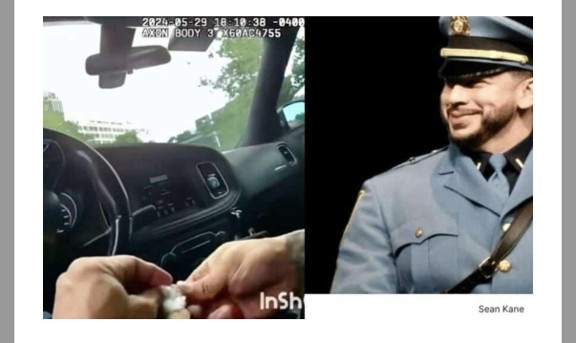
Photo credits (left): https://talkofthesound.com/2026/05/21/new-rochelle-police-records-kane-admitted-he-did-not-see-harper-discard-drugs-then-filed-for-disability-retirement/
And (right):
https://talkofthesound.com/2026/04/08/sean-kane-demoted-new-rochelle-police-officer-resigns-and-joins-putnam-county-sheriffs-office/
Kane has his own record. In a federal lawsuit filed July 13, 2026, Ivin Harper, a Black New Rochelle resident, alleges that Kane hid cocaine and crack under a parked car on May 29, 2024 to frame him. The suit says Kane’s body camera captured him holding the bag before he “discovered” it. The felony drug charges against Harper were dropped that August. Kane was disciplined and demoted in March 2026, resigned, and joined the Putnam County Sheriff’s Office as a deputy. He has not been criminally charged. The sheriff’s office said it knew of the allegations before hiring him and has “full confidence” in him. (WAMC)
New Rochelle’s own disciplinary records, obtained by Talk of the Sound, state that Kane admitted he did not see Harper discard any drugs, and that an informant either supplied the drugs or pointed out where they were. The records also show that Kane filed for accidental disability retirement while he was under investigation. (Talk of the Sound)
Harper’s allegations are about a different arrest, six years after Fishman’s. They prove nothing about what happened to Fishman. But Christopher says Fishman has asked LEMIO to formally review the conduct of both officers. That request raises the same question as the rest of this story: once an officer’s credibility is officially in doubt, who goes back through the files?
Eight years of headlines
Fishman has spent most of the time since his arrest fighting in court and in public.
He was tried in Westchester from January 24 to 27, 2020, and Fishman was convicted of criminal contempt in second degree (actually violating an order of protection on 1/27/20) and in the same verdict convicted of attempting to violate the same order. The verdict is defective under CPL310.50, Fishman says, because he cannot be charged guilty of two charges for one false crime.
He says it was an order he had never been served, and one that did not say how far he had to stay away during supervised visits. He says the court’s failure to provide ADA communication accommodations kept him from testifying, and that prosecutors withheld evidence that clears him. A month after the trial, on February 26, 2020, the Appellate Division ruled on the underlying order. Fishman says its exception for “certain supervised parental access” supports his reading of the order, not the prosecution’s. The jury never saw that decision, because it came after the verdict.
On July 16, 2021, in a separate lawsuit against New York’s court system (Fishman v. Office of Court Administration, No. 20-1300), he won what his supporters describe as a Second Circuit order recognizing his right to real-time transcription as a disability accommodation in court. (Yonkers Times)
Next, he took on the order-of-protection law itself. After New York’s Court of Appeals ruled against him in May 2023, he petitioned the U.S. Supreme Court (Fishman v. New York, No. 23-6338). He argued that the state’s order-of-protection statute violates due process because it allows orders to remain in place for long periods without adequate review. Disability Rights New York filed a friend-of-the-court brief in January 2024 supporting him. The Court denied the petition on April 15, 2024. (U.S. Supreme Court docket)
In September 2025 he was sentenced to 45 days in jail. Yonkers Times reported that he says the jury and his defense lawyers never saw police video, obtained only through his civil suit, in which Schlesinger can be heard telling the disability aide that Fishman had no intent to commit a crime. That same month, a state appellate court ordered him to explain why his appeal of a July 2025 county court order should not be dismissed as not appealable. (NY Appellate Division order)
After that, the story spread. Yonkers Times connected his case to the October 2025 federal indictment of Attorney General James and noted that Roger Stone had featured him on WABC radio. (Yonkers Times)
Black Westchester covered a December 2025 radio interview with Fishman and his spokesperson, James Christopher. (Black Westchester)
The Davis Vanguard ran a January 2026 piece headlined “When the State Knows You’re Innocent — And Prosecutes Anyway.”
In February, this reporter examined Fishman’s denied requests for real-time transcription in family court. When the Courtroom Becomes the Barrier
By April, the newsletter Father & Co. reported that he had not spoken to his four children since 2018. (Father & Co.)
Taken together, the coverage tells a moving story, but the numbers in it don’t agree. Talk of the Sound, working from the Attorney General’s report, counted 25 disciplined complaints. One Yonkers Times story said 35 incidents. Another said more than 40 complaints, “including falsified reports.” Some outlets say Schlesinger was fired. The account based on the report says he retired. In most of these stories, prosecutors, police and the city did not respond or were not asked to.
A movement can carry exaggerations. The underlying problem doesn’t need them.
The documented record is enough. A state oversight office found that an officer engaged in a pattern of abuse of authority. One person he arrested says the arrest was flawed and that evidence was kept from him. And no institution is required to check.
The gap
Under Section 75 of New York’s Executive Law, a police department must refer an officer to LEMIO after five complaints from five people about five separate incidents within two years. LEMIO then decides whether the officer shows a pattern of misconduct, excessive force or dishonesty. (Amsterdam News)
What the law does not include is a next step. When the state finds that an officer has a pattern of misconduct, no statewide rule tells district attorneys to find the cases where that officer’s arrest, report or testimony mattered, review them, and say what they found. LEMIO’s recommendations are advisory. (amNY)
That means it falls to defendants to raise the questions themselves, and many of the people most likely to be affected don’t have a lawyer, money or a federal lawsuit to do it. Fishman has all three, and he has still been fighting for nearly eight years.
The legal lines need to be stated clearly. The Attorney General’s finding did not overturn Fishman’s arrest or conviction. His federal appeal is about whether he was denied a disability accommodation, not whether he is guilty. His claims about withheld video have not been decided by any court. A full review might find that every arrest Schlesinger made was sound.
The problem is that under current law, nobody is required to check.
“Refusing to assume”
Fishman and his supporters are backing a proposal they call the Pattern Misconduct Case Review Act, also promoted as “Protect New Yorkers.” In its current form, after a formal pattern finding, prosecutors would have to identify cases in which the officer played a material role, review each one individually and issue a written determination. As Christopher’s team describes it, the first focus is misdemeanor cases like Fishman’s. It would not require automatic dismissals. Supporters put it this way: documented police misconduct should trigger documented prosecutorial review. (Amsterdam News)
The proposal has changed over time. An earlier version on the campaign’s website called for review of every related conviction within 60 days and a bail hearing within 30 days for anyone on trial. (Protect New Yorkers)
Destination Freedom could not identify a bill number or a legislative sponsor for either version.
“The disability case and the misconduct issue are different legal questions, but they meet at the same fundamental point: accountability cannot stop when scrutiny reaches the justice system itself,” said Christopher, founder of James Christopher Communications, LLC, who is Fishman’s spokesperson and advises the Protect New Yorkers initiative. “If the state has substantiated a pattern of misconduct by an officer, prosecutors should be able to tell the public whether that officer’s cases were reviewed, what they found and what they did about it.”
“This isn’t about assuming every case involving an officer was wrongful,” Christopher said. “It’s about refusing to assume every case was sound without looking. Individual review protects defendants, victims and the integrity of legitimate convictions at the same time.”
There is precedent for that kind of review. In 2022, Brooklyn District Attorney Eric Gonzalez’s office reviewed cases involving 13 former NYPD officers who were later convicted of crimes committed on duty. It moved to dismiss 378 convictions that relied directly on their work. (Amsterdam News)
Brooklyn did not assume that every officer lied or that every defendant was innocent. It looked at the cases.
The prosecutor’s own standard
Westchester District Attorney Susan Cacace recently stated a principle that advocates say should apply here. On September 18, after Mount Vernon youth basketball coach Dwayne Murray pleaded guilty to first-degree course of sexual conduct against a child, Cacace said her office would “hold accountable anyone who abuses a position of authority, regardless of their prominence or standing in the community.” Murray faces up to 18 years in state prison, followed by 20 years of post-release supervision, and must register as a sex offender. He is scheduled to be sentenced November 17. (News 12 Westchester)
The two cases are not alike. Murray admitted to abusing a child. Schlesinger has not been charged with a crime in connection with these findings, which concern policy violations and abuse of authority. Fishman’s supporters are not comparing the conduct. They are pointing to the principle: if a position of authority shouldn’t protect a coach from scrutiny, it shouldn’t protect a police officer’s case files either. In their view, the same expectation should apply to government institutions and law-enforcement personnel when official findings raise questions about their conduct.
What a card is for
Fishman’s federal appeal may turn on a narrow legal question about injury and causation. The Second Circuit can decide whether the ADA required New Rochelle police to do more that December morning.
It cannot decide the larger question his case raises: when New York identifies a pattern of misconduct in law enforcement, who is responsible for determining whether that misconduct affected the cases the officer helped build? That question belongs to Albany and to the prosecutors who rely on police work every day.
A brain-injury card is meant to tell an officer to slow down and make sure the person understands. A pattern-misconduct finding is meant to send a similar signal to the justice system. In New York, nobody is required to act on it.
Disclosure: Background materials for this article were provided by James Christopher Communications, LLC, which represents Marc Fishman and advises the Protect New Yorkers initiative. This reporter has covered Fishman’s case before. Factual claims were checked against court records, the Attorney General’s findings as reported and published news coverage. Statements from Fishman and his representatives are attributed to them.
Sidebar: The Fishman Case at a Glance
| Date | Event |
| Jul. 31, 2006 | Lane Schlesinger joins NRPD as a full-time officer (Talk of the Sound) |
| Dec. 15, 2018 | Fishman arrested by Schlesinger after a disputed supervised visit; aide not allowed to assist, per lawsuit |
| Jan. 8, 2019 | Fishman files federal ADA suit, Fishman v. City of New Rochelle (19-cv-265) |
| Jan. 24–27, 2020 | Westchester criminal trial; Fishman convicted of attempting to violate an order of protection (per Fishman) |
| Feb. 26, 2020 | Appellate Division decision on the underlying order includes exception for supervised parental access (per Fishman) |
| Jul. 16, 2021 | Second Circuit ruling in Fishman v. OCA (20-1300) on court accommodations, as described by supporters |
| Jan. 26, 2022 | NRPD refers Schlesinger to Attorney General under Exec. Law §75(5)(b) |
| Feb. 1, 2023 | District court dismisses §1983 claims; ADA/Rehab Act claims proceed |
| May 10, 2023 | NY Court of Appeals decision in Fishman’s order-of-protection challenge (per Supreme Court docket) |
| Oct. 16–17, 2023 | LEMIO subpoenas Schlesinger; NRPD Internal Affairs calls him “unreliable in merely showing up to work” (FOIL records) |
| Dec. 2023 | Fishman petitions the U.S. Supreme Court, Fishman v. New York (No. 23-6338); docketed Dec. 22 |
| Jan. 22, 2024 | Disability Rights New York files amicus brief supporting the petition |
| Apr. 15, 2024 | U.S. Supreme Court denies the petition |
| May 24, 2024 | LEMIO finds Schlesinger engaged in a pattern of abuse of authority |
| May 29, 2024 | Lt. Sean Kane arrests Ivin Harper; Harper later alleges drugs were planted (WAMC) |
| Jul. 20, 2024 | Schlesinger retires, per Talk of the Sound (other outlets say terminated) |
| Jan. 22, 2025 | District court grants summary judgment to the city |
| Feb. 21, 2025 | Fishman appeals to the Second Circuit (No. 25-423) |
| Apr. 23, 2025 | LEMIO chief Tyler Nims tells Fishman his incidents “were not part of the referral” and declines further action |
| Sept. 2025 | Fishman sentenced to 45 days in jail; Appellate Division orders him to show cause on appealability |
| Mar. 2026 | Kane disciplined and demoted; resigns and joins Putnam County Sheriff’s Office (WAMC) |
| Jul. 13, 2026 | Harper files federal suit against New Rochelle and Kane (WAMC) |
| Aug. 27, 2026 | Christopher op-ed in Amsterdam News proposes Pattern Misconduct Case Review Act |
| Sept. 24, 2026 | Second Circuit oral argument; no ruling from the bench |
Sources
- Second Circuit docket 25-423 (Justia)
- Court, Explained — district court opinion summary
- NY Appellate Division, People v Fishman, 2025 NY Slip Op 77019(U)
- Talk of the Sound — Former New Rochelle Cop Engaged in Years of Misconduct
- NY AG — §75(5)(b) findings, L. Schlesinger (PDF)
- Yonkers Times — sentenced to 45 days
- Yonkers Times — AG James indictment / Roger Stone
- Yonkers Times — As Judicial Hearings Surge
- Yonkers Times — Judge Schauer
- Black Westchester — Kinsey interview recap
- When the State Knows You’re Innocent — And Prosecutes Anyway (January 2026)
- When the Courtroom Becomes the Barrier (February 2026)
- Father & Co. — They’re Adults Now
- PoliticsNY — Fishman op-ed
- amNY — Christopher op-ed
- Amsterdam News — Christopher op-ed
- Protect New Yorkers campaign site
- WAMC — Harper lawsuit against Kane (Aug. 3, 2026)
- Talk of the Sound — Kane disciplinary records (May 21, 2026)
- U.S. Supreme Court — Fishman v. New York, No. 23-6338 docket
- U.S. Supreme Court — Fishman petition for certiorari (PDF)
- U.S. Supreme Court — Disability Rights New York amicus brief (PDF)
- Primary documents via Christopher (not public): Nims–Fishman emails Apr. 2025; FOIL G000007 Wenzler–Manigo emails Oct. 2023
- News 12 Westchester — Murray plea
Our song/video for this article is:
Tom Petty And The Heartbreakers – I Won’t Back Down