
They built San Francisco’s Black housing legacy with Sunday-school money and sweat equity. Now its elders are facing eviction over debts no one can document — and when City Hall finally summoned the landlords, the chairs stayed empty. So the subpoenas went out.
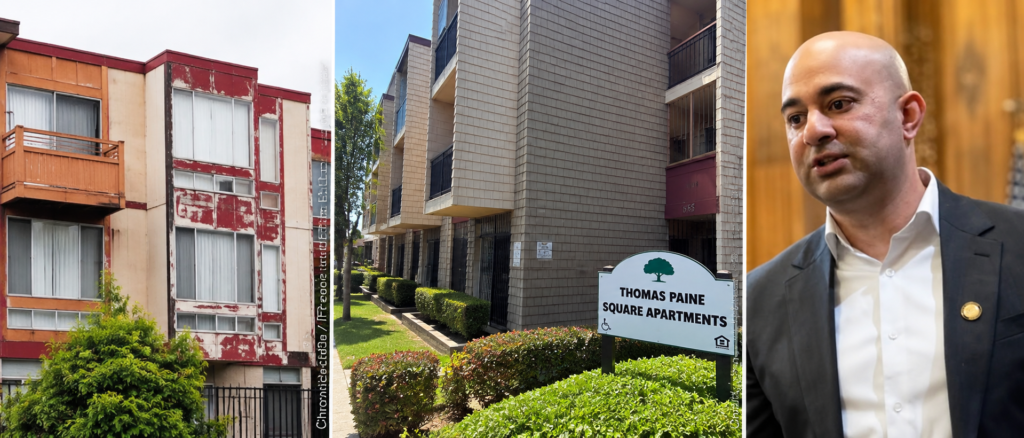
Photo credits: King-Garvey — SFGate; Thomas Paine Square — Mission Local; Supervisor Bilal Mahmood — The San Francisco Standard.
SAN FRANCISCO — Samuel Broadnax did not come before the San Francisco Board of Supervisors on the first day of October to debate housing policy in the abstract.
He came in a wheelchair.
Broadnax is 80 years old, and he has lived at the Martin Luther King–Marcus Garvey Square Cooperative for nearly four decades. He moved in when the Fillmore still carried the memory of the bulldozers, and when the cooperative still carried a promise: that Black San Franciscans who had been pushed out of this neighborhood once would never be pushed out again.
Now, he told the Government Audit and Oversight Committee, navigating his own home has become dangerous. A lift failed. He recently fell on stairs. He cannot properly use his kitchen or his patio. He was moved into a unit that was supposed to accommodate his disability — and he fears the bars on its windows would trap him in a fire.
“So you tell me we’re treated fairly? No. We are not treated fairly.”
~SAMUEL BROADNAX, 80, KING-GARVEY SHAREHOLDER, BEFORE THE BOARD OF SUPERVISORS
His testimony lasted only minutes. But it distilled what more than two and a half hours of testimony at City Hall made plain: this is no longer a dispute between tenants and a property management company. It is a fight over whether some of San Francisco’s historically Black affordable-housing institutions can still fulfill the purpose for which they were created — and whether anyone, anywhere in the overlapping machinery of government, can be compelled to answer for what is happening inside them.
The Night the Chairs Stayed Empty
The October 1 hearing was convened to investigate what the city formally described as “mass evictions,” along with concerns about habitability, affordable-housing recertification, payment processing and resident safety at three properties: King-Garvey, the Thomas Paine Square Apartments, and the Ammel Park Cooperative Homes — three of the Fillmore’s remaining bastions of Black and low-income housing, all subsidized by the U.S. Department of Housing and Urban Development, and all managed by the Domus Management Company, a firm headquartered in Lodi, in the Central Valley.
The official hearing file requested appearances from Domus representatives; from Mercedes Gavin, counsel to the King-Garvey cooperative; from the King-Garvey board of directors; from the officers of the Allen Community Development Corporation, the nonprofit affiliated with Bethel AME Church that owns Thomas Paine; from HUD’s regional office; and from the San Francisco Human Rights Commission.
Roughly 70 residents came — by wheelchair and by bus, carrying oxygen tanks, money-order receipts and folders full of notices. Their attorneys came. The Human Rights Commission came.
“If anyone from Domus is here, please come forward, because we are dying to talk to you,” said District 5 Supervisor Bilal Mahmood, who called the hearing after a year of meetings with tenants.
No one spoke up.
Domus did not come. Neither did the King-Garvey board, the Ammel Park board, or the Allen CDC, which declined through its attorney, Vernon Goins. HUD did not come. The Department of Building Inspection did not come. That empty space at the witness table may have said as much about San Francisco’s affordable-housing accountability problem as anything uttered at the microphone.
“The properties that the allegations are against didn’t come today,” Mahmood said afterward. “We had an empty chair.”
So the committee did something the Board of Supervisors rarely does. Supervisor Alan Wong told the residents in the room, “What I’ve heard from you directly is a pattern of mistreating people and mismanagement of the property — and I’m going to support the motion for a subpoena.” Committee chair Stephen Sherrill moved the subpoenas under Board Rule 3.3.1, and the committee voted 2–0 to compel testimony at a continued hearing tentatively set for December 3.
Who Was Subpoenaed — October 1, 2026 (Vote: 2–0)
- Domus Management Company: Anthony Sandoval, identified as the company’s president, and Christine Mason, its most recent property manager.
- Mercedes Gavin, counsel for the Martin Luther King–Marcus Garvey Square Cooperative.
- The King-Garvey Board of Directors: Linda Yoakum, Sean Kim, Emilia Penate and Lavonne McIntosh.
- The officers of the Allen Community Development Corporation: the Rev. Cecil L. Williams Jr., Alice Johnson, Nicole Acker and Bobby Sisk, through their legal representative Vernon Goins.
- The Ammel Park Cooperative Board of Directors: Ezra Mosgan.
The subpoenas are among the first the board has issued in years. HUD could not be compelled: “We cannot issue subpoenas to federal departments,” Mahmood said.
“They’re not engaging with the department. They’re not engaging with the supervisors,” Mahmood said. “We have to take unprecedented action with a subpoena to call them before the board, which hasn’t actually happened in many years.”
“The actions we’re about to take,” Sherrill added, “will not be the last actions.”
To understand why those subpoenas matter — why a parliamentary procedure drew applause from a chamber full of elders — you have to understand what residents say the machinery of management has already done to them. It is best understood one number at a time.
A $93,000 Surprise
Alveries Harper is 85. She left Amarillo, Texas, in 1960, part of the Great Migration that carried millions of Black Americans out of the segregated South, and she landed in San Francisco — first on Haight Street, then, in 1978, at King-Garvey, where she raised four children in her townhouse on a Muni driver’s wages.
This spring, she testified and has told reporters, her manager informed her that she owed $93,000 — roughly 51 months of carrying charges. Then came the eviction notice taped to her door. It said she owed just over $10,000.
“How are you gonna tell me today that I owe $93,000? And then you gonna send me an eviction notice for $10,000? How did you come up with that?”
~ALVERIES HARPER, 85, A KING-GARVEY RESIDENT SINCE 1978, TO THE SAN FRANCISCO STANDARD
She was not alone. On March 16, eviction notices went out to Harper and 15 other co-op residents — all of them Black, some disabled, most of them seniors. Another resident was first told he owed $100,000; the notice that followed put it at $21,000. Lula Jackson, 78, Harper’s friend of more than 40 years, told the Standard she has spent years estimating her own housing payment because no one would tell her what it was: “I know you’re supposed to pay 30% of your income, so that’s what I started paying.”
The numbers got no clearer under oath. Tuesday Thornton, a staff attorney with the Eviction Defense Collaborative who represents two King-Garvey residents in unlawful-detainer proceedings, told the committee that the nonpayment notices in her two cases sought roughly $5,000 and $6,000. In one case, she testified, the landlord’s ledger claimed approximately $47,000 — including debts that predate Domus’s management entirely.
“In one of my cases, the plaintiffs are claiming that the tenant owes like $47,000, even though the notice amount is only $6,000,” Thornton testified. And she told supervisors that Domus’s own operations manager, Christine Mason, conceded in a meeting that the company “did not have the records to back up the arrears that were in these ledgers.”
If accurate, that raises an obvious question: how does an alleged debt that cannot be substantiated become part of a ledger used against a shareholder facing eviction?
The trap has a second jaw. California law contains no “right of redemption” in these cases — even a resident who pays every dollar on the notice can still be evicted, because landlords can, as Thornton put it, “Trojan horse” older, undocumented arrears into settlement talks. Thornton testified that despite what the co-op’s counsel told Mahmood’s office, she has received no settlement offer in either of her cases; Open Door Legal, which represents seven more residents, confirmed the same. Meanwhile, the city is paying for both ends of the machine: public money funds the attorneys defending these elders, while those attorneys burn extraordinary hours trying to reconcile financial claims that should have been documented before an eviction case was ever filed.
And the company’s own account of the evictions has shifted. When the Standard first exposed the notices in May, Domus told Mahmood’s office it was “unaware of any eviction notices served.” The Standard confirmed the notices taped to residents’ doors were authentic — and that unlawful-detainer suits were filed against Harper and eight other residents on May 1.
“The juggernaut is moving forward no matter what,” Nikki Love, director of legal services at Open Door Legal, told the Standard. “Even if this is all based on some mistake in the system.” Love was blunter about what the pattern means: “This is a slap in the face of the Black community.”
“Where Are the Books?”
Again and again, testimony returned to the same question: where are the financial records?
King-Garvey is a limited-equity cooperative. Its 211 households do not merely rent; they hold shares. D.D. Hewitt, a longtime shareholder and former board member, told supervisors that shareholders historically received annual information about their equity — and that she has received none for approximately four or five years. Daniel Landry, whose family arrived in 1976 and who recently served on the board himself, raised similar alarms about transparency.
Then Hewitt raised a far larger issue. She testified that King-Garvey underwent approximately $54 million in rehabilitation financing around 2010 — and that last month, without a shareholder quorum, the cooperative was signed into roughly $59 million in new debt.
“I’m calling for a legal investigation — a forensic investigation into the books of Domus and the board of directors at Martin Luther King Marcus Garvey.”
~D.D. HEWITT, KING-GARVEY SHAREHOLDER AND FORMER BOARD MEMBER
Those figures, and the circumstances surrounding any new financing, require independent verification. But if the financing is confirmed, shareholders deserve straightforward answers. Who authorized the debt? What does it finance? What property or revenue secures it? Were shareholders entitled to vote? What was accomplished with the earlier rehabilitation money? And what disclosures did shareholders receive? These are not rhetorical questions. They are questions that contracts, audited financial statements, board minutes, loan agreements and HUD records can answer — which is precisely why the subpoenas name the people holding them.
Mahmood added a number of his own to the record: 80 complaints to the Department of Building Inspection have been filed on the King-Garvey complex since the beginning of 2024, he said — some of them still unabated.
Landry raised one more allegation that demands documentary investigation. While serving on the board, he testified, he and another board member encountered a box of applicant and waiting-list files sitting in a boardroom area — containing, he estimated, more than 500 Social Security numbers and other confidential information. “What kind of management agent,” he asked, handles confidential information that way? The allegation has not been independently substantiated, and the hearing established neither a breach nor a crime. But it should not disappear into a transcript. If those files existed as described, photographs, board records, witnesses and management policies can establish where they were stored, who had access, and whether privacy safeguards were followed.
On more than one occasion during the hearing, I heard the words fraud, waste and mismanagement. Those words now have a destination. San Francisco this year seated its first-ever inspector general, Alexandra “Alex” Shepard — a former federal prosecutor from the Mohammed Nuru corruption case, installed in the Controller’s Office with a mandate to investigate exactly those three things, and a new public tip line to report them. The allegations aired on October 1 fall squarely within the territory her office was built to patrol. After the hearing, an employee of the Human Rights Commission — who asked not to be named — raised a pointed question of their own: why, with testimony like this on the record, was no one from the City Attorney’s Office in the room? The office has confirmed only that Thomas Paine remains “on the radar.”
The Third Address
The hearing’s most overlooked testimony came from the property almost no headline has covered.
At Ammel Park Cooperative Homes, resident representative Harriet Morgan testified for roughly ten households — most of them Ethiopian and Eritrean families. She described the same accounting fog as King-Garvey, with a sharper edge: Domus, she said, claims HUD no longer subsidizes four-bedroom units — a claim the company has never produced in writing. Shareholders seeking their annual financial statements were sent from the board to Domus and from Domus back to the board; the documents were then supposed to arrive by email. They never did.
Meanwhile, Mahmood told the committee, market-rate four-bedroom rents at Ammel Park have jumped from about $2,000 to more than $6,000 in two years — and a $1.5 million loan has been taken against a property where residents describe flooding, mold and rats.
“If they don’t convert to Section 8, they’re going to be evicted… I Googled HUD. HUD has not made any changes.”
~HARRIET MORGAN, RESIDENT REPRESENTATIVE, AMMEL PARK COOPERATIVE HOMES
Read that sentence again. A shareholder in a federally subsidized housing cooperative, facing the eviction of immigrant families, was reduced to checking the federal government’s intentions on a search engine — because neither her board, her management company, nor HUD itself would put anything in writing. That is not a housing policy. That is an absence of one.
At Thomas Paine, the Record Is Already Public
Not everything heard on October 1 rests on testimony alone.
Thomas Paine Square — 98 federally subsidized units that opened in 1971, in the very footprint of urban renewal — is owned by the Allen Community Development Corporation, the nonprofit arm of Bethel AME Church, which has held the property since 2001. According to HUD documents reviewed by the Standard, the church received $3.5 million in annual federal funding through the property’s limited partnership in 2020, and is due to keep receiving federal funds through 2040. Domus took over management in 2021, after tenants organized to oust the previous company, Capri Management — which residents accused of cashing rent checks without crediting their accounts. The tenants’ optimism about Domus, tenants association co-chair Anona Lee has said, evaporated within a month. In 2022, Lee and 45 other residents signed a demand letter seeking repairs, mold and asbestos inspections, and access to their own payment records. Neither the company nor the church ever answered.
The city’s own files sketch the trajectory: DBI’s database lists 19 complaints at Thomas Paine between 2002 and 2021 — and 33 between 2022 and the present. An April 2024 notice of violation ordered correction of missing smoke and carbon-monoxide detectors, rodent infestation, water damage and mold. Residents gave the company a grim nickname: “Dumb-us.”
Then the failures turned violent. Au’janie McAllister reported an attack and robbery by a neighbor in August 2025; police confirmed it. She notified Domus and sought a restraining order, then withdrew from the process, fearing retaliation for involving law enforcement. On December 18, the same neighbor allegedly attacked McAllister’s sister, Ariane Gillmore — who stood up at a town hall with Mahmood that very night and asked: “Will it take one of us getting murdered before you take this seriously?” Less than a month later, on January 6, McAllister was beaten to the ground and struck in the head with a hammer. She left Zuckerberg San Francisco General with a concussion and a fractured eye socket. Police confirmed the incident; no arrests have been made. Tenants-rights attorney Eunice Chang is now invoking federal Violence Against Women Act protections to move McAllister and another client out. “These women are experiencing documented violence against them,” Chang said, “and it’s being ignored.”
The security force residents pay for is its own scandal. W.S.B. & Associates — the contractor for Thomas Paine and other church-affiliated housing — is owned by Bobby Sisk, who is simultaneously Bethel AME’s steward, an Allen CDC officer, and a figure residents say effectively controls the property’s contracts. Guards are on duty from 5 p.m. to 1 a.m., but residents told the Standard that patrols stopped five or six years ago and never resumed; Lee said she has never once seen a guard intervene in a fight or even take a report. “His day is coming,” Lee said of Sisk. On October 1, his subpoena was approved.
And then there was Christmas. A week before the holiday, security-camera footage — published by Mission Local — showed people identified by multiple tenants as Domus staff unlocking resident Timothy Lee’s unit with a key and carrying out boxes: roughly $2,000 in wrapped Christmas gifts, chosen over a month by his caregiver, Aveda Hussain. One figure on the tape tried to remove the camera; another blocked it with a wreath. Domus’s then-president, Cathy Metcalf, said staff believed the unit was vacant and called the items “trash” — and said the employees were fired. At the hearing, a resident named Rhonda said she lost a bike and power tools from a locked garage the same day. Isaac Santiago, a HUD organizer with the Housing Rights Committee of San Francisco, testified that Domus initially denied the break-in at all.
Retaliation is the drumbeat under every account. Jesica Salinas told Mission Local that after she spoke to reporters, Domus began posting repeated notices to enter her unit — appointments, about three times a week, that were mostly no-shows — while the mold aggravating her son’s asthma went unrepaired. Residents testified that a maintenance worker accused of sexual harassment under the previous management reappeared at Thomas Paine and, after complaints, was simply transferred to another Domus property a few blocks away. Hewitt said her eviction notices began arriving after she filed habitability complaints — and that inspectors have found four kinds of asbestos in her unit. Debora Howard, a 16-year Thomas Paine resident, testified that management returned her money orders for months, then pursued her for eviction — a dispute that stretched more than a year before records vindicated her. Evelyn Fields, a disabled resident who uses oxygen, described 48 hours’ notice to relocate to a hotel and an unexplained $7,000 PG&E bill.
When Mahmood asked Howard whether conditions improved after residents’ meetings with church leadership, her answer was immediate: “Nothing has gotten better. I mean, if anything, it has gotten worse.”
The Story, by the Numbers
16
$93,000 vs. ~$10,000
$6,000 vs. $47,000
80
19 → 33
84%
1,488
13.4% → 5.4%
4,719
1
Everybody Owns a Piece. Nobody Owns the Problem
The hearing’s most structural revelation was not any single allegation. It was the map of abdication.
HUD subsidizes all three properties — and HUD did not appear, and cannot be made to. “We cannot issue subpoenas to federal departments,” Mahmood said. The Mayor’s Office of Housing and Community Development holds loans on the properties but disclaims oversight: as its communications manager Anne Stanley put it when the hearing was announced, a board hearing “can gather testimony, request information, surface concerns, and help identify gaps in oversight — but it does not give the city authority over the property.” The Human Rights Commission testified that it cannot formally adjudicate the residents’ discrimination complaints because Domus is not a city contractor — it can only mediate, and its letter of concern to Domus drew back only general statements about property changes. “We can only mediate, and they have to be willing to come to the table,” one official said. The commission’s executive director added a statistic that should shame the room: civil-rights complaints to the agency are up 84% in three years, and the complaints arriving from King-Garvey come primarily from senior Black women.
Property owners and nonprofit boards exercise one layer of control; management companies run day-to-day operations; civil-rights agencies mediate what they cannot adjudicate; tenant attorneys can defend an eviction, but only after the machinery of displacement is already moving. When everybody has jurisdiction over a piece of the problem, residents are left to wonder whether anybody is responsible for the whole thing.
Landry put the demand plainly: government cannot keep telling residents their crisis lies somewhere outside its jurisdiction. Mahmood pointed to one concrete legislative target that emerged from the testimony — California’s Civil Code, which today allows a landlord to evict even a tenant who pays every dollar demanded, so long as undocumented arrears linger in the ledger. Fixing that would cost the state nothing, and might save the city a small fortune in eviction defense.
The Supervisor Without a Seat
One more empty chair at the hearing went mostly unremarked: Mahmood’s own.
The supervisor who forced this reckoning does not actually sit on the committee that held it. In August, as the Standard reported, Board President Rafael Mandelman stripped Mahmood of his seats on the Government Audit and Oversight and Land Use and Transportation committees amid a dispute over a historic-preservation bill — a removal that drew an extraordinary protest letter from groups that agree on little else, from GrowSF to SEIU Local 1021. Mahmood requested this hearing anyway, sat with it anyway, and won the subpoenas anyway — moved formally by the committee’s chair. Residents noticed who fought for them. “This is the most we’ve ever gotten out of a District 5 supervisor,” Thomas Paine resident Jesica Salinas said when the hearing was announced. Patrick Cochran, an organizer who has worked with the tenants since 2021, was plainer: “I’m extremely grateful that the supervisor stepped up to the plate. He’s fought for us.”
Mahmood, for his part, resisted letting one company carry the whole indictment. “Domus is hardly the only bad actor,” he said, “nor are they alone to blame for the difficulties residents at their properties have been facing.” That is the correct frame. The subpoena list — a management company, a church-affiliated nonprofit, two cooperative boards and an attorney — is a map of a system, not a single villain.
They Built It
There is a danger in describing what is happening in the Fillmore merely as an affordable-housing crisis. It erases the history — and the history is the point.
The Fillmore was once the Harlem of the West: jazz on the sidewalks, Black-owned businesses block after block, some 22,000 Black residents — nearly 60 percent of the neighborhood — in the 1970s. Before that came the demolition. The San Francisco Redevelopment Agency, created in 1948, declared the Western Addition “blighted” and set about clearing it. James Baldwin came to town in 1963 with a KQED film crew and gave the policy its true name: urban renewal, he said, “means Negro removal.” By the time the bulldozers idled, roughly 20,000 people — most of them Black — had been displaced, along with hundreds of businesses and the institutions that held a community together.
The city issued promissory paper to the displaced: 4,719 Certificates of Preference to families and 883 to business owners, entitling bearers to priority in new city-sponsored housing. San Francisco has since conceded what the displaced already knew — the certificates were rarely honored, a debt carried across generations that the city is still, six decades later, trying to learn how to pay.
The institutions now at the center of this crisis were built in the shadow of that betrayal — as the correction to it. King-Garvey became a cooperative in 1978, after HUD took over the financially distressed property, with an explicit design: turn low-income Black tenants into shareholders, with federal subsidies covering roughly 70 percent of monthly carrying charges and equity that could be passed to children. Permanence, in the one neighborhood where permanence had been systematically destroyed.
Brenda Backland’s brief testimony on October 1 carried that whole history in a single detail. She remembered attending Bethel AME Church as a child — and contributing her Sunday-school money to the credit union behind the effort to create affordable housing. Maxine Jones told supervisors her mother moved into King Square in 1967. Landry remembered his family arriving in the 1970s and residents organizing to establish their cooperative.
These are not people who arrived decades later demanding control of someone else’s institution. Their families built the institutions — with dimes from Sunday school, with decades of carrying charges, with labor and faith. And now some of them are asking City Hall to explain how those institutions are governed, where their money has gone, and why the people the institutions were created to protect are the ones facing displacement.
The demographic arithmetic gives the question its urgency. Black San Franciscans made up 13.4 percent of the city in 1970; by 2020, they were 5.4 percent. At King-Garvey, built to anchor Black ownership, only a few dozen Black residents remain among 211 households — and two years before this spring’s notices, another group of six Black residents was served eviction papers after decades in the co-op. All six were eventually evicted. What is happening in the Fillmore is not new. What is new is that there is so little left to take.
Martina Roland, a resident and former King-Garvey board member, added one more line of testimony that deserves follow-up: she said it was HUD itself, along with the Rev. Amos Brown and Bobby Sisk, who recommended Domus. If the institutions that were supposed to protect these communities helped choose the company now accused of failing them, the accountability question runs deeper than any single contract.
An 80-Year-Old Man Should Not Be the Oversight System
Strip the acronyms away and this is what remains: an 80-year-old man should not have to master HUD handbooks, cooperative corporate law, building codes, reasonable-accommodation requirements and the jurisdiction of six agencies simply to enter his home without falling. Nor should a 96-year-old have to become a housing-law expert to obtain an accommodation. Hewitt testified that Miriam White, an elderly longtime King-Garvey resident, has been unable to secure a requested move despite repeated medical documentation — an allegation that, like the financing figures, awaits verification. But Broadnax did not await verification. He was there, in his wheelchair, telling City Hall what his life has become.
Disclosure: I Testified
This newsroom has covered King-Garvey since April, when we reported on the first wave of eviction threats against the co-op’s Black elders. On October 1, I did what I ask institutions to do: I put my evidence on the record, under the same public scrutiny as every other witness. I told the committee about Alveries Harper: “This spring, her manager told her that she owed $93,000. The eviction notice taped to her door said $10,000. That is not a bookkeeping error. That is a machine.” And I urged the supervisors to use the power in front of them: “Do not accept an empty chair. Vote the subpoenas. Compel the ledgers, the recertification logs, the board records, the legal fees charged to the cooperative.”
I report on this community, and I am not neutral about whether it survives. The facts in this article stand on testimony, court filings, inspection records and published investigations — and every institution named here has been, and remains, invited to answer them.
The Questions That Must Be Answered
One sentiment echoed through the hearing room: the Black community is under attack — and where is city government? That is a community judgment, not a finding. But the facts beneath it deserve investigation, and December 3 is now the deadline for answers:
Why are residents facing eviction over amounts their own management company cannot document? Where are the equity statements shareholders say they have not seen in years? Who signed the debt — and with whose authority? What oversight exists over cooperative boards and their management companies, and who enforces it? What recourse exists when residents allege retaliation for speaking? Why are elderly and disabled residents still waiting on accommodations the law already guarantees? Why do habitability complaints survive years of meetings, inspections and headlines? And when the city summons the people with the power to answer — what happens when they simply do not come?
Those questions extend beyond Domus: to cooperative boards, property owners, contractors, attorneys, HUD, city departments — and ultimately to San Francisco itself. The city’s challenge now is not merely whether another hearing should be scheduled. It is whether an accountability structure exists that can protect these communities before another elder falls, before another disputed ledger becomes another eviction, before another family leaves the city — before another historically Black housing institution becomes Black only in its history.
Samuel Broadnax should not have had to come to City Hall in a wheelchair to explain that.
But he did. San Francisco heard him. And on December 3, the empty chairs will either be filled — or the city will learn, on the record, exactly what its subpoena is worth.
This hearing cannot be the end of the inquiry. It must be the beginning of the accounting.
Continued Hearing: December 3, 2026 — Time TBD
Government Audit and Oversight Committee · Subpoenaed testimony · San Francisco City Hall
Editor’s Note
Co-publication note: This investigation is produced by Destination Freedom Media Group and co-published in partnership with The Davis Vanguard (davisvanguard.org). Destination Freedom Media Group is continuing to review the financial, court, inspection and cooperative-governance records underlying the allegations raised at the October 1 hearing. Domus Management Company, the cooperative boards, the property owners, HUD and every individual named in this article have been and remain invited to respond to the specific allegations herein before additional investigative findings are published.
Our song for this article: The O’Jays — “Give the People What They Want