
The data they refuse to release: Coleman Advocates’ “Stop Suspending Our Success” campaign confronts SFUSD’s discriminatory suspension regime — and five years of records the district never kept.
Special Investigative Series — The Unquiet Resignation — Part Four of Five
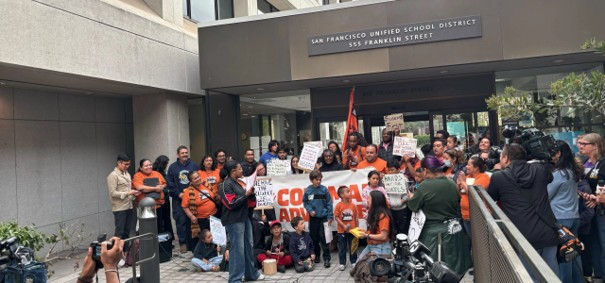
SAN FRANCISCO — Part Two of this investigation documented the doctrine. Seventy years after Brown v. Board of Education declared segregated public schooling unconstitutional, SFUSD’s own 2020 retrospective, Facing Our Past, Changing Our Future , conceded that San Francisco’s schools are “more segregated now under the current policy than they were thirty years ago.” In 1971, a federal judge found the district had “intentionally drawn segregated student assignment zones” and assigned Black teachers only to majority-Black schools. In 2005, federal court oversight expired. By the 2013–14 school year, the San Francisco Public Press counted twenty-seven of the district’s schools as entirely segregated. In spite of more than fifty years of studies, lawsuits, and court-ordered attempts to integrate its students, the district continues to operate the same system that harms Black and Brown students and educators — a system that, in 2026, swallowed Dr. Vidrale Franklin whole.
Now comes the number that proves the doctrine is not history.
It is not hidden behind a personnel confidentiality clause, the way Dr. Franklin’s forced resignation was managed. It is not buried in a settlement. It is simply not produced: a discipline report the district’s own Safe and Supportive Schools Policy requires it to publish annually — and has not issued since 2021. Five school years. Five missing reports. An entire city asked to take the district’s word for what happens to the children it removes from its classrooms.
This is Part Four: the data the district refuses to release, the records it never kept, and the community campaign that intends to produce both anyway.
The Doctrine
This series began at a fifth-grade graduation ceremony at a Bayview elementary school, where its principal, Dr. Vidrale Franklin, refused to leave quietly. Part One told her story: a twenty-nine-year veteran educator who took the helm of Dr. Charles R. Drew College Preparatory Academy in 2018, stabilized a school the district had written off, built a garden without fences as a gift to her community, and was forced out over parent-raised fundraising money.
The ledger of that removal: eight months of investigation, the seizure of more than $7,000 in parent-raised cash, the unaccounted-for confiscation of $2,394.54 in electronic Square payments, the release from her administrative post on May 13, 2026, a forced resignation on May 22, 2026, and, finally, a retaliatory demotion to an English language development teaching position — with her summer assignment cancelled less than twenty-four hours after a community protest at a school board meeting.
Part Two moved from the individual to the structural, and it left the district without excuses. Consider what is now on the public record:
In 1971, a federal court found that SFUSD had “intentionally drawn segregated student assignment zones” and assigned Black teachers only to majority-Black schools — findings that produced a desegregation consent decree whose court oversight lapsed in 2005. In its official 2020 retrospective, the district itself admitted its schools are more segregated now than thirty years ago; as recently as 2019, nearly sixty percent of its elementary schools enrolled more than forty-five percent of a single racial or ethnic group, and a quarter enrolled more than sixty percent of one group. By 2013–14, twenty-seven SFUSD schools were entirely segregated.
The financial machinery matched the maps. As documented in Part Two, Parent Teacher Association fundraising produces an opportunity gap that functions as a tuition system without the tuition: approximately $1,000 per student per year raised at Grattan Elementary in Haight-Ashbury, against roughly $25 per student at Junipero Serra Elementary in the southern reaches of the district — a forty-to-one gap, documented by EdSource and analyzed by the Berkeley Political Review.
And the quiet mechanism beneath those numbers — the removal that never makes the record — has now been measured. In 2025, Stanford University researchers Livia Steyer, Maude Provençal, Francis Pearman, and Jelena Obradović, publishing in the peer-reviewed journal AERA Open from a research partnership built on San Francisco public school records, put a name to it: de facto suspensions — informal exclusionary discipline in public preschool and early elementary settings, the child quietly sent home, or parked in the office, or “picked up early,” with no suspension ever entered in the ledger. Their study used SFUSD as its site.
What this series has documented is recorded in the district’s own discipline data, in the state’s significant-disproportionality sanction, and in the 1971 court finding of intentional segregation: one historical pattern. The Stanford study shows how early that pattern shapes a student’s academic career — often in the years before disciplinary measures start to be formally recorded.
The double standard was laid bare at Lowell High School. The New Yorker’s 2022 investigation documented an elite public school that enrolled less than two percent Black students in a district that was eight percent Black, and twelve percent Latinx in a district that was thirty-two percent Latinx — an island of thirty-one Advanced Placement courses and a ninety-nine percent graduation rate, protected by lottery formulas, alumni litigation, and a recall campaign that removed three school board commissioners. In September 2026, SFUSD and the California Interscholastic Federation confirmed incidents of race-based taunting by Lowell varsity baseball players; the district’s response to this overt show of racism was three forfeited games, a coaching change, and implicit bias training.
Lowell forfeited three games. The Bayview lost its principal.
That is in stark contrast to the discipline meted out to Dr. Franklin while the investigation into her conduct was still under way. Most damning of all, and first reported in Part Two by journalist Maura Corkery: SFUSD demanded Dr. Franklin’s resignation and forced her out before any conclusions from the eight-month audit were drawn; the investigation remained unfinished. In response to the sustained public outcry over her resignation, the Board of Education itself, which almost never intervenes in personnel matters, asked Superintendent Dr. Maria Su to produce the work that justified the district’s actions. When the time came, Dr. Su was unable to produce the requested documents, leaving a frustrated board with more questions than answers and the impression of a shoddy investigation. The work could not be produced. Keep that sentence in mind. It is the key to everything that follows.
Part Three, published this month, documented the culture behind that removal — the March 30 meeting notes, the demand for her resignation without any specific cause given, the testimony of former Board of Education President Gabriela López — and reported the state’s answer: on September 18, 2026, the California Department of Education referred this newsroom’s complaint against SFUSD back to the district under state civil-rights procedures, starting a sixty-day clock that is now running against 555 Franklin Street. This installment is the data that the clock will be tested against.
As Bayview educator and Lowell alumnus Noah Marjavi put it for this investigation:
“SFUSD operates under a simple formula: Resources IN versus Resources OUT. Private foundation dollars and corporate matching flow freely INTO Westside and Northside campuses. Meanwhile, resources are actively extracted OUT of Bayview schools through punitive audits, asset seizures, and administrative confiscation.”
— NOAH MARJAVI, BAYVIEW EDUCATOR AND LOWELL HIGH SCHOOL ALUMNUS, ON THE RECORD
“SFUSD created chaos where calm was increasing. That was not bureaucratic incompetence. That was a deliberate choice.”
— NOAH MARJAVI, ON THE DISTRICT’S INTERVENTION AT DREW ACADEMY
The Campaign
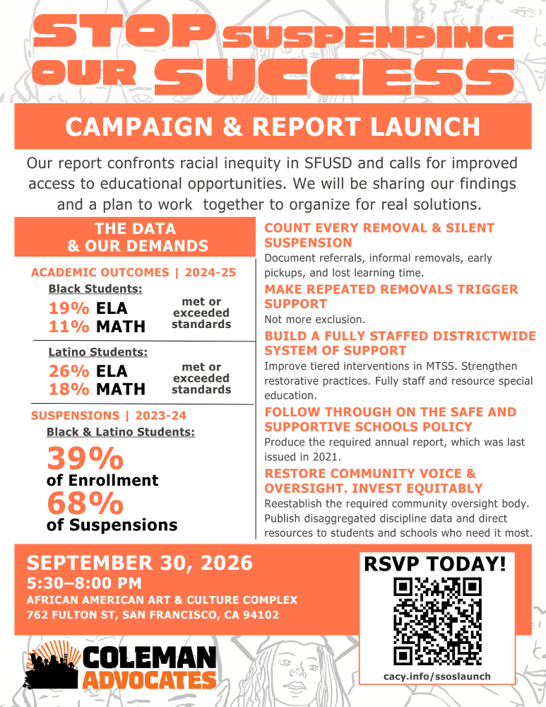
On September 30, at the African American Art & Culture Complex, Coleman Advocates for Children and Youth will formally launch “Stop Suspending Our Success” (SSOS) — a community campaign and report confronting racial inequity in SFUSD discipline. The figures at its center come from the district’s own reporting, and they render Part Two’s structure as arithmetic.
Coleman Advocates, headquartered at 459 Vienna Street in the heart of the community it serves, grew out of Citizens for Juvenile Justice, a group Jean Jacobs founded in San Francisco in the 1960s, and was incorporated in 1975. Particularly formative for the work it would take on was a lawsuit filed on behalf of Black schoolchildren by their parents, with David Johnson as lead plaintiff: Johnson v. San Francisco Unified School District charged the district with discriminatory practices that kept its schools racially segregated, in direct violation of the Supreme Court’s landmark 1954 ruling in Brown v. Board of Education .
The district contested the charges. On July 9, 1971, Judge Stanley Weigel of the U.S. District Court for the Northern District of California ruled against SFUSD and ordered it to desegregate. That fall, more than 48,000 students were reassigned under the district’s “Horseshoe Plan,” and buses began carrying children across the city.
The victory was short-lived. In 1978 the same judge ended large-scale busing; the NAACP sued again that year, and a 1983 consent decree followed. When the last court oversight expired in 2005, the resegregation that had already begun accelerated — until, by the district’s own 2020 account, its schools were more segregated than they had been thirty years earlier. Half a century of rulings, settlements, and promises has left Coleman’s work as necessary in 2026 as it was when its founders began.
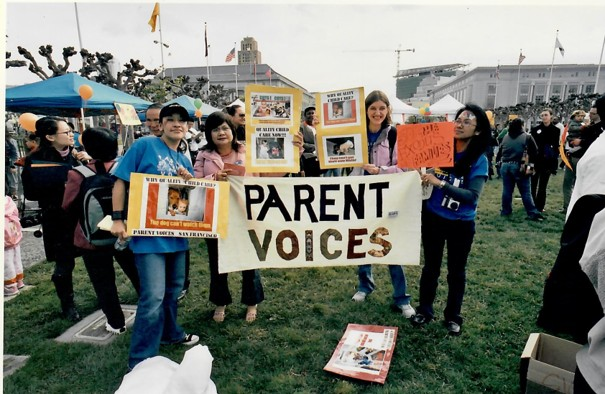
“This fight is not new,” said Tyler Wiest, Coleman Advocates’ marketing director. “Coleman Advocates has been around since 1975, and every year we are campaigning for the rights of the most vulnerable population here in San Francisco, our children.”
The SSOS campaign carries the philosophy in Director of Policy Brandie Bowen-Bremond’s own signature — Paulo Freire’s “Education becomes the practice of freedom” — operationalized: bilingual materials, a community booklet, and a public launch built for the families who live the data. Its report, Stop Suspending Our Students’ Success — Beyond the Data: A Community Report on Discipline, Lost Instructional Time, and the Fight for Safe and Supportive Schools in SFUSD , is authored by Bowen-Bremond and Youth Justice Director Rachel Jones.
“Our Stop Suspending Our Students’ Success report is a response to SFUSD falling short year after year,” said Wiest. “We are tired of waiting for the data, so we went out and got it so the public will be able to see it for themselves.”
And to the public it will go. Coleman Advocates invites anyone with an interest to read the report, in the hope that its findings will inform and empower their communities. It is posted at cacy.info/ssossreport , publicly viewable after September 30.


The flyer is itself part of the story: a community taking the district’s silence and handing it back as a receipt.
CAMPAIGN & REPORT LAUNCH — “STOP SUSPENDING OUR SUCCESS” Tuesday, September 30, 2026 | 5:30–8:00 p.m. | African American Art & Culture Complex, 762 Fulton St., San Francisco | RSVP: cacy.info/ssoslaunch
The launch’s own language is promise and indictment at once: “Our report confronts racial inequity in SFUSD and calls for improved access to educational opportunities. We will be sharing our findings and a plan to work together to organize for real solutions.”
The Data
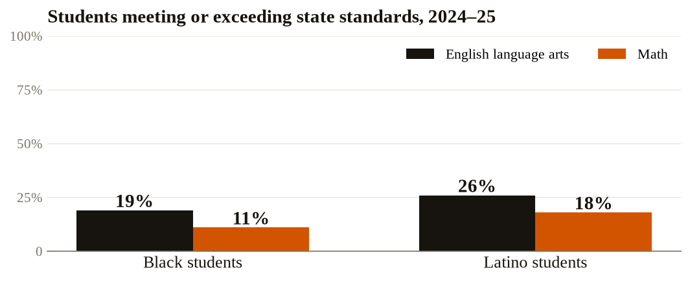
The SSOS figures, drawn by Coleman Advocates from the district’s own reporting, convert Part Two’s structure into arithmetic. First, what the district’s children can actually do — and for whom the system’s promise holds:
Second, what happens to the children the system is failing:
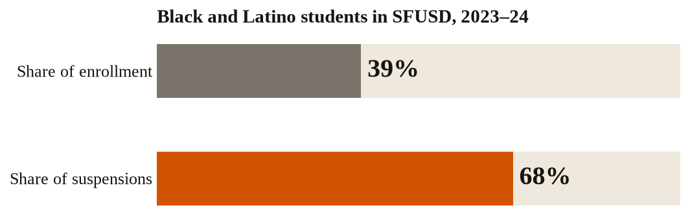
Read the second chart slowly. Black and Latino children are barely a third of SFUSD’s enrollment — and more than two-thirds of the children the system removes from its classrooms. Fewer than one in five Black students meets the state standard in English; barely one in ten meets it in math. These are not the metrics of a system failing accidentally. They are the metrics of a system performing exactly as it was arranged to perform: removing the children it has already decided not to teach, then declining to publish the paperwork.
The SSOS data is the statistical confirmation of Marjavi’s formula. The same district that pumps resources into the Westside removes Black and Brown children from the classroom at nearly double their share of enrollment — and declines to produce the legally required report that would let the city watch it happen in real time. The full report, with its methodology and complete tables, is under embargo until its September 30 release.
The Five Demands
on its own terms. Director of Policy Brandie Bowen-Bremond, M.A. — one of the report’s principal authors — has distilled its findings into five demands, printed in English and Spanish for the campaign booklet.
Before the demands, the woman who wrote them puts the stakes in her own words:

“Black, Latino, and Pacific Islander students are brilliant. Yet, they are punished far more for growing and developing as children and youth. Disproportionate patterns of pushout are not a reflection of students or parents, they reflect systemic racism and decisions about where support is invested. We need to give them every opportunity and pathway to shine, rather than closing those pathways off. Keeping young people connected to school is public safety. SFUSD’s current lack of implementation emboldens the school-to-prison pipeline, but we will not allow this to incarcerate any more futures.
“Silent suspensions became a loophole to documenting and preventing formal suspensions: learning time disappears, but the loss does not appear in the data and the learning recovery is not initiated. Our goal is for students to succeed academically and feel good about coming to school. While accountability is vital, real support for educators is also necessary. Teacher supports are student supports. When schools have the staff, consistent district guidance, funded tiers of support, and resources to respond to students’ needs, the entire school community succeeds.”
— BRANDIE BOWEN-BREMOND, M.A., DIRECTOR OF POLICY, COLEMAN ADVOCATES FOR CHILDREN AND YOUTH
The five demands, in the campaign’s own words:
- COUNT EVERY REMOVAL AND SILENT SUSPENSION. Document referrals, classroom removals, early pickups, teacher suspensions, and the instructional time students lose. Keep personally identifiable records internal, with an active window of no more than one academic year, to review removals and connect students with support. Publish only aggregate patterns—such as by race, disability status, and school—on a public dashboard and in School Accountability Report Cards, with safeguards to protect student privacy.
- MAKE REPEATED REMOVALS TRIGGER SUPPORT, NOT MORE EXCLUSION. Repeated referrals should prompt a Coordinated Care Team and MTSS review of the student’s needs, existing supports, and any missed IEP services. Document what help was provided and whether it worked.
- BUILD A FULLY STAFFED DISTRICTWIDE SYSTEM OF SUPPORT. Fund tiered MTSS interventions, restorative practices, academic and mental-health supports, coordinated care, and fully staffed special education. Give educators the training and resources to keep students learning in class.
- FOLLOW THROUGH ON THE SAFE AND SUPPORTIVE SCHOOLS POLICY. Resume the required annual reporting, last issued in 2021, and show how the district is carrying out its written commitments.
- RESTORE COMMUNITY VOICE AND OVERSIGHT. INVEST EQUITABLY. Reestablish the required community oversight body, publish privacy-protected discipline and lost-learning-time data, and direct resources to the students and schools that need them most.
“Each demand asks SFUSD to make its commitments visible in students’ daily lives,” the campaign says. “The district has named the problem and adopted policies to address it. Now it must count lost learning time, respond to repeated removals with support, and give communities a way to see whether those changes are happening.”
The Records That Do Not Exist
What follows is this newsroom’s reporting, not the campaign’s. Set the district’s own reporting obligations beside this series’s record of the Franklin removal and a single pattern emerges — one this report puts at its center. The paper trail of the San Francisco Unified School District ends precisely where accountability would begin. Call the roll:
The annual discipline report. The district’s own Safe and Supportive Schools Policy requires an annual report on school discipline. The last one was published in 2021. Five school years have followed. The campaign’s fourth demand exists because the fourth report — and the fifth, and the sixth — do not.
The shadow ledger. The silent suspensions, informal removals, office seat time, and “early pickups” that Demand One would count are, by design, uncounted. A child sent home at ten in the morning with no paperwork appears in no dataset, triggers no review, and — this is the point — cannot appear in any pattern a journalist, a parent, or a state agency could later subpoena.
The oversight body. District policy requires a community oversight body with the power to review exactly this kind of data. It lapsed. Who sat on it, when it last met, and why it stopped meeting are questions this newsroom has asked — and a public records request is in preparation — because the answer, in the most literal sense, is nowhere to be found.
Dr. Franklin’s file. The investigation opened against her in October 2025 was never concluded in writing. No written statement of the district’s reasons for demanding her resignation was ever produced, despite multiple requests — she has not received such a letter to date. When the Board of Education asked the superintendent to show the work behind the removal, the work could not be shown.
The seized funds. More than $7,000 in parent-raised cash was seized from Drew Academy, and $2,394.54 in electronic Square payments was confiscated without, on the record produced to date, an accounting of where either went. A district that cannot say where a school’s fundraiser went is a district that cannot be audited by its own community.
The nurse list. SFUSD publishes no master list of the schools that lack a full-time nurse. Parents must simply discover, on the day of the emergency, which category their child’s school falls into. (The Schools the System Forgot)
| The Record | Required By | Last Produced | Status |
| Annual discipline report | Safe & Supportive Schools Policy | 2021 | Five school years missing |
| Count of silent suspensions & informal removals | Demand No. 1; state discipline definitions | Never | Uncounted by design |
| Community oversight body minutes | District policy | Lapsed | No meeting record |
| Written findings, Franklin investigation | Due-process commitments; Ed Code | Never | Investigation never concluded |
| Written statement of reasons for her removal | Her contract’s corrective steps | Never | Requested; not received to date |
| Accounting of seized Drew Academy funds | Fiduciary obligations | Never | $7,000+ cash; $2,394.54 electronic |
| Master list of schools without full-time nurses | None — no policy requires it | Never | Does not exist |
A district that cannot say how many children it suspends, cannot say where its nurses are, and could not produce the work behind a principal’s removal has not lost its records. The record assembled across four installments supports only one reading: the absence is the policy. The most effective censorship in a city that prides itself on transparency is simply never publishing the data — and then declining to keep the kind of records that could be compelled.
The Enforcement Map: Chiu, Bonta & Shepard
A record without enforcement is a eulogy. Across four installments, we have documented facts that, on their face, violate California law and the district’s own binding commitments. They are not offered here as a story to be admired. They are offered as a case to be investigated — and three officers, each independent of 555 Franklin Street, hold jurisdiction over pieces of it: San Francisco City Attorney David Chiu, California Attorney General Rob Bonta, and Inspector General Alexandra Shepard of the City and County of San Francisco.
What the Law Requires — in Plain Terms
California Education Code sections 200 and 201 open the Education Code itself: it is the policy of the State of California that all persons in its public schools — regardless of race, ethnicity, gender, or disability — have equal rights and opportunities, and no person may be subjected to discrimination in any educational institution. Section 220 makes that prohibition enforceable. Government Code section 11135 extends the same guarantee to every program conducted or funded by the state. Title VI of the federal Civil Rights Act of 1964 prohibits discrimination in any program that receives federal dollars — which is every public school district in America. A discipline regime that removes Black and Latino children at nearly double their share of enrollment — attached to a judicial finding of intentionally drawn segregation and a directive Dr. Franklin says she refused to displace students by race — is exactly what these statutes exist to reach.
The Uniform Complaint Procedures — Title 5 of the California Code of Regulations, sections 4600 through 4687 — is the state’s machinery for investigating these allegations. Section 4631(a) requires a district to complete an investigation and issue a written Investigation Report within sixty calendar days; section 4631(e) requires findings of fact and a separate determination on each allegation, together with corrective actions and a remedy to affected pupils; section 4621(a) protects complainants from retaliation while it happens. That clock began on September 18, 2026. The report is due on or about November 17.
Education Code section 44932 governs the discipline of veteran educators — the statute the March 30 meeting notes invoked while Dr. Franklin faced a threatened termination delivered without written charges, written findings, or the progressive corrective steps her employment contract required. And the federal significant-disproportionality provisions of the Individuals with Disabilities Education Act — already applied to SFUSD by the state, in the form of a finding requiring the district to reallocate fifteen percent of its special-education budget to corrective work — are the enforcement arm of the very pipeline Dr. Franklin refused to feed.
Finally, the California Public Records Act (Government Code section 7920.000 et seq.) secures the public’s right to the records this installment shows were never produced: five years of annual discipline reports, the minutes of the lapsed oversight body, an accounting of seized funds. A right to a record the agency declines to create is the next frontier of this case — and the public records requests now in preparation will test it.
The Three Officers — and What Each Must Investigate
City Attorney David Chiu. Since Part Two, this series has carried his office’s silence on the documented seizure of more than $7,000 in parent-raised funds, the unfinished investigation, and the racial-disparity record — and a formal inquiry, drafted by this newsroom, stands ready. The City Attorney is the city’s chief legal officer, and the questions in this record touch the public right in ways that cannot be politely forwarded to the district’s own press office. What we ask of the office is thoroughness: an investigation of the misappropriation and public-records questions a city lawyer is best placed to pursue. Not an opinion. An investigation.
Attorney General Rob Bonta. The Attorney General’s Civil Rights Enforcement Section — whose published mandate expressly includes education rights and children’s rights, and which houses the Bureau of Children’s Justice — is the state officer with direct authority over the statutes above. As reported in Part Three, the full documentary record has been offered to that section: the district’s correspondence, the state’s September 18 referral, the March 30 meeting notes, and the accounts of both the named and the anonymous sources. Whether the office investigates is its call. That it be asked, in the open, on this record, and before the district’s November 17 deadline forecloses the question, is not.
Inspector General Alexandra Shepard. Seated January 5, 2026 as the city’s first Inspector General, within the Office of the City Controller, and charged — in the Mayor’s office’s words — with investigating fraud, waste, and abuse in city government. San Francisco Unified is not a city agency; as Part Three documented, however, its finances and its fiduciary obligations to public dollars flowing through the City and its philanthropic ecosystem sit within reach of that mandate. The fund allegations live here: the seizure of $7,000 in cash and $2,394.54 in electronic Square payments from a school fundraiser without a public accounting; the Title I and site-level fund concerns raised during the Franklin investigation (recorded, without adoption, in the state complaint); and five years of legally required reports never produced at public expense. As Part Three reported, this newsroom has transmitted the record to the Inspector General with a formal request that the office act on it without waiting for the district. That request stands.
| The documented fact | The law it implicates | Where it is documented | Officer with purview |
| Black & Latino students are 39% of enrollment but 68% of suspensions (2023–24) | Ed. Code §§ 200, 201, 220; Gov. Code § 11135; Title VI (1964) | This installment; SSOS campaign materials | Bonta — Civil Rights Enforcement |
| The 2010 directive to displace Black & Brown students via suspensions, expulsions & special-education referral — and a principal’s refusal | Ed. Code §§ 200, 201, 220; IDEA significant-disproportionality (the state’s 15% reallocation sanction) | Parts One & Three | Bonta; district under CDE referral |
| Removal of Dr. Franklin without progressive discipline, written charges, or a completed investigation | Ed. Code § 44932; district corrective-step agreements | Parts One & Three | Bonta — Bureau of Children’s Justice; Chiu |
| Seizure of $7,000+ in cash and $2,394.54 in Square payments, with no accounting | Misappropriation — fraud, waste & abuse | Part One; this installment | Shepard |
| Title I & site-level fund concerns raised during the investigation | Fraud, waste & abuse; fiduciary obligations | Part Three | Shepard |
| Five missing annual discipline reports; lapsed oversight body; no master nurse list | California Public Records Act (Gov. Code § 7920.000 et seq.); district’s own policy | This installment | Chiu; Shepard (waste & abuse) |
| Retaliation against educators and sources | 5 CCR § 4621(a) | Parts Two & Three | All three — a watching brief |
We ask none of the three to prejudge the outcome. We ask each to investigate — thoroughly, in the open, and now. Neither the City Attorney, nor the Attorney General, nor the Inspector General requires the district’s permission to look. None is bound by the district’s sixty-day clock. The record now sits before all three.
Franklin Is the Data’s Face
Coleman Advocates’ campaign stands on its own, and nothing in this section is the campaign’s claim. It is ours. It would be possible to read the SSOS findings as an abstraction. District 10 cannot afford to.
“Fences are a metaphor for gatekeeping. Dr. Franklin refused to gatekeep her school from the community that built it. SFUSD constantly builds institutional fences — and pretends it is surprised when communities stop trusting the district.”
— NOAH MARJAVI, BAYVIEW EDUCATOR AND LOWELL HIGH SCHOOL ALUMNUS, ON THE RECORD FOR THIS SERIES
As documented in Part One, Dr. Franklin — nearly thirty years in SFUSD, beginning at Bret Harte Elementary in 1997 — was confronted by a district official with the question that defines this investigation: “Why are you bringing in so many Black students?” When she refused a 2010 directive to “turn around” Bret Harte’s demographics — a strategy she understood would replace existing Black and Brown students through suspension, expulsion, and special-education referral — her previously unblemished evaluations were suddenly deemed “ineffective,” and her contract was not renewed.
Now read the SSOS data through that lens. A discipline regime that removes Black and Latino children at nearly double their share of enrollment is not an equity problem. It is the machinery of the strategy Dr. Franklin refused to execute — removal as enrollment management, exclusion as demographic engineering. The suspension slip and the forced resignation are the same instrument, aimed at different heights of the same community.
And the children’s loss is measurable in the record of the school she was taken from: as Part Three reported, the share of Drew students meeting or exceeding state English language arts standards rose from ten percent to twenty-three percent between 2022–23 and 2024–25 — the record of a school lifting itself, with the leader the district removed.
The retaliation continues. As this series has documented, allies of Dr. Franklin — community liaison Mesepa Kaulave, teacher Noah Marjavi, and others — have faced contract-renewal delays, payroll freezes, and workplace harassment while a second district investigation into her case remains formally ongoing. Staff describe her removal as having been “swept under the rug.” One teacher put the motive plainly:
“In my opinion, they want to gentrify the school, but Dr. Franklin wasn’t letting them get away with it, so they just needed a minor offense to get her out of the way, in order to proceed.”
— NOAH MARJAVI, TEACHER, DR. CHARLES R. DREW COLLEGE PREPARATORY ACADEMY
“Our families come from communities that have been historically underserved and overlooked. Our students deserve the same opportunities and celebrations as students in wealthier neighborhoods. Our families deserve transparency and respect. And our school deserves autonomy to serve our community in ways that actually work.”
— MESEPA KAULAVE, DREW ACADEMY COMMUNITY LIAISON AND SCHOOL SITE COUNCIL CHAIR, ON THE RECORD
The Schools the System Forgot
The doctrine Part Two documented is not limited to discipline files. In materials provided to this newspaper, Coleman staff document a quieter, equally damning area of neglect: a significant number of SFUSD schools operate with no on-site nurse at all.
SFUSD does not publish a master list of schools lacking a full-time nurse. Its own website concedes the reality: “Some SFUSD schools have an on-site School District Nurse, two to five days per week.” Many campuses share “itinerant” nurses splitting time across two to five sites, with gaps covered by a centralized “Nurse of the Day” program.
Two to five days. Which means: at schools across this district — disproportionately, parents and advocates contend, the same under-resourced schools serving Black and Brown children throughout the Bayview, Visitacion Valley, and the Excelsior — there are days every week when a child’s asthma attack, diabetic episode, or playground injury is met by a front office with a phone number instead of a medical professional. A district whose own history placed its highest-asthma schools on Superfund-adjacent ground, as Part Two documented, declines to staff those schools with nurses every day. The deficit is not in the children of District 10. It is in the will of the institution that governs them.
September 30
Two clocks are now running against 555 Franklin Street at once.
The first is the community’s. On Tuesday, September 30 — two days after this installment reaches print — Coleman Advocates will launch “Stop Suspending Our Success” at the African American Art & Culture Complex, 762 Fulton Street, from 5:30 to 8:00 in the evening. The full report goes public that evening — online at cacy.info/ssossreport and in a booklet in English and Spanish — five years after the district’s last annual discipline report. The families who live the data will read, in public, what the district’s own numbers say about their children.
The second is the state’s. As Part Three reported, the California Department of Education’s Uniform Complaint Procedures Office referred this newsroom’s complaint to the SFUSD Office of Equity on September 18, 2026, at 1:59 p.m. Under the state’s Uniform Complaint Procedures — Title 5 of the California Code of Regulations, section 4631(a) — the district must complete its investigation and issue a written Investigation Report within sixty calendar days: on or about November 17, 2026. Section 4631(e) requires findings of fact and a separate determination on each allegation, together with corrective actions and a remedy to affected pupils. Section 4621(a) requires the district to protect complainants from retaliation while it does so.
The SSOS report lands in the middle of that clock, and the timing is the point. A district that declined to publish its discipline data for five years will now have to answer for that record in writing, under a deadline it cannot extend and a city that is finally reading.
We will both be in the room on the thirtieth — Malik on the program and the leadership, Maura working the floor for the parents, teachers, and students willing to put their own suspensions on the record. If that is you, find one of us; we will handle your name with whatever care you ask of us, and no less.
The Questions We Are Still Asking
While we await the full SSOS report and the district’s comments, these questions remain live:
- To SFUSD and Superintendent Dr. Maria Su: Why has the Safe and Supportive Schools annual report not been published since 2021? Will the superintendent commit, in the district’s written Investigation Report due on or about November 17, to producing the missing five years before the first day of school in 2027? (Comment was requested in this newsroom’s September 8 letters; any response will be published in full.)
- To the Board of Education: Will the community oversight body required by district policy be restored — who sat on it, when did it last meet, and why did it lapse? (A public records request is in preparation.)
- To City Attorney David Chiu: Why has your office remained silent on the documented seizure of more than $7,000 in community-raised funds, the unfinished investigation, and the racial-disparity record the SSOS data now quantifies — and when will the formal inquiry this newsroom has drafted produce an investigation rather than an acknowledgment?
- To Attorney General Rob Bonta and Inspector General Alexandra Shepard: What will it take — which document, which witness, which date — for your offices to open the investigations the record now requires?
- To the California Department of Education: The referral your Uniform Complaint Procedures Office issued on September 18 places the district’s discipline record — and its five years of missing reports — before its own Office of Equity. What review has the state set over an LEA investigating a complaint about data it declined to publish, and what does the state do on day sixty-one if the report does not come?
- To SFUSD employees, current and former: The discipline numbers in this report are the product of classroom and front-office decisions made by human beings. We want to hear from the educators, clerks, counselors, and nurses who witness silent suspensions, informal removals, and staffing gaps every day. Contact: mwashington2059@gmail.com. Identities are protected on request.
The Unquiet Majority
Dr. Vidrale Franklin told the families of Drew Academy, in her June farewell: “The world needs to know that in this progressive city we call San Francisco, how racist this city is.”
On September 30, the world gets the receipts.
Part Two laid bare the seventy-year structure: the redlined maps, the 1971 findings, the expired consent decree, the forty-to-one fundraising gap, the Lowell double standard, the silent City Attorney. Part Three documented the culture that removed the woman who said so out loud — and put the state’s sixty-day clock in motion. This installment supplies the live data that structure produces every school year: two-thirds of suspensions drawn from a third of the enrollment; one in ten Black children doing math at grade level; a legally required report last issued in 2021; schools without nurses for days at a stretch; and a ledger of records that ends, every time, at the exact place where accountability would begin. These are not separate failures. They are one system, functioning as designed — in a district that has learned the most effective censorship is simply never publishing the data.
Dr. Franklin refused to be quiet, and they made her resign. The families of District 10 refuse to be quiet, and they are being handed flyers, in two languages, with a date and an address. The resignation was never going to stay unquiet in one schoolhouse. It was always going to become a movement.
Part Five, the series’s final installment, will follow the answer: the Investigation Report SFUSD owes the state on or about November 17, the full findings of Coleman Advocates’ report when the booklet lands, and whether 555 Franklin Street rebuilds the oversight its own policy promises — or whether, once again, the district’s only answer to organized community voice is silence.
Method, Attribution & Sources
Attribution and method. The reporting in this installment rests on three kinds of ground: the campaign documents Coleman Advocates for Children and Youth shared with us, the district’s own records and website, and interviews on file from this series. Where a figure comes from Coleman’s materials, we say so; those figures cite SFUSD’s own reporting, and the full report, with its methodology, is under embargo until September 30. Every quotation comes from interviews or correspondence on the record; nothing is reconstructed. We wrote for comment to Superintendent Maria Su, the members of the Board of Education, and district leadership in our letters of September 8, 2026; any response will be published in full. Corrections of fact will be published promptly and prominently.
| Source | What it is | Date |
| Coleman Advocates & the SSOS Campaign | ||
| SSOS launch flyers (English & Spanish) | The campaign document reproduced in this installment — the data and the five demands | September 2026 |
| SSOS report highlights | Summary of the report’s figures, provided by Director of Policy Brandie Bowen-Bremond, M.A. | September 8, 2026 |
| Brandie Bowen-Bremond correspondence | Director of Policy’s revisions to the five demands, on-record quotation, and photograph, by email to the authors | September 25, 2026 |
| Tyler Wiest correspondence | Coleman’s Marketing Director: on-record quotations, archival photographs, report cover, and report link, by email to the authors | August–September 26, 2026 |
| Stop Suspending Our Students’ Success (Bowen-Bremond & Jones) | Coleman Advocates community report, online at cacy.info/ssossreport | Public after September 30, 2026 |
| Carnochan et al., Mack Center, UC Berkeley; colemanadvocates.org | Organizational history: Citizens for Juvenile Justice (1960s) and Coleman Advocates’ founding in 1975 | 2011; current |
| “Many SFUSD Schools Don’t Have Onsite Nurses” | Coleman Advocates internal documentation | August 31, 2026 |
| On-Record Interviews | ||
| Mesepa Kaulave | Drew Academy community liaison & School Site Council chair — interview | July 2, 2026 |
| Member of the SFUSD Board of Education | Interview | July 8, 2026 |
| Noah Marjavi | Drew Academy teacher — interview | August 31, 2026 |
| Dr. Vidrale Franklin | Public farewell remarks to Drew Academy families, quoted on the record | June 2026 |
| Government & Agency Records | ||
| CDE referral, “CDE-UCPO” | Uniform Complaint Procedures Office email referring this newsroom’s complaint to SFUSD’s Office of Equity, 1:59 p.m. PT; district acknowledgment 3:24 p.m. the same day | September 18, 2026 |
| 5 CCR §§ 4600–4687 (UCP) | The state’s complaint procedure — incl. §§ 4621(a), 4631(a) & (e), the 60-day clock | In force |
| Ed. Code §§ 200, 201, 220, 44932; Gov. Code § 11135; Title VI (1964) | The anti-discrimination and due-process statutes engaged by this record | In force |
| SFUSD CCEIS | District program recording the state’s significant-disproportionality finding — the 15% special-education budget reallocation | Reported in Part Three |
| SFUSD Student & Family Handbook, ch. 3, § 39.8; Budget FAQs | District records on nurse staffing and budget development | Current |
| SFUSD Board records; SF Dept. of Elections | The Lowell admissions vote (5–2) and the recall results | Feb. 9, 2021; Feb. 15, 2022 |
| Published Reporting & Prior Installments | ||
| This series, Parts One–Three | “How Dr. Vidrale Franklin’s Fight… Uncovered a Pattern of Institutional Racism”; “Separate and Unequal”; “A Question of Competence” | September 2026 |
| SFUSD, “Facing Our Past, Changing Our Future” | The district’s own segregation retrospective | 2020 |
| San Francisco Public Press | School-by-school segregation analysis | 2013–14 data |
| Johnson v. San Francisco Unified School District , 339 F. Supp. 1315 (N.D. Cal.) | Judge Stanley Weigel’s desegregation decision and decree | July 9, 1971 |
| San Francisco Public Press, “As Courts Flip-Flopped on School Integration”; SFUSD, “Five Decades of Desegregation” | Timeline: 1971 busing, 1978 end of busing and NAACP suit, 1983 consent decree, 2005 expiration | 2015; 2020 |
| Nathan Heller, The New Yorker | Lowell High School investigation | March 2022 |
| EdSource; Berkeley Political Review | PTA fundraising-gap documentation and analysis | Carried in Part Two |
| Steyer, Provençal, Pearman & Obradović, AERA Open | Stanford University study, “De Facto Suspensions: Informal Exclusionary Discipline Practices in Public Preschool and Early Elementary Settings” — informal exclusionary discipline, with SFUSD as the site of study; shared with this newsroom by Maura Corkery, September 11, 2026 | 2025 |
| Mission Local | Reporting on Dr. Franklin (with Maura Corkery) | June 9, 2026 |
| Tyler Wiest, “Dr. Franklin’s Second Investigation Ongoing, meanwhile turmoil ensues” | Field reporting | August 31, 2026 |
| This Newsroom’s Record | ||
| Complaint letters of September 8 | “The Unquiet Resignation — Request for Accountability and Corrective Action,” mailed to the CDE, state and city officers, SFUSD, and all Board members, enclosing Part One | September 8, 2026 |
| March 30, 2026 meeting notes | Contemporaneous notes, obtained by this newsroom (Dr. Franklin, Dino Velez, Jolynn Washington) | March 30, 2026 |
| Release notice & release agreement | District documents in the Franklin removal | May 13 & May 22, 2026 |
How to read this list: every figure, quotation, and date in this installment traces to a source above.
Our song/video for this article is: Aretha Franklin: RESPECT