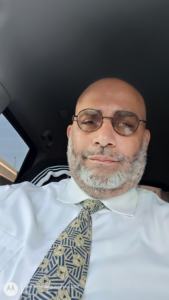
How Mano Raju — the son of Tamil immigrants, the courtroom gladiator his colleagues once dubbed “The Not Guilty Machine,” and California’s only elected public defender — stared down a $26,000 contempt fine to defend the Sixth Amendment, and why the battle for the soul of American justice runs through San Francisco on November 3, 2026.
INVESTIGATIVE PROFILE · CRIMINAL JUSTICE · ELECTION 2026
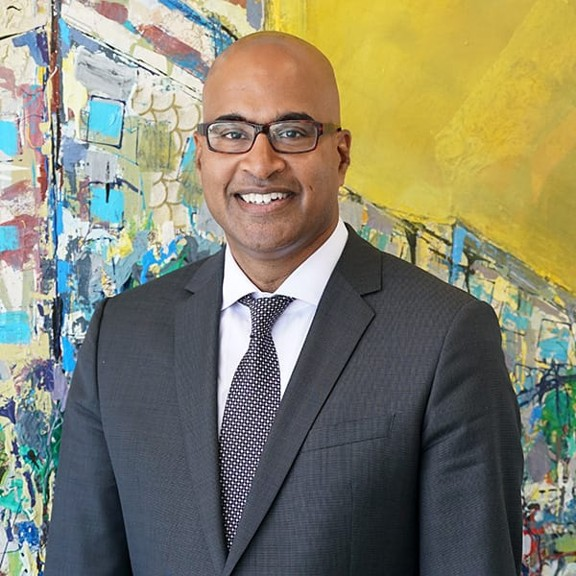
Photo: San Francisco Public Defender’s Office
You do not usually see a chief public defender walk into a state courtroom expecting to be punished for doing his job. You do not usually see nine of his peers — the men and women who lead public defender offices from Alameda to Napa — rise from their seats and stand behind him, in silent formation, as a judge prepares to hand down a fine. And yet that is exactly what happened on March 24, 2026, in a wood-paneled courtroom at 850 Bryant Street. The state of California, in effect, was about to punish a man for refusing to let his clients be represented badly. His name is Manohar “Mano” Raju. He is in his early fifties, the son of Tamil-speakers from a farming community in South India, the elected Public Defender of San Francisco, and — in the estimation of colleagues, judges, and a national chorus of legal ethicists — the best in the country at what he does.
This is the story of how he got there, what he built, why they came for him, and why the people of San Francisco should send him back to City Hall on November 3, 2026.
A Son of Immigrants
Manohar Raju was born in Wilmington, Delaware, and raised in Pittsburgh and Boston, but the moral compass he brought to a Bay Area courtroom two decades later was set in a farming village in Tamil Nadu, India — in the house of a father who was the first person in his entire extended family to graduate from high school. Read that sentence again. The first. When Raju’s parents emigrated to America, they carried that hard-won diploma the way other families carry heirlooms. “His parents,” reads the biography maintained by the San Francisco Public Defender’s Office, “raised Mano to not forget his humble beginnings or those still left behind.” The family’s moral code carried across the ocean with them. Years after Raju’s parents settled in America on a trip back to the village, Raju learned that an uncle had been wrongfully accused of a homicide — accused on assumptions drawn from the family’s jati, the Tamil word for caste. Raju does not offer that detail as decoration. It is, he says, the reason he defends gang cases the way he does: he knows, from his own family’s history, exactly what it looks like when the state mistakes a name, a brown face, a community for an accusation.
At Columbia University, Raju worked as a research assistant for Kendall Thomas, a leading scholar of critical race theory. He crossed the country to the University of California, Berkeley, where he took both a master’s degree in South Asian Studies and a J.D. He cites the civil-rights organizer Bayard Rustin and the Indian freedom fighter and international racial justice advocate Ram Manohar Lohia as touchstones. Public defender work, he has said publicly, “falls within the tradition of broader freedom struggles that have always relied upon multiracial solidarities.”
That is the philosophy. What follows is what he did with it.
The Not Guilty Machine
Before Raju was a chief, before he was an appointee, before the television cameras arrived in the rotunda of City Hall, he was a trial lawyer — and, by the near-unanimous testimony of the Bay Area criminal-defense bar, a devastating one. When he left the Contra Costa County Public Defender’s Office in 2008 after seven years as a deputy public defender there, his colleagues did not send him off with a card. They sent him off with a plaque. It read, in four words that have followed him ever since: THE NOT GUILTY MACHINE.
| “Raju is a legend. I’ve seen him win cases that every other attorney would have lost.” — A prominent Bay Area defense attorney |
When Jeff Adachi — the legendary San Francisco Public Defender whose shoes Raju would eventually fill — recruited him across the Bay Bridge in 2008, it was because that reputation had crossed the water first. Inside Adachi’s felony unit, Raju compiled what a widely cited profile of his record called “a highly regarded string of acquittals and successful defenses in major homicide cases,” and was “widely respected as a fierce advocate for indigent clients, carrying forward the legacy of aggressive defense work established by his predecessor.” The evidence was not anecdotal. When the San Francisco Examiner published “Lack of Conviction,” its investigation of District Attorney Kamala Harris’s tenure, two of the three cases the paper singled out as emblematic, in widely cited Examiner reporting, were trials Mano Raju ran out of the Public Defender’s Office. He won them.
Matt Gonzalez — the former San Francisco Board of Supervisors president, the chief attorney of the Public Defender’s Office, and the man who briefly ran that office in the terrible weeks after Adachi’s death — has watched more trial lawyers work than nearly anyone alive. At the March 2019 press conference where Mayor London Breed announced Raju’s appointment, Gonzalez did not hedge:
| “I’ve seen a lot of trial lawyers. He may be the best I’ve seen.” — Matt Gonzalez, Chief Attorney, San Francisco Public Defender’s Office |
He would say it again in a different key later that year: “If I could have made the choice on my own, I would have chosen him.”
The trial record built the credibility, and the credibility built the lectern. Today, Raju teaches. He has lectured statewide and nationally on the successful defense of gang cases — among the hardest, most racially charged, and most publicly maligned files a defender ever touches — and on race-conscious representation, trial advocacy, and homicide defense for the California Public Defenders Association, California Attorneys for Criminal Justice, and the Black Public Defender’s Association. This is the man who now runs the office. Keep that in mind as we get to the caseload numbers. And the teaching is not academic. Long before he led this office, Raju understood — from an uncle’s wrongful homicide accusation half a world away — what happens when investigators look at a young man in a gang case and stop looking at the person. That is why the machine never stops.
| “Manohar is a trial lawyer’s trial lawyer. No case seems unwinnable to him, and as a result they almost always never are. Also, as a result, Mano drives the hardest bargains in town. A master strategist in all phases of litigation, Manohar Raju is one of the very best trial lawyers in the country.” — Robert Dunlap, Raju’s former supervisor in the San Francisco Public Defender’s Office, speaking to India Abroad |
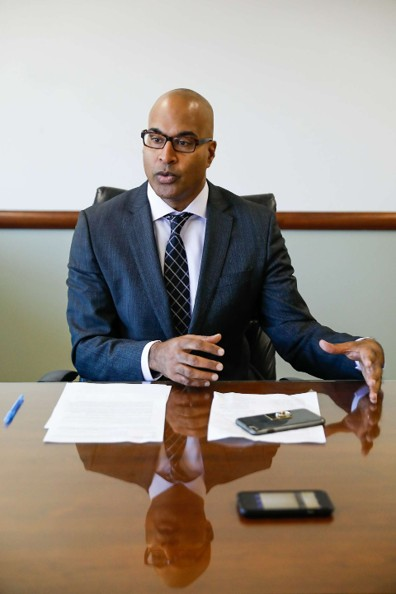
Photo: San Francisco Chronicle
The Adachi Inheritance
February 22, 2019, was the night that changed him. Mano Raju was the felony unit manager for the San Francisco Public Defender’s Office. His boss, Jeff Adachi — a national reformer, a man who had spent his career remaking what a public defender’s office could be — was suddenly dead. Adachi’s legacy — the Immigration Defense Unit, the Pre-Trial Release Unit, the campaign for bail reform, the insistence that public defense could be political, systemic, holistic — was already the country’s benchmark. Someone had to carry it.
On March 11, 2019, Mayor London Breed named Raju to succeed him. Later that year, San Francisco voters ratified the choice without opposition. In November 2022, they re-elected him to a full four-year term with 69.75 percent of the vote — a landslide mandate for the office he had rebuilt.
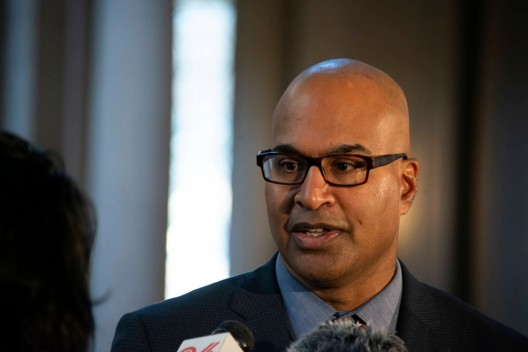
Photo: KQED
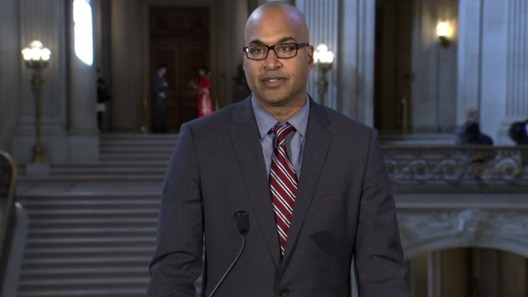
Photo: ABC7 News
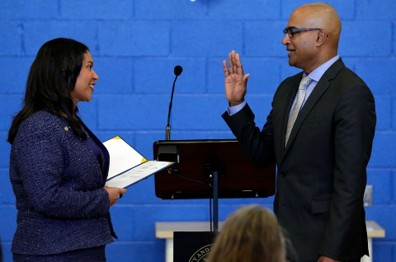
Photo: San Francisco Chronicle
The Family in the Room
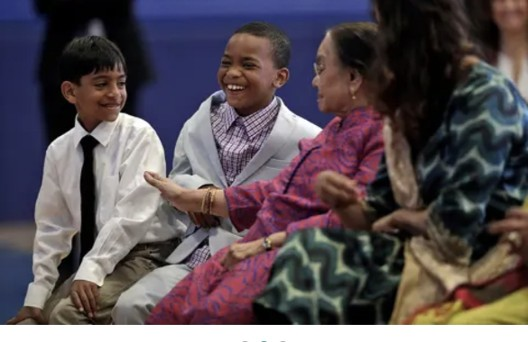
The cameras that week were pointed at a courtroom appointment. But at the community swearing-in that followed at the Ella Hill Hutch Community Center, they caught something the political story could not: the people who had been waiting for this moment far longer than any mayor’s calendar required.
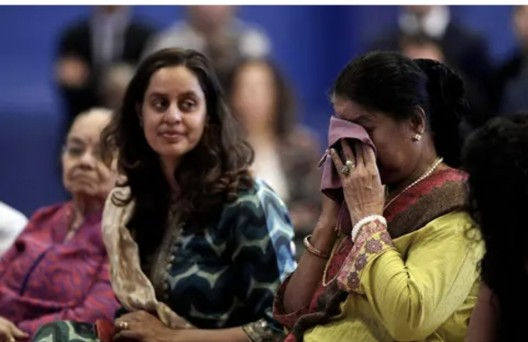
Raju’s mother, Dhanam Raju, wiped away tears as her son spoke of his parents’ journey from a farming village in Tamil Nadu to a life they could not have imagined for him — the same journey, the same jati, the same history of an uncle wrongly accused an ocean away, that Raju says still guides how he defends the people this city is quickest to write off. Beside her sat his wife, Asha Mehta, listening the way her husband is famous for listening. Asha Mehta is one of the most transformational leadership developers in the country. His son, Asim Mehta-Raju, sat with his friend Kofi Katamani, two boys in borrowed neckties trying to hold still through the speeches. And at the center of it, mid-ceremony, his goddaughter Rowan Porter simply could not wait — she ran to him, and San Francisco’s newest Public Defender bent down mid-sentence to catch her.
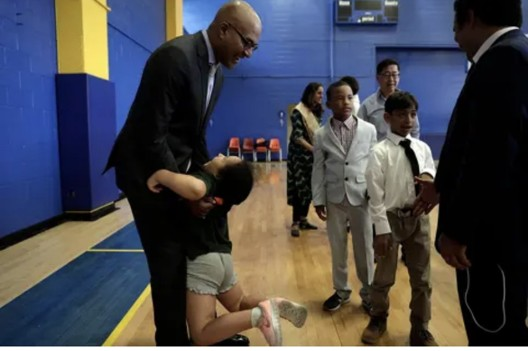
Photo: Carlos Avila Gonzalez / San Francisco Chronicle
An Office Built Like a Mission
What Raju inherited he did not merely maintain. He grew it, deepened it, made it more explicitly the public defender’s office as social infrastructure. The San Francisco Public Defender’s Office, now a team of more than 240 people and the city’s largest publicly funded criminal defense operation, It provides legal representation to more than 20,000 people every year — people who are poor without exception, roughly 75 percent of whom suffer from mental illness or substance-use disorders, roughly one in ten of whom are immigrants or non-English speakers. Under Raju, it is achieving what the office openly aspires to: “the state and nationwide model for transformative, holistic public defense services.”
Consider what the office actually does. Its Clean Slate Program, which turned twenty-five in 2024, helps San Franciscans clear old convictions that would otherwise close doors to housing, jobs, and licenses. Mayor Daniel Lurie, who took office in January 2025, has appeared at Clean Slate workshops alongside Raju and paralegal Melissa Viera to promote the service. The MAGIC programs in the Bayview and Western Addition run summer literacy sessions, backpack giveaways, and holiday events. The Legal Education Advocacy Program (LEAP) puts advocates inside SFUSD campuses every single week. End the Cycle embeds social workers at the first contact with the system. And Raju secured funding for a medical social worker, enhancing the ability of the office’s mental health unit to determine appropriate placements for the thousands of people the unit represents. The College Pathway Project connects clients to SF State and City College. The Immigration Defense Unit fights deportation regardless of birthplace or status. The Law Enforcement Accountability Unit tracks police misconduct.
Then there is the innovation that reached past the courtroom and into the jury box itself. In collaboration with San Francisco Treasurer José Cisneros, Raju’s office built Be The Jury — the nation’s first pilot program to pay low- and moderate-income jurors $100 a day for service in criminal trials, authorized by state legislation in 2021 and expanded with $650,000 in new state funding in 2024. More than a thousand San Franciscans have since answered the call to serve, measurably widening the racial and economic diversity of the city’s juries. The reform’s reach has extended all the way to the screen: Judging Juries, a documentary short by Peabody Award-winning filmmaker Abby Ginzberg on who gets to sit in judgment — and who is priced out of it — is now streaming on Apple TV.
In the courtroom, the 2023 record reads like a mission statement in numbers: 60 felony jury trials, 40% ending in acquittals or hung juries, another 33% in mixed verdicts, and 2,715 felony and misdemeanor cases dismissed outright. And then the bar rose again: in 2025, Raju says, the office took substantially more cases to jury trial than it had two years earlier — and posted an even better record. These are not people freed on technicalities. These are people the state could not prove its case against.
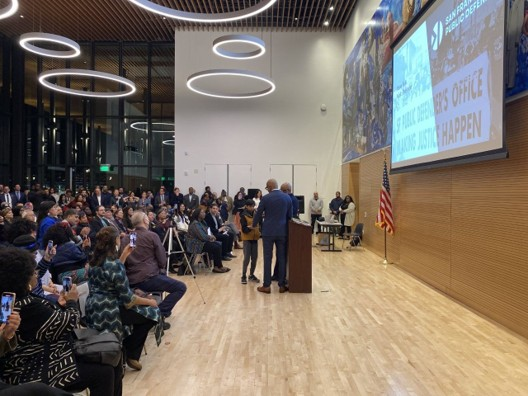
Photo: San Francisco Public Defender’s Office
The Freedom Project
Now consider the innovation that may be the most consequential of Raju’s tenure — and the least well known outside the criminal justice bar. It is called the Freedom Project. It is a post-conviction unit, created under Raju’s watch, and its work is nothing less than this: it finds the men and women whom California put away years or decades ago under laws that have since changed, and it brings them home.
The Freedom Project has, so far, secured the release of 110 people from California’s prisons. Many of them had been sentenced to life in prison. All of them are alive, today, breathing free air, because when the law evolved someone in a downtown San Francisco office remembered that evolution is supposed to apply retroactively to actual human beings. That unit has reunited families. It has saved the state of California millions of dollars. And it has made the state’s response to violence, to error, and to the passage of time more honest — something the tough-on-crime rhetoric of the late 20th century always promised but never actually delivered.
Put it plainly. Under Mano Raju, San Francisco has quietly become a city that reads the law forward, not backward.
The Strategist
Ask people who have worked closely with Mano Raju what surprises them about him, and after they mention the trial talent and the philosophical seriousness, they will almost always mention something quieter: he is obsessed with strategic planning. Trial lawyer. Training director. Felony manager. Chief. And, running beneath all of it, a strategist — a man who thinks in three-year and five-year arcs and asks, of every program his office launches, how it connects to a coalition and how it moves the underlying policy.
Danielle Harris — who ran the felony unit alongside Raju and today directs the office’s Freedom Project — put her finger on the trait that makes the strategy work. Interviewed by the San Francisco Chronicle when Raju was appointed, she called him an “extraordinarily good listener.” That is not a soft compliment. In a strategist, listening is the load-bearing skill — it is how a chief learns what a coalition needs before he asks it to move. It is no accident that when Raju went looking for sixty civil-rights, traffic-safety and community groups to back the end of racially biased pretext stops, they answered the call. The coalitions came because the listening came first. “He is very approachable,” she said. “He is very hands-on. He wants to know the details of things. He wants to understand issues. He’s not someone to throw out an opinion or a viewpoint until he understands what all of the factors are.”
The proof is in the record. Under Raju, the San Francisco Public Defender’s Office has, in his own careful phrasing, “in coalition, moved local and state policy changes for a more equitable and safe system.” Read that sentence carefully. It is not the language of a lone-wolf activist. It is the language of a strategist who knows that a single office cannot legislate, but a coalition can. One of the clearest wins of that approach: the anti-pretext stop general order — a policy reform that limits the practice of officers using minor traffic infractions as a pretext to pull over Black and brown drivers. Every civil-liberties organization in America has been railing against pretext stops for a generation. San Francisco, working in coalition, moved a general order that constrains them. That happened on Mano Raju’s watch.
The point is not that Raju did it alone. The point is that he built the office that could do it in coalition. Public defense done right is not just courtroom work. It is systems work. It is the long game.
By the Numbers
65% Rise in active cases since 2019 (5,039 → 8,335) | 20,000+ People served by the office every year | 2,715 Felony & misdemeanor dismissals secured in 2023 | $26,000 Contempt sanction — stayed on appeal |
The Contempt That Made Him Famous
Here is where the story bends. Beginning in May 2025, in the face of budget pressures under Mayor Daniel Lurie and a surge in arrests — active felony and misdemeanor cases had risen roughly 65 percent since Raju took office, from 5,039 in 2019 to 8,335 as of March 2026, by the Public Defender’s own count — the Public Defender’s Office began, one business day per week, to declare itself unavailable to take on new cases. Chief Attorney Matt Gonzalez wrote a letter to the presiding judge. Two hundred more arraignments had entered the docket in the first four months of 2025 than in the same period of 2024. To keep taking those cases on top of everything else, the office argued, would violate the Sixth Amendment rights of the clients it already had.
This is where a lesser chief blinks. Raju did not. On March 10, 2026, San Francisco Superior Court Judge Harry Dorfman held Mano Raju in contempt of court. On March 24, Dorfman fined him $26,000 — calculated, insultingly, as $1,000 for each of the 26 people the Public Defender’s Office had declined to represent since January. The nation’s public defense community lost its mind. Chief public defenders from nine counties — Alameda’s Brendon Woods, Contra Costa’s Ellen McDonnell, Yolo’s Tracie Olson, Sonoma’s Brian Morris, Santa Cruz’s Heather Rogers, San Joaquin’s Judyanne Vallado, Sacramento’s Amanda Benson, Marin’s David Sutton, and Napa’s Kris Keeley — came to San Francisco and stood behind him in court.
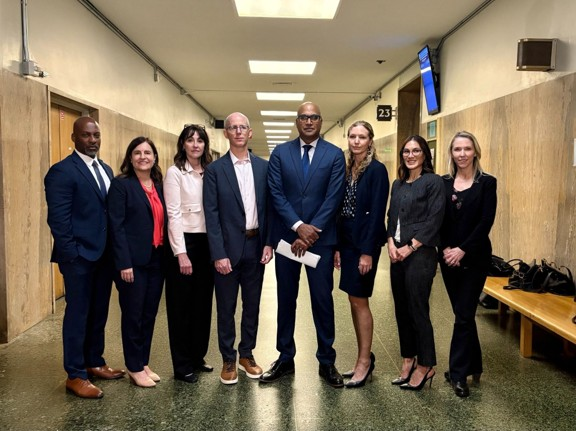
Photo: San Francisco Public Defender’s Office
| “Public defenders have been asked to do more with less for decades, and Mano Raju’s office in San Francisco is a perfect example of the end result of these growing caseloads and dwindling budgets for public defense.” — April Frazier Camara, President & CEO, National Legal Aid & Defender Association (NLADA) |
| “We commend San Francisco Public Defender Mano Raju for standing strong in defense of the right to effective counsel for his office’s clients, in the face of a contempt order that does nothing to address the under-resourcing of his office.” — Danny Engelberg, Chair, American Council of Chief Defenders (ACCD) |
| “Today we rise to stand in solidarity with San Francisco Chief Public Defender Mano Raju, who was held in contempt of court and heavily fined for standing up for his clients, his office and all others.” — Cook County Public Defender’s Office, Chicago |
In court that day, Raju did not flinch. “The San Francisco Public Defender’s Office remains unwavering in our constitutional duty to provide effective assistance of counsel to every person we represent,” he said. “We serve a unique role in our justice system as guardians of due process. Having excessive caseloads is a conflict of interest for our existing clients. The absurdity of being fined when we are already underfunded is counterproductive and a further injustice to our clients and our office. Sanctions cannot change the reality that more cases are being filed and they are taking significantly longer to resolve.” The California Court of Appeal agreed. On April 8, 2026, the First District stayed enforcement of the $26,000 sanction. On April 10, it affirmed the stay. The fine remains on the books. Raju has not paid a dollar. He continues, as of this writing, to run the office.
Awards & Recognition
| AWARDS & RECOGNITION 2019 North America South Asian Bar Association — Public Interest Achievement Award 2019 California Public Defenders Association — Special Recognition Award for a landmark California Court of Appeal decision on reciprocal discovery 2021 Society of Professional Journalists — James Madison Freedom of Information Award 2022 La Raza Centro Legal — Visionary of Justice Award 2025 Washington State Office of Public Defense — Faculty Award, Public Defense Leadership Institute 2025 The Family Foundation — Award for dedication to justice and advocacy for the underserved 2026 California Public Defenders Association — Special Recognition Award for confronting excessive workloads and protecting Sixth Amendment rights under contempt sanctions and significant institutional pressure |
From the Vault
A brief archival gallery from the seven years of a chief’s tenure. These are the images of a man who did not campaign to run the office — he was drafted — and who has, at every stage, looked less like a politician than like a lawyer who happens to have won the vote.
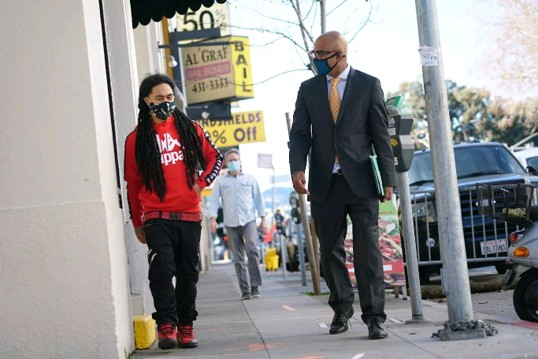
Photo: San Francisco Public Defender’s Office
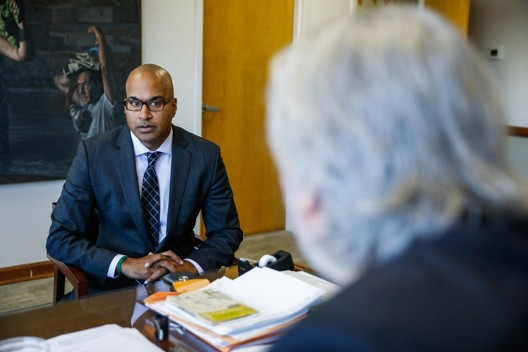
Photo: San Francisco Chronicle
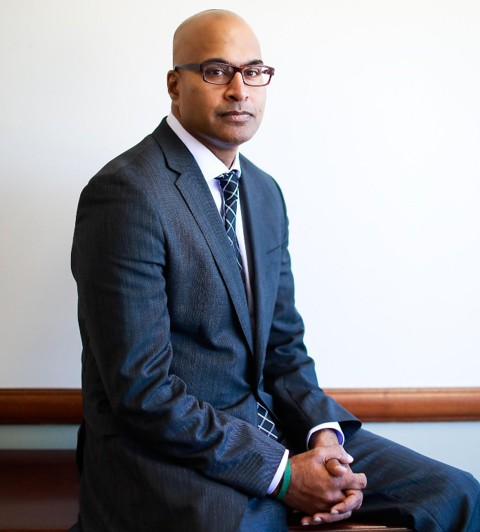
Photo: The Matt Gonzalez Reader
The November Question
On November 3, 2026, San Franciscans will decide whether to send Mano Raju back to City Hall for another four-year term. The city’s political organizations have lined up behind him. On August 26, 2026, the San Francisco Democratic County Central Committee — the county party’s official endorsing body — formally added its endorsement. It has since been joined by the San Francisco Women’s Political Committee, the San Francisco Young Democrats, the Eastern Democratic Club, the Rose Pak Democratic Club, and the League of Pissed Off Voters, and the Harvey Milk LGBTQ Democratic Club — a coalition that stretches from the party’s establishment core to its rising young organizers, from its Chinatown neighborhood roots to the gay-rights pioneers whose club still bends the city’s conscience. His campaign runs under a plain-spoken banner: “Fairness is not a privilege. Every day, as San Francisco’s Public Defender, Mano Raju leads a team of accomplished defenders to fight when liberty hangs in the balance.”
Consider what the affirmative case actually looks like. A trial lawyer his own colleagues called The Not Guilty Machine. An office of 240 people that has become the national model for holistic public defense. A Freedom Project that has walked 110 human beings out of state prison — many of them once condemned to die there — and reunited them with their families. A strategic office that helped move an anti-pretext stop general order into law. A courtroom record that kept climbing — 2,715 dismissals and a forty percent acquittal-or-hung-jury mark in 2023, then substantially more trials and an even better record in 2025. A body of awards stretching from the South Asian Bar Association in 2019 to the California Public Defenders Association in 2026. And a chief who, when the state asked him to violate the Sixth Amendment, chose contempt instead. When the choice on your ballot is between the person who shouldered a contempt fine to protect his clients’ constitutional rights and anything else — that is not a hard call. That is a moral test with one correct answer.
| IN HIS OWN WORDS — CHIEF PUBLIC DEFENDER MANO RAJU A statement provided to investigative journalist Malik Washington (Davis Vanguard / Destination Freedom Media Group), September 2026. “I’ve talked with people in every part of this city, and I know San Franciscans want a defender’s office that zealously defends constitutional rights, fights for just outcomes, and finds ways to support individuals who come from areas that have been historically under-resourced. In any urban area, our lives are all interconnected. When we have a vigorous, holistic defense office that strategically works with other organizations to empower our clients and their families, all of our communities are healthier and safer. I’m grateful for the opportunity to lead a skilled and passionate group of defenders committed to working for justice. ” — Mano Raju, San Francisco Public Defender |
Gideon’s Promise, on the Ballot
In 1963, in Gideon v. Wainwright, the Supreme Court of the United States held that every person accused of a crime has a right to a lawyer, and that if he cannot afford one the state will provide him with one. That sentence sounds simple. It is not. Public defense in America is chronically underfunded, chronically overworked, and chronically, quietly asked to swallow the consequences of every failure upstream of it: failure of housing, of mental health, of schools, of immigration, of policing. That is the system Mano Raju walked into. That is the system he refused to accept.
The judge who fined him $26,000 does not think Mano Raju is a bad lawyer. The record shows the opposite — the office notes that Judge Dorfman has repeatedly praised its professionalism. The fine was about jurisdiction, about docket management, about the terrible arithmetic of a city that keeps arresting more people than its public defender can ethically represent. It was not, in the end, about whether Raju was right. He was right. The Court of Appeal has stayed the fine, and the legal community from around the country has written letters of support for him.
This is what Raju himself has said his work is measured by — not the numbers, not the awards, not even the plaque his old Contra Costa colleagues gave him:
| “Our impact is not measured in numbers, but in the people we represent. It’s the mother who can return home to her family. The son who gets to return to school. And to the children of those we defend, who benefit from having an equal opportunity to survive and who might one day use that opportunity to lead.” — Mano Raju, San Francisco Public Defender |
On November 3, San Franciscans will decide whether Gideon’s promise is still worth keeping in this city. They will decide whether the person who took a contempt fine rather than let his clients receive substandard counsel deserves another four years to do the work. They will decide whether the son of Tamil immigrants — a man whose father was the first in his family ever to graduate from high school — will continue to run the office that has become the national gold standard for public defense. This is not a hard question. This is not even close. Vote for Mano Raju. Vote for the best public defender in the nation. Vote for Gideon’s promise, on the ballot, in your city, on November 3, 2026.
Destination Freedom Media Group and The Davis Vanguard extend our sincere appreciation to Mano Ragu and the entire San Francisco Public Defender’s Office for their unwavering dedication to serving the people of San Francisco and for their steadfast commitment to protecting the rights, dignity, and humanity of those too often marginalized or overlooked by the criminal legal system.
Sources & Further Reading
• Manohar Raju — Official biography, San Francisco Public Defender’s Office — https://sfpublicdefender.org/personnel/mano-raju/
• Manohar Raju — Ballotpedia (elections & career timeline) — https://ballotpedia.org/Manohar_Raju
• Manohar Raju — Wikipedia — https://en.wikipedia.org/wiki/Manohar_Raju
• Re-Elected SF Public Defender Mano Raju Sworn In (Feb 9, 2023) — https://sfpublicdefender.org/2023/02/09/re-elected-sf-public-defender-mano-raju-sworn-in-at-community-ceremony-and-black-history-month-celebration/
• Transformative Justice, Community Safety & Empowerment — SF Public Defender Community Budget Presentation, 2024 — https://sfpublicdefender.org/wp-content/uploads/sites/2/2024/02/2_9_Public-Presentation_2024.pdf
• San Francisco Public Defender Mano Raju to Appeal Sanctions (March 24, 2026) — https://sfpublicdefender.org/2026/03/24/san-francisco-public-defender-mano-raju-to-appeal-sanctions/
• Court of Appeal Halts Sanctions Against SF Public Defender (April 9, 2026) — https://sfpublicdefender.org/2026/04/09/court-of-appeal-halts-sanctions-against-sf-public-defender/
• Court of Appeal Affirms S.F. Public Defender Need Not Pay Fine (April 10, 2026) — https://sfpublicdefender.org/2026/04/10/court-of-appeal-affirms-s-f-public-defender-need-not-pay-fine/
• NLADA / ACCD Statement on the $26,000 Fine — https://www.nlada.org/newsroom/nlada-accd-release-statement-response-san-francisco-public-defender-mano-rajus-26000-fine
• S.F. Mayor Breed Appoints Mano Raju as Successor to Jeff Adachi — KQED — https://www.kqed.org/news/11732158/s-f-mayor-breed-appoints-manohar-raju-as-successor-to-late-public-defender-jeff-adachi
• Manohar “Mano” Raju to Succeed Jeff Adachi as Public Defender — Mission Local — https://missionlocal.org/2019/03/manohar-mano-raju-jeff-adachi-public-defender/
• Meet Mano Raju, the SF Public Defender — San Francisco Chronicle (Heather Knight profile) — https://www.sfchronicle.com/bayarea/heatherknight/article/Meet-Mano-Raju-under-the-radar-S-F-public-14990469.php Family photographs from the April 25, 2019 community swearing-in courtesy of the San Francisco Chronicle, photographed by Carlos Avila Gonzalez.
• Mano Raju Sworn In as San Francisco’s New Public Defender — SF Chronicle, 2019 — https://www.sfchronicle.com/crime/article/Mano-Raju-sworn-in-as-San-Francisco-s-new-13796438.php
• San Francisco Just Got Its First Contested Public Defender’s Race in 20 Years — SF Chronicle — https://www.sfchronicle.com/sf/article/San-Francisco-just-got-its-first-contested-public-17278069.php
• Guest Commentary: Why Mano Raju Deserves to Be Re-elected — Davis Vanguard, 2022 — https://davisvanguard.org/2022/10/guest-commentary-why-mano-raju-deserves-to-be-re-elected-san-francisco-public-defender/
• CA Court of Appeal Stays $26K Contempt Sanction — Davis Vanguard, 2026 — https://davisvanguard.org/2026/04/san-francisco-public-defender-contempt-stay/
• Re-Elect Mano Raju For Public Defender — Campaign Site — https://www.manoraju.com/
• Mano Raju — Art & Politics: The Matt Gonzalez Reader — https://themattgonzalezreader.com/2022/10/07/mano-raju/
• Davis Vanguard — author affiliation — https://davisvanguard.org/
• Destination Freedom Media Group — author affiliation – https:/destination-freedom.org
• Robert Dunlap, former supervisor of Mano Raju in the San Francisco Public Defender’s Office, quoted in India Abroad — “Manohar is a trial lawyer’s trial lawyer… one of the very best trial lawyers in the country” (via Wikipedia, “Manohar Raju” — https://en.wikipedia.org/wiki/Manohar_Raju).
• Danielle Harris, then co-manager of the Public Defender’s felony unit, on Raju — “extraordinarily good listener” — San Francisco Chronicle, “New SF Public Defender Mano Raju intends to build on Adachi’s legacy” — https://www.sfchronicle.com/crime/article/New-SF-Public-Defender-Mano-Raju-intends-to-build-13692950.php
• Mano Raju for Public Defender — campaign endorsements — https://www.manoraju.com/endorsements (San Francisco Democratic County Central Committee; San Francisco Women’s Political Committee; San Francisco Young Democrats; Eastern Democratic Club; Rose Pak Democratic Club; League of Pissed Off Voters; Harvey Milk LGBTQ Democratic Club).
• “Be The Jury” pilot program (AB 1452) — SF Public Defender & Treasurer José Cisneros, 2021 — https://sfpublicdefender.org/2021/10/12/san-francisco-public-defender-mano-raju-treasurer-jose-cisneros-applaud-signing-of-new-bill-piloting-higher-compensation-for-low-income-jurors-in-san-francisco/
• “Be The Jury” receives $650K in state funding, Aug 2024 — https://sfpublicdefender.org/2024/08/27/10274/ — 1,000+ jurors served — http://sftreasurer.org/unique-program-increase-juror-pay-proves-impactful-expanding-racial-and-economic-diversity-san
• Judging Juries — documentary short, dir. Abby Ginzberg (Peabody Award winner), streaming on Apple TV — https://www.judgingjuriesfilm.com/about
PHOTO CREDITS
San Francisco Public Defender’s Office; San Francisco Chronicle; KQED; ABC7 News; Mission Local; The Matt Gonzalez Reader.
Our song/video for this article is: Lauryn Hill – Everything Is Everything (Official HD Video)