
Separate and Unequal: How the Lowell Baseball Scandal, the Bayview Extraction, and SFUSD’s Seventy-Year Segregation Doctrine Betray Every BIPOC Child in San Francisco
SPECIAL INVESTIGATION
A Historical and Contemporary Investigation into Institutional Racism, Environmental Injustice, Political and Prosecutorial Inaction, and the Systemic Two-Tiered Public Education System That Has Trapped District 10 for Decades
Editor’s Note: The Continuing Investigation
Part One of this series documented how Dr. Vidrale Franklin, a twenty-nine-year veteran Black educator, was systematically pushed out of Dr. Charles R. Drew College Preparatory Academy after refusing to abandon the Bayview community she served. The foundation for public awareness of this crisis was laid when journalist Maura Corkery, reporting alongside veteran editor Lydia Chávez for Mission Local, published the original groundbreaking investigation that first broke the story of Dr. Franklin’s forced resignation and brought SFUSD’s covert administrative campaign to citywide attention. In this second installment, journalists Malik Washington and Maura Corkery join forces in a shared byline for The Davis Vanguard and Destination Freedom Media Group to expand that reporting from the individual to the systemic.
Dr. Franklin’s story remains the connective thread of this investigation. Every historical, environmental, financial, and political strand documented below runs directly through the classroom she built, the garden she planted, and the graduation stage where she refused to leave quietly. What happened to her is not an isolated personnel dispute; it is the latest chapter of a seventy-year, district-wide doctrine of “separate and unequal” schooling that harms every Black, Brown, Pacific Islander, and working-class Asian family in San Francisco’s District 10. This installment draws on primary legal documents, historic court filings, published investigative journalism (including The New Yorker’s landmark 2022 investigation of Lowell High School), and exclusive on-the-record testimony from Bayview educator, Lowell High School alumnus, and Dr. Charles R. Drew Garden Teacher Noah Marjavi, alongside the continuing voice of Community Liaison Mesepa Kaulave.
The Doctrine That Never Died: SFUSD’s Modern “Separate but Equal”
Seventy years after the United States Supreme Court declared in Brown v. Board of Education that racially segregated public education is inherently unconstitutional, the San Francisco Unified School District (SFUSD) continues to operate a de facto “separate but equal” system. It is separate, and it is emphatically unequal.
This is not the polemic of activists. It is documented in SFUSD’s own published historical reports. In its official 2020 retrospective, “Facing Our Past, Changing Our Future,” the district itself concedes: “San Francisco’s schools are more segregated now under the current policy than they were thirty years ago.” The district’s own data shows that as recently as 2019, nearly sixty percent of SFUSD’s elementary schools enrolled more than forty-five percent of a single racial or ethnic group; a quarter of elementary schools enrolled more than sixty percent of a single group.
Meanwhile, the San Francisco Public Press documented that by the 2013–2014 school year, twenty-seven San Francisco public schools were entirely segregated. This is the administrative infrastructure Dr. Franklin encountered when she began teaching at Bret Harte Elementary in 1997. It is the exact same infrastructure that engineered her removal from Dr. Charles R. Drew Academy in 2026.
As Noah Marjavi, a Bernal Heights resident, longtime SFUSD educator, Lowell High School alumnus, and Dr. Charles R. Drew Garden Teacher who agreed to be quoted for this investigation, put it plainly: “SFUSD is running a modern separate-but-equal system. The difference is that schools with PTA fundraising have the luxury to supplement themselves and the privilege to privatize school decisions, while schools without PTA funds are left struggling in the dark, alone. Instead of ‘whites only’ signs, the district uses lottery formulas, PTA fundraising loopholes, and public ‘low-performing school’ maps to accomplish the exact same outcome.”
The Historical Foundation: Redlining, Radiation, and Educational Containment
The story of Dr. Franklin cannot be understood in isolation from the soil beneath her school. The classrooms she was expected to run, the water her students drank, and the very political neglect that made her leadership so necessary are the direct products of nearly a century of coordinated municipal disinvestment. Every institutional pressure she absorbed at Bret Harte in 1997 and at Drew Academy in 2026 was authored, in the first instance, by the choices San Francisco and its school district made about who counts and who does not.
From the Shipyard to the Schoolhouse: How San Francisco Drew the Lines
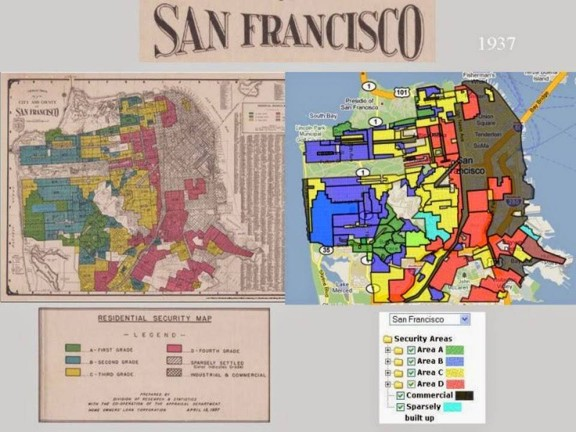
In 1937, the U.S. Navy purchased what became the Hunters Point Naval Shipyard. During World War II, the Second Great Migration brought tens of thousands of Black workers and their families to the neighborhood, seeking wartime jobs and dignity denied to them in the Jim Crow South. That same year, federal redlining maps drawn by the Home Owners’ Loan Corporation (shown above) encircled the Bayview in red ink, systematically denying Black, Asian, and Latino families access to mortgages, business capital, and equitable municipal investment.
Those redlining maps did not just determine housing values—they determined which neighborhoods San Francisco Unified School District would treat as worthy of stable teachers, modern facilities, advanced curricula, and long-term principal tenure. The redlining map and the SFUSD resource map are, functionally, the same map.
After the wartime economy collapsed, the shipyard became a decommissioning site for radioactive naval vessels used in the Marshall Islands nuclear tests. Plutonium-239, cesium-137, and strontium-90 were introduced into Bayview soil. In 1989, Hunters Point was declared a federal Superfund site—a designation reserved for the most severely contaminated properties in the United States, and one of the small number of such sites in the entire country. According to data compiled by Greenaction for Health and Environmental Justice, the U.S. Environmental Protection Agency, and the California Office of Environmental Health Hazard Assessment, Bayview–Hunters Point ranks in the ninety-sixth percentile in California and the ninety-ninth percentile nationwide for asthma hospitalizations. In 2018, community residents filed a twenty-seven-billion-dollar class-action lawsuit against Tetra Tech, the private contractor accused of falsifying radiological soil testing samples. In 2019, the U.S. Department of Justice filed its own civil fraud complaint.
This is the ground SFUSD chose to build Bret Harte, Charles Drew, Malcolm X, and George Washington Carver Elementary Schools on. This is the ground where Dr. Franklin reported for her first day of work in 1997 as a young teacher, and where she was still showing up nearly three decades later when the district decided her leadership was a threat. Every parent she served worked around asthma, absentee municipal services, and generational disinvestment before their child ever entered her classroom. That is the very definition of the Resources OUT that this investigation documents in the next section—the extraction of everything a community needs before the district audit even begins. It is not background; it is the operating environment SFUSD refused to acknowledge every time it audited her, questioned her Square receipts, and finally forced her resignation. When Dr. Franklin said at graduation, “The world needs to know how you don’t value us,” she was naming the through-line between the toxic soil, the redlined maps, and the district’s eight-month investigation of her career.
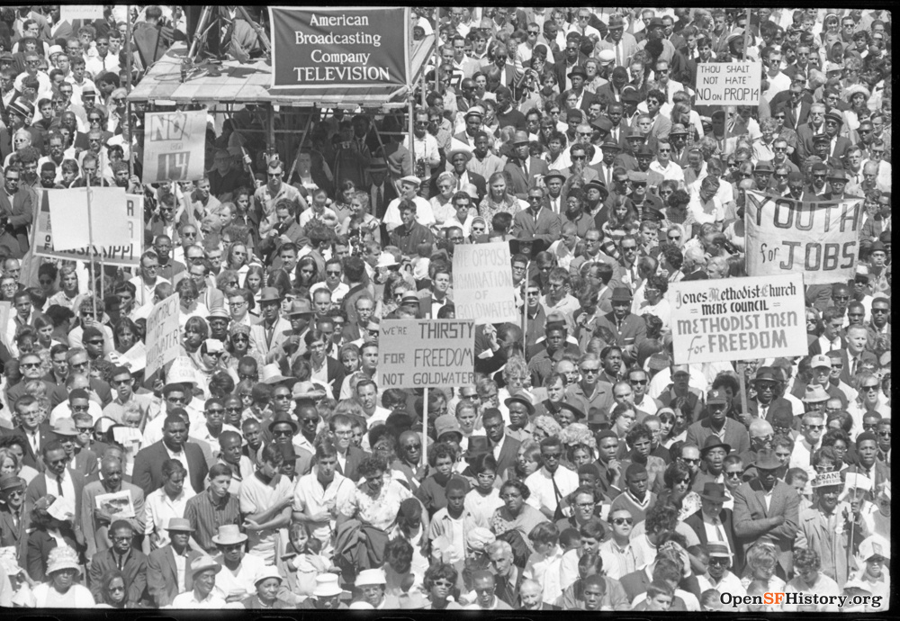
Educational containment mirrored environmental containment with a precision that no honest administrator can call coincidence. As the historical photograph above illustrates, the struggle against SFUSD’s racial hierarchy is not new: in July 1964, tens of thousands of San Franciscans marched through Civic Center Plaza demanding an end to de facto school segregation. At that time, seventeen SFUSD schools were more than ninety percent white, while nine schools were more than ninety percent Black. The landmark 1971 federal ruling in Johnson v. SFUSD found that the school district had “intentionally drawn segregated student assignment zones” and systematically assigned “Black teachers only to majority-Black schools,” where educators were “systematically less experienced and more poorly paid.” SFUSD responded with a succession of desegregation experiments: the Horseshoe Plan (1971), Educational Redesign (1978), and the court-monitored Consent Decree in San Francisco NAACP v. SFUSD (1983). Each was gradually dismantled under political pressure from wealthier neighborhoods. In 2005, the federal court’s oversight expired. The moment the courts stopped watching, SFUSD returned to the pattern Judge Weigel first found unlawful in 1971—these were the conditions that Dr. Franklin would walk into at Bret Harte nearly a quarter-century later, and it is that pattern that eventually swallowed her whole in 2026.
Beyond Black and White: The Multi-Racial BIPOC Coalition SFUSD Is Failing
The educational crisis in District 10 is not a Black issue alone. It is an across-the-board disenfranchisement of the multi-racial BIPOC coalition that sustains the Bayview–Hunters Point, Sunnydale, Visitacion Valley, and Portola corridors. Any narrative that reduces this struggle to a single demographic fails to capture the breadth of SFUSD’s systemic failure.
Samoan and Pacific Islander families, whose generational presence in Sunnydale and Alice Griffith is central to San Francisco’s cultural fabric, receive virtually no culturally responsive curriculum from SFUSD and remain nearly invisible in administrative leadership pipelines. Latinx and Chicanx families—who led courageous school walkouts in 1968 and 1969 to build multiracial student solidarity across San Francisco—continue to face chronic shortages of certified bilingual instructors and English Language Learner resources. Working-class Cantonese, Filipino, and immigrant Asian families in the Portola and Visitacion Valley neighborhoods—distinct from affluent Westside enclaves—are regularly denied adequate translation services and personalized educational support.
Mesepa Kaulave, Drew Academy Community Liaison, School Site Council Chair, and parent of three SFUSD students, articulated this collective reality during her on-the-record testimony for this investigation:
“Our families come from communities that have been historically underserved and overlooked. Our students deserve the same opportunities and celebrations as students in wealthier neighborhoods. Our families deserve transparency and respect. And our school deserves autonomy to serve our community in ways that actually work.”
Resources IN vs. Resources OUT: The Documented Financial Segregation
Bayview educator Noah Marjavi described the core structural mechanism of SFUSD’s inequality for this investigation: “SFUSD operates under a simple formula: Resources IN versus Resources OUT. Parent volunteers, private foundation dollars, and corporate matching flow freely INTO Westside and Northside campuses. Meanwhile, resources are actively extracted OUT of Bayview schools—through community divestment and the absence of any consistent infrastructure for parents to support the school. What flow of resources does exist goes TO parents, who are positioned as recipients of social services rather than as co-investors in their children’s education. And when the community organizes anyway, it is punished through punitive audits, asset seizures, and administrative confiscation.”
Independent reporting corroborates Marjavi’s analysis. As documented by EdSource and analyzed by the Berkeley Political Review, private Parent Teacher Association (PTA) fundraising creates a devastating opportunity gap across San Francisco elementary schools. Grattan Elementary in Haight-Ashbury raises approximately $1,000 per student annually through its PTA. By comparison, Junipero Serra Elementary in Bernal Heights raises approximately $25 per student—a staggering forty-to-one disparity in private supplemental funding. And that comparison still understates the crisis: many of San Francisco’s historically redlined schools have rarely, if ever, sustained a functioning PTA, raised a single supplemental dollar, or maintained the sort of consistent parental support infrastructure that Westside campuses take for granted.
| Dimension | Westside / Northside Schools | District 10 Schools (Drew, Bret Harte) |
| Direction of Money Flow | Resources IN: Private PTA funds, foundation endowments, and corporate matching flow into school programs without district interference. | Resources OUT: Parent-raised cash and electronic Square collections seized by central district audit; $7,000+ cash and $2,394.54 Square funds confiscated at Drew. |
| PTA / Foundation Capacity | ~$1,000 per pupil raised annually through private parent networks (e.g., Grattan Elementary). | ~$25 per pupil raised annually through grassroots collections (e.g., Junipero Serra Elementary); many redlined schools have never sustained a PTA at all. |
| Advanced Academic Offerings | Lowell High School offers 31 Advanced Placement (AP) courses (The New Yorker, March 2022). | Southeast high schools and feeder programs chronically underfunded, lacking comparable AP pipelines. |
| Socioeconomic Indicators | 33% of students qualify for free or reduced-price lunch at Lowell High School. | 60% at Balboa High School; 62% at Galileo Academy; over 85% across Bayview elementary campuses. |
| District Branding & Stigma | Celebrated in official district marketing as citywide academic crown jewels. | SFUSD published maps publicly branding Southeast schools as “low-performing,” including Bret Harte during Dr. Franklin’s principalship. |
Marjavi confirmed the real-world impact of the district’s public branding maps: “While Dr. Franklin was principal at Bret Harte, the literature SFUSD distributed at school enrollment fair events included district maps that specifically highlighted Southeast schools as ‘low-performing.’ Imagine what that scarlet letter does to prospective family enrollment. It told the entire city that a school led by a Black woman serving Black children was defective. That map wasn’t an objective evaluation; it was a public sanction.”
Even former SFUSD Board Vice President Alison Collins conceded on the record—quoted by Nathan Heller in The New Yorker—that the district’s funding architecture “basically means that schools that have students that are more likely to take tests get more money.” Sitting Commissioner Matt Alexander reinforced this finding, stating publicly that the district’s extra funding and prep allocations for AP programs had been “an inequitable practice for a long, long time.” SFUSD’s own leadership has admitted this systemic inequity in open public sessions. Yet the unequal funding pipeline remains intact.
The Garden Without Fences: What Dr. Franklin Built, and What SFUSD Destroyed
One of the most profound symbols of Dr. Franklin’s leadership at Drew Academy was the creation of a large, dynamic campus garden on the main schoolyard—designed deliberately without perimeter fences as an open community gathering space for the surrounding neighborhood.
How that garden came to exist is itself a documentary indictment of SFUSD. According to Marjavi, during a major school infrastructure renovation at Drew, Dr. Franklin recovered the funding for the garden from previously unused SFUSD green school bonds—bond money that had been quietly available but that Drew staff had never been told existed. Dr. Franklin, on being informed of the funds, simply asked, according to Marjavi, “Can we get those back?” She could. She did. The result is what SFUSD itself calls a “Green Schoolyard”—a model for nature-based play, discovery, and healing—built for the current children of the Bayview and, as Marjavi emphasizes, for the generations of families who have attended Drew Academy across decades. It is a living rebuke to every district administrator who has treated Bayview schools as under-resourced by necessity rather than by choice.
As Marjavi, who serves as Drew’s Garden Teacher, reflected: “Fences are a metaphor for gatekeeping. Dr. Franklin refused to gatekeep her school from the community that built it and from the generations of families who have attended Drew. SFUSD constantly builds institutional fences around Bayview children. She refused.”
Under Dr. Franklin’s stewardship, Drew Academy was steadily stabilizing. School social worker LaTonya Carpenter testified at the May 26, 2026 town hall that comprehensive behavioral care systems had dramatically reduced disciplinary referrals. Community partnerships with the Mission Science Workshop flourished, and Saturday family academies brought parents onto campus. As Kaulave documented in Part One, the school was finally establishing the culturally responsive support systems Bayview families had sought for decades.
Marjavi characterized SFUSD’s aggressive intervention in devastating terms: “SFUSD created chaos where calm was increasing. That was not bureaucratic incompetence. That was a deliberate choice.”
That choice is further illuminated by the physical renovation of the Drew campus. Marjavi described the recent facility upgrades as distinctly “gentrification-ready”—capital improvements that appear tailored to attract incoming affluent residents as real estate pressures accelerate in the Southeast sector, rather than serving current working-class families. When paired with the forced removal of a trusted Black principal and the installation of an external administrator from Oakland, the district’s maneuvers resemble a classic municipal displacement playbook: push out grassroots Black leadership, renovate the physical asset, and reposition the school for demographic transition.
The contrast with other neighborhood civic landmarks is stark. The Florence Fang Community Farm—named in honor of Florence Fang, the prominent, wealthy, and politically connected former publisher of the San Francisco Examiner—sits just two short blocks from Dr. Charles R. Drew Academy in the Bayview, celebrated, well-resourced, and institutionally protected. The site has drawn frequent official visits from prominent elected officials, including former U.S. House Speaker Nancy Pelosi and State Senator Scott Wiener. Wealth, media power, and political influence command municipal reverence. Grassroots Black educational leadership, by contrast, is subjected to eight-month forensic audits, stripped of student funds, and erased. Bayview residents understand the lesson: the city protects the powerful and disciplines the vulnerable.
The Lowell Precedent: The New Yorker Exposé, an Illegal Admissions System, and the Baseball Scandal
The most damning evidence of SFUSD’s two-tiered racial governance is found in the district’s handling of Lowell High School. In March 2022, staff writer Nathan Heller published a landmark investigation in The New Yorker entitled “What Happens When an Élite Public School Becomes Open to All?”
Heller documented a pattern of unaddressed campus racism. In winter 2021, an official online anti-racism educational forum at Lowell was vandalized with “slurs—the N-word, the K-word—and pornography.” Lowell students subsequently sent a joint letter to the Mayor condemning the “rampant, unchecked racism at Lowell.” Gabrielle Grice, President of Lowell’s Black Student Union, told Heller: “In most of my classes I’m the only Black student.” Aliyah Hunter, the BSU events coordinator, recounted how a Lowell teacher singled her out in front of the entire class during a slavery unit, stating that she could leave if she wished because the material would affect “your kind of people.” Jacqueline Juarez, a Latinx junior, described being excluded from study group chats and being told by her teacher to “learn from her peers” when she sought academic help. A student newspaper survey revealed that fifty percent of Lowell students had fallen asleep in class under severe psychological pressure.
Demographically, Heller showed that prior to the lottery, Lowell enrolled less than two percent Black students in a district that was eight percent Black, and twelve percent Latinx students in a district that was thirty-two percent Latinx. Lowell offered thirty-one AP courses, maintained a 99% graduation rate, and saw only 33% of its student body qualify for free or reduced lunch, compared to over 60% at Balboa and Galileo.
Noah Marjavi, speaking as a Lowell alumnus himself, provided this investigation with the vital legal and cultural dimension that district officials consistently evade:
“Let’s be completely clear about California education law. A competitive, test-based admissions system at a general public high school violates the spirit of the California Constitution, which mandates a free and common public school system. Lowell used standardized test scores as a legal fig leaf for decades to preserve an elite, segregated enclave inside a public system. When COVID-19 temporarily suspended testing, that fig leaf was removed—and the world finally saw both the radically different standard of academic preparation Lowell had quietly relied on for years and the racial hostility Black and Brown students were enduring inside its classrooms. That is why Nathan Heller’s New Yorker article was even possible. The screening mechanism had briefly broken down.”
When the School Board voted in 2021 to maintain lottery admissions, affluent alumni networks mobilized massive legal and financial resources. The Lowell Alumni Association sued the district, and a well-funded recall campaign ousted three school board commissioners in February 2022. By June 2022, the newly appointed board majority voted 4–3 to reinstate selective admissions.
Compare that institutional shield to what occurred at Drew Academy. When Dr. Franklin was investigated for eight months over grassroots parent fundraising, there was no litigation funded by affluent donors mobilized to defend her. For most of the investigation, the attack was largely invisible to the school community: Dr. Franklin came to work each day with a smile and a fierce determination to fight for her students. Only in the final month of the school year did the crisis fully surface—in a community town hall, in the testimony of a veteran social worker, and in the forced departure of a dedicated Black educator from administrative leadership.
The double standard reached its zenith in September 2026 with the resolution of the Lowell baseball scandal. Following an investigation by SFUSD and the California Interscholastic Federation (CIF) into race-based taunting by Lowell varsity baseball players targeting opponents during a junior varsity championship game against Lincoln High School, the district’s punishment consisted of requiring the team to forfeit three games, replacing the coaching staff, and mandating “implicit bias training.”
Three forfeited games for documented racial taunting at an interscholastic sporting event. Meanwhile, Dr. Franklin faced an eight-month forensic inquiry, the seizure of over $7,000 in cash, the unaccounted confiscation of $2,394.54 in Square funds, forced resignation, and a demotion to an ELD teaching post. Lowell forfeited three games; the Bayview lost its beloved principal.
The Unfinished Investigation: SFUSD Fired Dr. Franklin Before It Could Prove Anything
There is a fact about the SFUSD investigation of Dr. Franklin that the district has never willingly acknowledged in public. Co-author Maura Corkery, who first reported on Dr. Franklin’s ouster with Lydia Chávez for Mission Local, brings crucial new reporting to this installment: SFUSD forced Dr. Franklin out before its own investigation was ever completed. The eight-month audit that district officials cited to justify her removal was, at the moment they removed her, unfinished. There was no closing report. There were no publicly substantiated findings. There was only a Black principal, a Bayview school, and a predetermined outcome.
The irregularity was so serious that the SFUSD Board of Education itself—a body that, as a matter of governance, almost never intervenes in individual personnel investigations, because personnel matters are simply not the board’s statutory purview—stepped in. Multiple commissioners raised the issue directly and repeatedly, in open session and in closed session, until Superintendent Dr. Maria Su publicly agreed to reopen and finish the investigation she and her staff had already used as the basis to end Dr. Franklin’s principalship. That is not a routine board request. That is the elected board of the San Francisco Unified School District refusing to accept its own superintendent’s account of what happened at Drew Academy.
At the final Board of Education meeting of the 2025–2026 school year, the board asked Superintendent Su to show them the work: the investigative record, the analytical chain that linked evidence to findings, the paperwork behind the conclusions the district had already announced to the public and used to demote a twenty-nine-year veteran educator. According to the reporting reviewed for this installment, the Superintendent could not produce it. She could not walk the board through how conclusions had been reached, because in a strict investigatory sense, they had not been reached at all. The district had punished the principal first and gone looking for the paperwork afterward.
This is the single most important procedural revelation in the entire SFUSD record on Dr. Franklin. Every element of her removal—the seizure of over $7,000 in cash, the unaccounted disappearance of $2,394.54 in Square payments, the release from her administrative position on May 13, 2026, the forced resignation on May 22, the retaliatory demotion to an ELD teaching position at Carver Elementary, the cancellation of her summer assignment within twenty-four hours of a board protest—was executed on the authority of an investigation that SFUSD itself did not close. In any other context, that fact pattern alone would trigger a civil rights inquiry from the City Attorney’s Office. It has not.
Nor is Dr. Franklin fighting this alone. The Davis Vanguard and Destination Freedom Media Group have confirmed through community sources that the San Francisco branch of the NAACP is preparing to formally involve itself in the matter. The exact scope of that involvement is still being finalized, and this investigation will report the details as they become public. What is already clear is that the civil rights community understands what SFUSD is banking on the wider city not understanding: that Dr. Franklin’s ouster was not procedurally clean, not evidentiarily supported, and not, on the record, complete.
The Pattern, Laid Bare: SFUSD’s Racial Double Standard
| Institutional Response | Lowell High School (Westside) | Drew Academy (District 10, Bayview) |
| Trigger | Documented on-platform racial slurs (N-word, K-word) and pornography; racist classroom incidents; Latinx student exclusion; race-based baseball taunting. | Grassroots parent fundraising, Square donations, community handyman payments, and Amazon-delivered school supplies routed to principal’s home during renovation. |
| District Investigative Speed | Baseball investigation delayed for months; New Yorker documented racism years earlier without administrative discipline. | Investigation opened by email on October 8, 2025; eight months of forensic scrutiny—closed without a completed report. |
| Penalties Imposed | 3-game forfeit; coaching staff removed; “implicit bias training.” | Over $7,000 cash seized; $2,394.54 Square funds seized; principal forced to resign; retaliatory demotion to ELD teacher. |
| Institutional Protection | Wealthy alumni funded lawsuits and recall of 3 elected commissioners; merit admissions restored 4–3. | No protection. Successor principal imported from Oakland. Summer assignment for Franklin canceled 24 hours after community protest. |
| Public Framing | Prestige protected; The New Yorker coverage focused on “what happens when an elite school opens.” | SFUSD maps publicly branded Bret Harte as “low-performing” during Franklin’s tenure; Drew’s stabilization erased. |
This is not equity. This is a two-tiered public education system enforced by SFUSD’s Central Office at 555 Franklin Street. The pattern is structural, continuous, and institutional.
The Silence of the City Attorney: The Calculated Inaction of David Chiu’s Office
This investigation directs an urgent, specific question to San Francisco City Attorney David Chiu: why has San Francisco’s highest municipal law enforcement office remained completely silent regarding the documented civil rights abuses, unfinished investigations, and unlawful financial seizures inside SFUSD? Dr. Franklin was removed from her principalship on the authority of an investigation SFUSD itself did not close and did not defend to its own elected board. That fact alone is a civil rights matter—and yet the City Attorney has said nothing.
Under the San Francisco Charter and California law, the City Attorney is not merely an advisor; the office holds expansive affirmative litigation authority to protect the public interest, enforce civil rights statutes, and investigate municipal wrongdoing. The City Attorney’s Office has repeatedly demonstrated that it possesses the legal power to challenge the school district directly when politically advantageous. In February 2021, former City Attorney Dennis Herrera—with the active backing of Mayor London Breed—filed an unprecedented lawsuit against SFUSD and its Board of Education to force the reopening of public school classrooms during the COVID-19 pandemic. In March 2025, current City Attorney David Chiu joined SFUSD in a federal lawsuit challenging federal restrictions on AmeriCorps educational funding.
The legal precedent is undeniable: when City Hall wants to intervene in SFUSD affairs, it possesses every legal tool necessary. Yet when the issue involves institutional racism and civil rights violations against Black and Brown educators in District 10, the City Attorney’s Office has chosen total silence and inaction.
Consider what the City Attorney’s Office has ignored:
- The Unauthorized Seizure and Conversion of Community Funds: SFUSD confiscated over $7,000 in parent-raised cash and $2,394.54 in electronic Square payments from Drew Academy. The district has never returned these funds to the working-class families who contributed them, nor has it provided an audited accounting. The City Attorney has clear statutory authority under California Business and Professions Code § 17200 (Unfair Competition Law) and municipal fraud provisions to investigate this unlawful conversion of community funds.
- A Documented Pattern of Racial Retaliation: The retaliatory demotion of Dr. Franklin and the punitive cancellation of her summer assignment less than 24 hours after a community school board protest directly implicate the California Fair Employment and Housing Act (FEHA, Gov. Code § 12940) and the California Whistleblower Protection Act (Labor Code § 1102.5). The City Attorney routinely prosecutes private employers for identical retaliatory conduct.
- A Personnel Action Executed on an Unfinished Investigation: SFUSD terminated a twenty-nine-year veteran Black educator’s principalship on the authority of an investigation the Superintendent later could not defend to the elected Board of Education. That factual predicate alone triggers the office’s general oversight duties.
- The Systemic Violation of Article IX of the California Constitution: By maintaining an exclusionary two-tiered system that hoards advanced coursework at Lowell while starving District 10 campuses, SFUSD is violating the California constitutional mandate guaranteeing a free, common, and equal system of public education (Butt v. State of California, 1992).
- The Lowell Double Standard: SFUSD’s disparate disciplinary standards—imposing an eight-month career-ending investigation on a Black female principal over grassroots student funds while imposing a nominal three-game forfeit for documented racial taunting at Lowell—constitute prima facie evidence of institutional disparate treatment under the Unruh Civil Rights Act (Civil Code § 51).
Why is City Attorney David Chiu so aggressive in defending consumers and suing federal agencies, yet utterly paralyzed when confronted with institutional discrimination in the Bayview? Is the political cost of holding SFUSD accountable to Black and Brown families simply too high for City Hall? The Davis Vanguard and Destination Freedom Media Group formally call upon Mr. Chiu to break his silence and launch an immediate, independent civil rights inquiry into SFUSD’s financial seizures, personnel practices, and unfinished investigations in District 10.
Calling In Mayor Daniel Lurie: A Direct Address
Mayor Daniel Lurie was inaugurated as the forty-sixth Mayor of the City and County of San Francisco on a public pledge of transparency, executive accountability, and an end to entrenched bureaucratic dysfunction. In his “Family Opportunity Agenda,” launched January 14, 2026, Mayor Lurie committed to making San Francisco a thriving home for all families.
Yet on the most urgent educational equity test of his administration—the institutional disenfranchisement of Black, Brown, Samoan, Pacific Islander, and working-class Asian children in District 10—Mayor Lurie has maintained a detached silence.
This is not a partisan attack. In investigative journalism, this is what is known as a “call in.” A call out seeks to dismiss. A call in invites leadership to take responsibility. This investigation directly invites Mayor Lurie to use the formidable power of the Mayor’s Office to stand with the families of District 10 and demand the accountability SFUSD central leadership refuses to provide.
There are real-world dynamics that Mayor Lurie must address with radical honesty. As Mission Local reported in February 2026, Mayor Lurie sends his own children to private school. He is part of the approximately thirty percent of San Francisco parents who opt out of public education. But an elected leader who does not personally rely on SFUSD bears an even greater moral duty to champion the working families who have no private alternative. That duty does not diminish when the students are in the Bayview; it multiplies.
Following the Lowell baseball findings on September 1, 2026, Mayor Lurie told reporters: “There should be no tolerance of hatred, for those types of remarks, that type of behavior.” This investigation asks Mayor Lurie: does that standard apply equally to the systemic harm inflicted on Dr. Vidrale Franklin and the children of Drew Academy, whose parent-raised funds remain confiscated in district coffers?
Concrete, actionable steps for Mayor Lurie:
- Convene an In-Person Bayview–Hunters Point Education Roundtable at Drew Academy alongside Dr. Franklin, Mesepa Kaulave, School Site Council members, social worker LaTonya Carpenter, Virginia Marshall (SF-NAACP), Vanessa Marrero (Parents for Public Schools SF), and District 10 Supervisor Shamann Walton.
- Order an Immediate Municipal Audit of all student activity funds seized from Drew Academy and mandate full public restitution of the $7,000+ cash and $2,394.54 in Square payments to the school’s community programs.
- Bypass SFUSD Administrative Bottlenecks by channeling city-controlled funding from the Public Education Enrichment Fund (PEEF), the Department of Children, Youth & Their Families (DCYF), and environmental health grants directly to District 10 school sites.
- Demand Full Executive Transparency from Superintendent Dr. Maria Su and the Board of Education regarding the systematic displacement of Black administrators.
- Direct the City Attorney’s Office to cooperate fully with a state Civil Rights Department investigation into SFUSD’s discriminatory practices in District 10.
The Struggle Continues: A Closing Word
This investigation began at a fifth-grade graduation ceremony in the Bayview where Dr. Vidrale Franklin refused to depart in silence. It has now traversed over a century of racial segregation, seven decades since Brown v. Board of Education, five decades of abandoned desegregation decrees, a federal Superfund site, a New Yorker exposé, an elite sports scandal, an unfinished district investigation, and a silent City Attorney’s Office.
These events are not disconnected anomalies. They are the predictable consequences of a two-tiered public school system that prioritizes institutional privilege on the Westside while treating District 10 as an administrative colony.
Part Three of this series will examine specific municipal and legal remedies for structural reform, present a forensic financial audit of SFUSD Central Office expenditures over the past decade, and amplify continuing testimony from District 10 educators and families who demand justice.
The community’s trust in independent Black journalism to tell this unvarnished truth remains unshakable. The demand for answers will not subside.
Comprehensive Source List & Investigative Documentation
This investigation is based on primary legal filings, published journalism, official government records, and exclusive on-the-record community testimony. Where sources requested anonymity to protect against professional retaliation, those identities have been protected.
A. Exclusive On-the-Record Interviews and Community Testimony
- 1. Noah Marjavi — Bernal Heights resident, longtime SFUSD educator, Lowell High School alumnus, and Dr. Charles R. Drew Garden Teacher. Exclusive on-the-record interview and written source contributions to this investigation with Journalists Malik Washington and Maura Corkery (2026).
- 2. Mesepa Kaulave — Community Liaison, Chair of School Site Council, and parent, Dr. Charles R. Drew College Preparatory Academy. Continuing on-the-record investigative interview (July 2026).
- 3. Dr. Vidrale Franklin — Former Principal, Dr. Charles R. Drew College Preparatory Academy; public address at 2026 fifth-grade commencement ceremony.
- 4. LaTonya Carpenter, LCSW — School Social Worker, Dr. Charles R. Drew College Preparatory Academy; public testimony at Drew Community Town Hall (May 26, 2026).
- 5. Maura Corkery & Lydia Chávez — Journalists; authors of the original groundbreaking investigation for Mission Local that first broke the story of Dr. Franklin’s forced resignation (June 2026); investigative source records regarding the unfinished SFUSD investigation, the Board of Education’s intervention, and the June 2026 final board meeting.
- 6. San Francisco Branch, NAACP — Preparing formal engagement with the Franklin – Drew Academy matter; scope of involvement developing at time of publication (2026).
B. Published Investigative Journalism
- 7. Maura Corkery & Lydia Chávez, “Vidrale Franklin, Drew Elementary, and the San Francisco School District: The Fight Behind a Bayview Resignation,” Mission Local, June 2026.
- 8. Nathan Heller, “What Happens When an Élite Public School Becomes Open to All?” The New Yorker, March 14, 2022 issue.
- 9. Isaac Chotiner, “How San Francisco Renamed Its Schools,” The New Yorker, February 6, 2021.
- 10. KQED News, “SF Varsity Baseball Team to Forfeit 3 Games, Remove Coaches After Investigation,” September 1, 2026.
- 11. ABC7 News, “SF’s Lowell High Baseball Team Required to Forfeit Games, Replace Head Coach After Racial Incident,” September 2026.
- 12. San Francisco Chronicle, “Lowell High Racial Misconduct Baseball” investigative reporting series, spring–fall 2026.
- 13. Io Yeh Gilman, “Here’s How Many S.F. Politicians Send Their Kids to Public School,” Mission Local, February 13, 2026. URL
- 14. Mission Local investigative reporting series on Dr. Vidrale Franklin, Drew Elementary, and SFUSD administration (June 2026).
- 15. Kyra Peterson, “A Legacy of Separation: Connecting San Francisco’s History of Redlining to the Educational Disparities in SFUSD,” Berkeley Political Review, April 22, 2024.
- 16. San Francisco Public Press, “As Courts Flip-Flopped on School Integration, Diversity Has Remained Elusive,” February 5, 2015.
- 17. EdSource, “How Budget Cuts and PTA Fundraising Undermined Equity in San Francisco Public Schools” (2014).
C. Primary Legal, Historical, and Government Records
- 18. OpenSFHistory / Western Neighborhoods Project — Historical Photograph wnp28.2260: Civil Rights & School Desegregation March in Civic Center Plaza, San Francisco, July 12, 1964.
- 19. Home Owners’ Loan Corporation (HOLC) — San Francisco Residential Security Map (Prepared by Division of Research and Statistics with the Appraisal Department, April 18, 1937; National Archives and Records Administration, Record Group 195).
- 20. City and County of San Francisco v. San Francisco Board of Education and SFUSD, San Francisco Superior Court (February 2021 school reopening lawsuit by City Attorney Dennis Herrera).
- 21. SFUSD and City of Santa Fe v. Corporation for National and Community Service (AmeriCorps), U.S. District Court, Northern District of California (March 2025 litigation co-led by City Attorney David Chiu).
- 22. San Francisco Unified School District, “Facing Our Past, Changing Our Future: Part I — A Century of Segregation in San Francisco Unified School District (1851–1971)” (2020).
- 23. San Francisco Unified School District, “Facing Our Past, Changing Our Future: Part II — Five Decades of Desegregation in SFUSD (1971–today)” (2020).
- 24. Johnson v. San Francisco Unified School District, U.S. District Court, Northern District of California (1971).
- 25. San Francisco NAACP v. SFUSD, 576 F. Supp. 34, U.S. District Court, Northern District of California (1983 Consent Decree).
- 26. Ho v. SFUSD, settlement agreement (1999), invalidating race-conscious student assignment.
- 27. Lau v. Nichols, 414 U.S. 563 (1974), establishing bilingual education rights.
- 28. Tape v. Hurley, 66 Cal. 473 (1885).
- 29. Mendez v. Westminster, 64 F. Supp. 544 (S.D. Cal. 1946); 161 F.2d 774 (9th Cir. 1947).
- 30. Brown v. Board of Education of Topeka, 347 U.S. 483 (1954).
- 31. Butt v. State of California, 4 Cal. 4th 668 (1992), establishing fundamental right to equal educational opportunity under California Constitution, Article IX.
- 32. California Constitution, Article IX, § 5 (Common School System).
- 33. California Government Code § 12940 (Fair Employment and Housing Act).
- 34. California Labor Code § 1102.5 (Whistleblower Protection Act).
- 35. California Civil Code § 51 (Unruh Civil Rights Act).
- 36. California Business and Professions Code § 17200 (Unfair Competition Law).
D. Environmental Justice and Public Health Records
- 37. Carleton College Department of Chemistry, “History and Legacy of Environmental Racism in the Bayview–Hunters Point Neighborhood” (2022).
- 38. Greenaction for Health and Environmental Justice, “Pollution, Health, Environmental Racism and Injustice: A Toxic Inventory of Bayview Hunters Point, San Francisco.”
- 39. U.S. Environmental Protection Agency, Hunters Point Naval Shipyard Superfund Site Profile.
- 40. California Office of Environmental Health Hazard Assessment (OEHHA), CalEnviroScreen 4.0.
- 41. San Francisco Civil Grand Jury, “Buried Problems and a Buried Process: The Hunters Point Naval Shipyard in a Time of Climate Change” (2021–2022).
- 42. U.S. Department of Justice, Civil Fraud Complaint against Tetra Tech, Inc. (2019).
E. Municipal and District Administrative Records
- 43. San Francisco Unified School District Board of Education, Public Meeting Records and Transcripts (2021–2026), including the final Board meeting of the 2025–2026 school year at which the Superintendent was asked to produce the Franklin investigation record.
- 44. California Department of Education, School Directory Profile of Dr. Charles R. Drew College Preparatory Academy (CDS Code 38-68478-6104673).
- 45. Office of Mayor Daniel Lurie, “Family Opportunity Agenda” launch announcement, January 14, 2026.
- 46. Office of Mayor Daniel Lurie, press briefing on Lowell High School baseball investigation findings, September 1, 2026.
Our song/video for this article is: Common and John Legend Perform ‘Glory’ From ‘Selma’