Gary, Indiana — the Blackest city in America — sat in the dark for fourteen days. The blackout was a storm story. What happened next was a story about whose suffering this country sees, and whose it doesn’t.
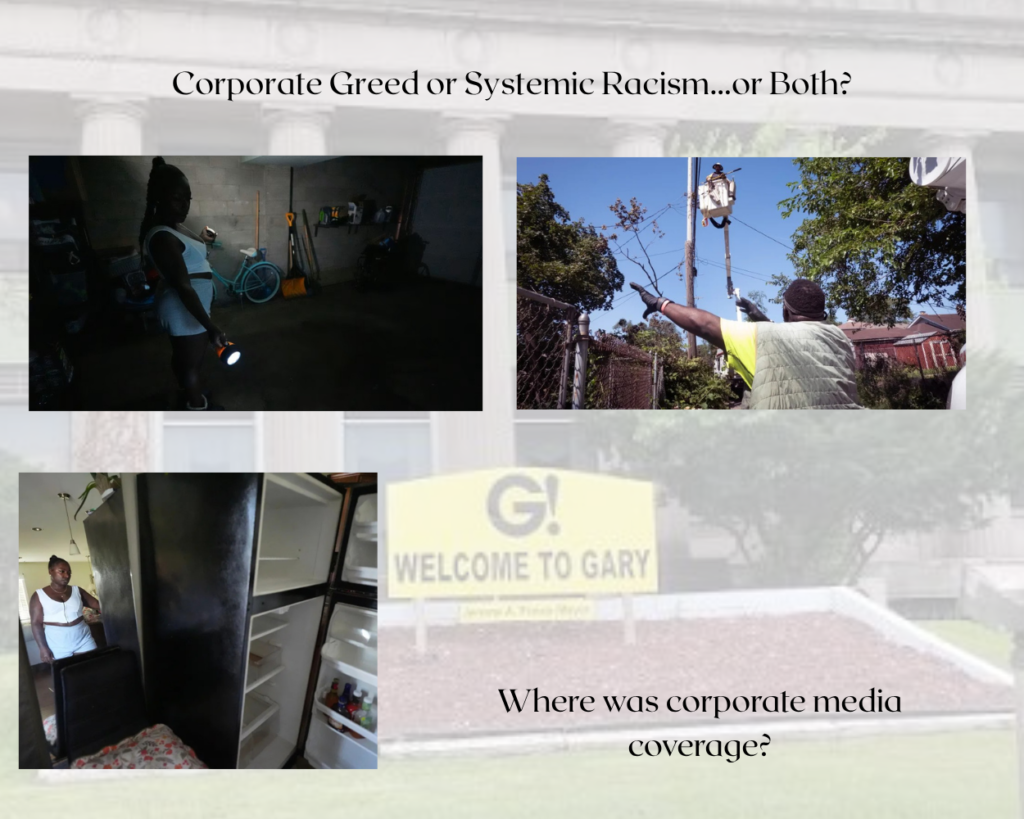
Photo credits:
Top left: https://www.theatlantic.com/health/2026/08/gary-indiana-blackout/688417/
The Lights Are Back On in Gary, Indiana
Top Right: https://www.motherjones.com/politics/2026/08/gary-indiana-power-outage-nipsco-utility-corporate-greed-blame-blackout-power-outage-storm/
“Corporate Greed”: Outraged Gary Locals Take Aim at Utility Over Prolonged Blackout (Photo Caption: A Gary resident queries a utility worker about when power will be restored to his home. Scott Olson/Getty)
Bottom Left: https://prospect.org/2026/08/28/gary-indiana-americas-latest-climate-victim/ (Photo Caption: Shatiya Hardin checks her refrigerator after power outages at her home in Gary, more than a week after the storm passed through the area. Nam Y. Huh/AP Photo) Gary, Indiana, Is America’s Latest Climate Victim
This community has already faced structural racism and disinvestment. A two-week blackout unleashed a humanitarian disaster.
Background Image: https://www.facebook.com/groups/2213102018/ You Know You’re From Gary, Indiana Group (G.I.)
https://www.facebook.com/groups/2213102018/posts/10160034898037019/
GARY — The lights are back on here, and you can tell the date by the smell. It hangs in the doorways of the small brick houses along Broadway and in the garden apartments of Marshalltown: the sweet-rot stink of two weeks of spoiled food dragged to the curb, of mold blooming in drywall, of a city that spent fourteen days and nights marinating in its own abandonment. Ask residents what time their power returned and they answer to the minute — 11:32 p.m. Saturday; just after midnight Sunday; 2:45 p.m. Monday — the way survivors of violence recall the hour of the blow. The lights are back on. The question is whether anyone in America noticed they were ever off.
On August 11, a derecho packing winds near 100 miles an hour — the force of a Category 2 hurricane — tore across northwest Indiana, snapping an estimated 300 utility poles, crumpling 44 steel transmission towers, and killing power to more than 370,000 customers of the Northern Indiana Public Service Company, the monopoly utility known as NIPSCO. At least seven Hoosiers died in the storm’s sweep. Ninety-five percent of Lake County went dark. What followed was one of the longest urban blackouts in modern American history — and a forensic map of who, in this country, gets rescued first.
“We’re the Blackest City Out Here”
Gary is a city of roughly 69,000 souls, about 75 to 80 percent of them Black — the Blackest city in Indiana, and by most measures in America. Nearly a third of its residents live in poverty. The median household income is about $40,000, barely half the state figure. One in five residents is 65 or older. It is a city built by Black migrants who came north for the steel mills, then watched the mills, the tax base, and the white population leave — taking with them, over five decades, the maintenance budgets, the political leverage, and, as August proved, the place in line.
In the first hours after the storm, the outage was genuinely regional. Then the region came back — and Gary didn’t. First Dyer (87 percent white) and East Chicago were restored, then Hobart and Merrillville, then Munster (85 percent white), Highland (82 percent white), Portage (81 percent white). A week after the storm, 26,836 Gary customers remained dark. At the ten-day mark, the city held roughly two-thirds of the area’s remaining outages; by the final week, more than 70 percent of everyone still without power in the county lived in Gary. NIPSCO’s own restoration schedule made it official: Gary was the last community in its entire service territory slated to get its lights back.
This compilation of videos from residents across Gary and Northwest Indiana shows the excruciating conditions people say they’re enduring during the current crisis. Posted by Black Indy LIVE https://www.facebook.com/BlackIndyLIVE
THESE ARE THE VOICES AND IMAGES THAT DESERVE NATIONAL ATTENTION.
And then the mayor of Gary said the quiet part into a microphone. Eight days in, Eddie Melton was still framing the blackout as a regional misfortune. But by the second weekend, he told The Atlantic, he had learned something worse: Gary had not initially been on NIPSCO’s restoration schedule at all. The Blackest city in the state had been, in the literal bureaucratic sense, overlooked — left off the list — until the city itself pushed back.
NIPSCO insists its process is colorblind — that repairs follow “the hierarchy of the grid,” that “no outage is being overlooked, and no customer will be left behind.” But a procedure is only as neutral as the system it operates on. Gary’s grid was almost entirely above ground, strung beneath decades-old oaks, starved for generations of the tree-trimming and hardening budgets that flowed to whiter, wealthier territory. A neglected grid fails hardest where it was neglected. The hierarchy can be blind. The outcome never is. Peer-reviewed research on energy injustice has found exactly this nationwide: low-income Black households face more outages and slower restorations after extreme weather. Gary was not an anomaly. It was a case study with a population attached.
The people living it did not need a study. As the blackout stretched into its second week, resident-shot footage from Gary went viral on Instagram, and one man stared into the camera and said what the outage maps were already saying: “We’re the Blackest city out here, so they don’t want to check on us.” Another resident summed up the city’s ledger with its monopoly in a single breath: “We don’t pay, we get cut off. But when disaster happens, they want to charge us. They have billions of dollars, we’re working day-to-day.”
Power Restored to Gary, IN, after 14 days. Here’s How that Compares to other blackouts Read Full Story (link below) – wlkynews (Facebook): https://www.facebook.com/wlkynews
https://www.facebook.com/photo/?fbid=1068629185541016&set=a.161119449625332
What Fourteen Days of Darkness Looked Like
Kimya Williams, 50, knew the drill — that was the tragedy. Twenty-one years ago she survived Hurricane Katrina in New Orleans, where she learned how a Black family endures when the grid dies and the cavalry doesn’t come. So when Gary went dark, she opened the hood of her car. “I used my car battery as a generator,” she said. “I plugged my refrigerator into an inverter. I learned that from Katrina.” It wasn’t enough. The food spoiled. The heat settled into the walls. “It was too triggering. It was too dark,” she said, and she fled to Indianapolis. When she came home, “my house smells like mold and mildew.” A woman who escaped one abandonment spent August reliving it in another state, in another decade, in a disaster with no name.
Across the city, the arithmetic of survival repeated itself in thousands of kitchens. David and Tiffany Rucker drove an hour to Chicago every single day — in a car with a broken transmission — to charge David’s BiPAP ventilator, which holds only four hours of battery, just enough to sleep and wake and do it all again. Willett Wright, 77, sat powerless and thought of the seniors marooned above him: “Our seniors are stuck in their apartments, completely dark. There’s no generators in the world that can get up to their apartments. They’re stuck in their rooms with all this heat, and no food.” Residents threw out maggot-filled refrigerators, charged phones in running cars, and spent their last dollars on gas to drive darkened streets — no working streetlights, past uprooted trees and live power lines — hunting for ice and baby formula. “At night we’re sweating, we’re irritable, we have children to look out for, elderly people who need electricity for oxygen tanks,” said resident Shatiya Hardin. “It’s not OK for us to continually be in survival mode.” Pastor Eric Boone of Tree of Life Missionary Baptist Church opened his sanctuary to families who lost their homes outright. “Some people are 70 and 80 years old, in hot conditions with no air conditioning, and it’s 85 degrees in the house,” he said. “People who were already living check to check are now trying to put gas in cars and generators while needing baby formula and diapers. You name it, we saw it.
The Half-Billion-Dollar Utility
Against all of this, set the numbers of the Northern Indiana Public Service Company. NIPSCO’s customers already pay the highest electric bills of any of Indiana’s five investor-owned utilities — some Gary households reported monthly charges spiking as high as $1,447. In the first half of 2026, while its Gary infrastructure rotted, the company booked roughly half a billion dollars in profit. In the days after the storm, residents sitting in the dark noted the one thing that arrived exactly on schedule: the bill.
The physical failure, by the company’s own admission, was not a repair job but a rebuild — which is a confession. What stood over Gary before August 11 was not a resilient grid but a patchwork of aging lines running beneath trees the company had been warned for years to cut back. A class-action lawsuit now alleges precisely that: that NIPSCO’s vegetation-management failures “predictably” produced the catastrophe. The company denies it and vows to fight. Meanwhile, NIPSCO had found the money and the urgency for other priorities — last year it launched a spinoff, GenCo, to fast-track power generation for the region’s data-center boom. The servers, presumably, would not be left off the schedule.
“I worked at NIPSCO for 15 years,” said Mayor Melton, a former employee. “It does not take that long to turn the lights on.” The Rev. Boise Kimber, president of the National Baptist Convention, which rallied nearly 40 Gary churches to the relief effort, named it outright: “What we are witnessing in Gary is not an unavoidable natural disaster, but a man-made crisis born of corporate greed and environmental injustice.”
Where Was the Cavalry?
Here is the question that should hang over every hearing this fall: why did the United States government allow a blackout in an American city to run for fourteen days?
The timeline is an indictment of its own. The storm hit August 11. Four days later, Washington issued a federal Emergency Declaration — a limited instrument covering emergency protective measures for government entities, delivering not one dollar of direct aid to a single family sweating in a dark apartment in Gary. Not until August 20 — day nine — did Governor Mike Braun submit an expedited request for a Major Disaster Declaration, the Stafford Act mechanism that unlocks FEMA’s Individual Assistance. FEMA assessors toured the damage while residents hauled their refrigerators to the curb. The full declaration was approved only after a direct call from Mayor Melton to President Trump — by which point the lights were already substantially back on. The cavalry, such as it was, arrived after the siege had ended. And no one in Washington sent so much as a single federal crew to raise a pole: restoration remained, start to finish, in the hands of the monopoly that had failed.
The absence was so conspicuous that ordinary Americans noticed. When the Black financial media platform Earn Your Leisure devoted an episode of its “Black Out” program to the crisis, its audience kept circling the same missing ritual. “When something like this storm damage and outage happens, you used to hear of utility workers and trucks coming in from other states to help out to restore power,” one commenter wrote. “Something is amiss!” Experts now agree the instinct was right: NIPSCO may have failed to put out a wide enough call for mutual aid from other utilities — or waited too long to make it. “Clearly something is broken here,” said Tyson Slocum, energy program director at Public Citizen, noting that a two-week restoration is far beyond typical storm recovery. “Not having utility service is a human rights issue and can become a life and death issue.”
Even the governor, a Republican not given to theatrical populism, finally reached for the lever. Braun ordered the Indiana Utility Regulatory Commission to investigate NIPSCO’s storm preparation and response — including whether money approved for infrastructure and reliability was ever actually spent on it — and declared that the utility “has failed to keep its end of the bargain.” But the deeper design failure is Washington’s. The Stafford Act is reactive, request-based, and bureaucratically slow; it routes rescue through state paperwork and damage-assessment forms. That machinery functions as indifference when the population waiting on it is poor, Black, and politically expendable. Ask yourself whether Carmel, Indiana, or Lake Forest, Illinois, would have been permitted to sit dark for two weeks while the forms were filed. You know the answer. So does Gary.
The Story America Didn’t Watch
There is a second abandonment inside this one, and it belongs to my own profession. For two weeks, an American city of 69,000 people lived without power — ventilators charged in Chicago parking lots, seniors stranded in blacked-out high-rises, food rotting in August heat — and the national press largely looked away. The story was carried, instead, by the community itself: by residents livestreaming from candlelit porches, by Black-owned platforms like Earn Your Leisure, by young organizers on the ground. One of them, a Gary woman named Aja Hall, posted footage of the aftermath with a GoFundMe in her bio and a caption that should be engraved on the assignment desk of every newsroom in America: “It’s crazy that once the cameras are gone we are still surrounded by darkness and lies. People need more and they deserve more from our legislation.”
Her sentence is the whole indictment. The cameras — such as they were — came late and left early. The New York Times and The Atlantic arrived as the power returned, on day twelve and day fifteen respectively; cable news barely came at all. “We kno why it’s no coverage,” one viewer wrote beneath the Earn Your Leisure episode, and the comment sits there unanswered because it is unanswerable. When a hurricane floods a coastal county, the anchors wade in on day one. When the Blackest city in America loses power for two weeks, the coverage arrives with the apology tour. The disparity in restoration has a twin: a disparity in attention. Gary was failed twice — once by the grid, and once by the spotlight.
“This is bigger than a power outage in Gary, Indiana,” said Bernice King, daughter of Martin Luther King Jr. “It is part of a pattern. Black communities have too often been expected to endure conditions that would be treated as intolerable somewhere else.” The pattern has a paper trail — Katrina, Flint, Altadena — and a peer-reviewed literature to match. The storm was an act of nature. The fourteen days were an act of omission: by the utility that left Gary off the schedule, by the federal machinery that took nine days to file the right form, and by the press that treated an American blackout as a local story.
“We Keep Us Safe”
If there is a redeeming chapter, Gary wrote it itself. Black Lives Matter Grassroots ran daily community giveaways — charging stations, gas cards, dry ice, food, bottled water — even as its own members sweltered in the same darkness. Frontline organizers shouldered chainsaws and cut open the blocked roads themselves; in Marshalltown, where both entrances were sealed by fallen trees, resident Latrice Farmer said, “Residents had to carve themselves out.” Nearly forty churches became shelters and cooling stations. World Central Kitchen served meals; the Salvation Army distributed supplies; food influencer Keith Lee and Pacers star Tyrese Haliburton put up $30,000 for relief — private generosity filling the crater left by public machinery. “We have to keep boots on the ground. We can’t trust the government to take care of us and corporations will only continue to oppress us,” said Akili Shakur, co-founder of BLM Grassroots Gary. “We must nation-build.” It was beautiful. It was heroic. It should never have been necessary.
The Reckoning
What comes next is a contest between accountability and amnesia. The class-action suit grinds forward. The IURC investigation will ask where the infrastructure money went. Mayor Melton has presented NIPSCO with a list of demands — a 60-to-90-day moratorium on disconnections, no shutoff notices, and one question that must be answered in writing: “What are you going to do to prepare us for the next storm?” Community leaders want more than patches: they want the utility legally bound to bury the lines, modernize the substations, and fund the tree-trimming it starved for decades — to rebuild Gary’s grid not to its fragile pre-storm state, but to the standard its customers, the highest-billed in Indiana, have been paying for all along. There is even a proposal in the air that Earn Your Leisure bring its Investfest to Gary, to turn the nation’s fleeting glance into lasting investment.
But the larger reckoning is not NIPSCO’s alone. A storm exposed a grid; the grid exposed a city; and the city exposed a country — one in which a community can be left off the restoration schedule, off the front page, and out of the federal frame, all at the same time, for fourteen days, in the year 2026. “I grew up in Gary, and social inequality was very evident to me,” said Erin Carreon, a University of Chicago doctoral researcher who sat through the blackout herself. “Seeing how the city has been neglected over the years has been very central to my life.”
The lights are back on in Gary. The food has been thrown out, the ventilators are humming, the bills are due. But somewhere in the files of a utility, and in the logs of a federal agency, and in the archives of every newsroom that filed this story late, there is a record of fourteen days during which America’s Blackest city was left to power itself with car batteries and church basements. The next storm is already forming somewhere over the plains. The only question that matters is the one Gary has been asking all along: when it hits the next Black city, will anyone come — and will anyone watch?
Sources
- The Atlantic — “The Lights Are Back On in Gary, Indiana” (Aug. 2026): Mayor Melton on Gary being left off NIPSCO’s restoration schedule; restoration order (Dyer, East Chicago, Hobart, Merrillville); Rucker family ventilator account; Willett Wright; residents recalling restoration times to the minute; NIPSCO highest-billed of Indiana’s five investor-owned utilities; peer-reviewed findings on slower restoration for low-income Black households
- CNN / Associated Press — “Powerful storms knocked out power in northwest Indiana 2 weeks ago. This majority Black city has suffered the most” (Aug. 25, 2026): Kimya Williams account; 26,836 Gary customers out on Aug. 18; demographics
- Mother Jones / Capital B — “‘Corporate Greed’: Outraged Gary Locals Take Aim at Utility Over Prolonged Blackout” (Aug. 2026): Pastor Eric Boone; Rev. Boise Kimber / National Baptist Convention; class-action suit; GenCo data-center spinoff; restoration statistics; Mayor Melton quotes
- New York Times — “Indiana Governor Calls for NIPSCO to Be Investigated Over Widespread Power Outages” (Aug. 24, 2026): Braun’s IURC probe; Public Citizen’s Tyson Slocum; expert findings on the delayed mutual-aid call
- USA TODAY (Kofi Mframa) — “Two weeks. No power. Gary, Indiana, failed Black citizens.” (Aug. 25, 2026): Shatiya Hardin; Latrice Farmer; NIPSCO half-billion-dollar profits; $1,447 bills; community comparison; BLM Grassroots / Akili Shakur
- Instagram (viral resident footage) — “We’re the Blackest city out here, so they don’t want to check on us” (Aug. 2026): resident quotes; community mutual-aid footage
- Earn Your Leisure (Instagram/YouTube) — “Black Out” episode on the Gary blackout and audience commentary on the absent out-of-state utility response and Investfest proposal (Aug. 2026)
- Instagram — Aja Hall, on-the-ground aftermath footage: “Once the cameras are gone we are still surrounded by darkness and lies” (Aug. 2026)
- Emerald Book — “How Decades of Neglect Left Indiana’s Only Black Town Without Power” (Aug. 2026): Phase 1/Phase 2 rebuild demands; IURC accountability; above-ground grid and tree-trimming neglect
- Wikipedia — “2026 Gary power outage”: timeline (Aug. 11 storm; Aug. 15 Emergency Declaration; Aug. 20 Major Disaster request; Aug. 26 restoration to 99%); 374,500 customers; 95% of Lake County; seven deaths
- City of Gary — “Mayor Eddie Melton Applauds Federal Disaster Declaration” (Aug. 2026): Major Disaster Declaration approval; Lake County Individual and Public Assistance; Melton’s call with President Trump
- WGN-TV — “Braun: Major disaster declaration submitted to FEMA as storm recovery continues” (Aug. 2026)
- LA Progressive — “Blackout in Gary: Disaster Capitalism and the Abandonment of Black America” (Aug. 2026): Bernice King statement; mutual-aid networks
- Salvation Army USA / BET — Keith Lee & Tyrese Haliburton $30,000 Gary relief donation (Aug. 2026)
Our song/video for this article is:
Kelly Price – Healing