
A Single Mother Beat the John Stewart Company. Then, the Same Day She Settled, They Moved to Evict Her Again.

Journalistic Note: Lynette Moore with the help of a private attorney and another attorney from Bay Area Legal has confronted John Stewart Property Management. At this time in her struggle, she feels overwhelmed and in need of support. I encourage the strong women and men at Alice Griffith Apartments in San Francisco to read her story and to be encouraged. The City and County of San Francisco and the California Attorney General’s Office CANNOT continue to ignore the civil rights and human rights abuses you are subjected to on a daily basis, and I don’t think they will. Know this, that if they are not with you, the Davis Vanguard and Destination Freedom Media Group will continue to report and advocate for justice.
For nearly a year, this reporter has documented what tenants inside San Francisco’s Alice Griffith Apartments have described as a system of neglect, retaliation, and institutional indifference operating under the management of the John Stewart Company. Across nine installments of “The Price of Being Poor,” residents have described mold, rodents, sewage failures, structural deterioration, broken elevators, unsafe living conditions, and a reported cluster of deaths that they insist demands independent scrutiny. They did not suffer silently. They organized. They documented. They filed grievances. They showed video evidence of vermin in their homes to city officials and legal representatives sitting in the same room. And when they spoke, they described being met not with urgency, but with pressure.
That reporting record is a matter of public record:
Open Letter to California Attorney General Rob Bonta
Special Investigative Report: The Price of Being Poor;
The Price of Being Poor — Part 4: The People Fight Back;
THE PRICE OF BEING POOR — PART 6: The Legal Reckoning Begins;
The Price of Being Poor – Part 7;
The Price of Being Poor – Part 8 and Built on Promises, Managed by Contradictions – Price of Being Poor Part 9
Now, more than 30 miles across the bay in Pinole, California, a single mother named Lynette Moore has done something few tenants living inside John Stewart–managed properties have been able to do. She fought a habitability case against the John Stewart Company — and she won.
But almost as soon as the ink dried, John Stewart came back for her again.
The Settlement — and the Same-Day Eviction Filing
Ms. Moore has confirmed to this reporter that she has reached a settlement with the John Stewart Company’s insurance carrier on her habitability case. She also confirmed that on the very same day the settlement was finalized, the attorneys representing John Stewart Property Management filed a new petition to evict her from her home in Pinole, California.
“Not a coincidence,” she wrote.
Her court date was set for Thursday, July 30, 2026 — days before this article went to press. This reporter will publish the outcome of that hearing in a follow-up installment as soon as it is confirmed through Ms. Moore, her legal counsel, and available court records.
Ms. Moore has also clarified that she has been represented, over the course of these matters, by two separate attorneys. Bay Area Legal Aid represented her in the initial eviction case. A separate solo-practitioner attorney — whom Ms. Moore describes as “God sent” and whose name is being withheld pending his consent to be identified publicly — represented her in the habitability case that has now settled. Ms. Moore says she contacted more than 50 attorneys before he called her.
She has also learned, and confirmed to this reporter, that her on-site property manager, Latoya Garrett, has been terminated. Her regional supervisor, Uella Laughlin, remains based out of San Francisco. Francisco Torrez, who Ms. Moore says has served as John Stewart’s attorney on the property for the past three years, is no longer the attorney handling her matter, though Ms. Moore has been careful to note she cannot confirm the reason for his departure from the case. According to Ms. Moore, the company has expended significant resources as a result of her refusal to be silent.
“The fact of the matter is that Latoya has been taking advantage of the tenants here,” Ms. Moore wrote, “and she has been able to get away with it because most tenants are extremely sick.”
That last sentence carries weight, because at this John Stewart-managed property in Pinole, medical vulnerability is not incidental. It is the point of entry. This is a roughly 20-unit property whose residency is restricted to people with qualifying medical conditions. In other words: the tenant population is, by design, among the most fragile in the community.
Who Lynette Moore Is
Before this case, Lynette Moore was not a public figure. She is 54 years old. She was born in San Francisco and raised in East Oakland. She is a single mother of a 15-year-old high school sophomore who is enrolled in college courses and plays for both her varsity high school volleyball team and a club program. She has three older adult children in the Bay Area. Until 2024, she worked full-time at an office in Oakland, leaving her home at 5:30 a.m. and returning at 6:30 p.m., Monday through Friday. She has no criminal history. She has never been evicted.
She has, in her own words, the receipts.
A Home That Was Supposed to Be Safe
In 2019, after a brief period of housing instability, Ms. Moore secured a two-bedroom unit in Pinole. It is managed by the John Stewart Company. Her on-site property manager, Latoya Garrett — now terminated — lived next door to her. Her regional supervisor, Uella Laughlin, is based out of San Francisco. Francisco Torrez has served as John Stewart’s attorney on the property for the past three years.
What Ms. Moore now describes is not a chain of unrelated maintenance issues. It is a pattern.
The $5,000 That Vanished
At the end of 2020, Ms. Moore says Latoya handed her a slip of paper claiming she owed nearly $5,000 in back rent. For weeks, she asked for a breakdown. It never came. When she escalated to Uella, she says the reply was that Latoya had been contacted internally but that no explanation followed. Instead, she says, Latoya began harassing her. When she reported the harassment upward, she says management doubted it was happening because “no disciplinary action” had been triggered internally — a circular defense in which the absence of accountability becomes proof of innocence.
The alleged $5,000 debt, Ms. Moore said, then quietly disappeared.
Ten Months of Overcharges — Confirmed After a State Audit
Throughout 2021, Ms. Moore says she was overcharged as much as $900 a month in rent for ten consecutive months. Repeatedly, she requested that management recalculate. Repeatedly, she was told the numbers were correct. She says she told Uella directly that the figures “looked made up.” She was assured they were not.
Then, in 2022, Ms. Moore learned that the California Department of Real Estate had conducted an administrative audit of the property’s books during 2021 — an audit that she says swept in files handled by Latoya. Only after that audit, she says, did John Stewart Property Management notify her in writing that she was owed a credit for overpayment of rent.
“For ten months is crazy,” she said. “I can only think of two reasons that could happen. Either it was intentional, or Latoya didn’t know how to do the calculations. Either way is a problem.”
Two Heat Strokes, a Firefighter’s Alarm, and a Denied Accommodation
From 2021 through 2024, Ms. Moore says her unit reached interior temperatures most Californians would associate with an emergency, not a home. She recorded 94 degrees at 2 a.m. Her daughter’s bedroom, she said, ran hotter still. She suffered two heat strokes. After the second, discharged from the emergency room, she refused to return to the same conditions. She stopped at Home Depot and spent roughly $800 out of pocket on two window air-conditioning units.
She also obtained a letter from her ER physician stating that an air conditioner was medically necessary to prevent another incident. Management’s response, she says, was two-fold: remove the unit installed in her daughter’s window immediately, and deny the reasonable-accommodation request — not because the medical need was disputed, but because the doctor’s letter was not, in their view, on the “correct form.”
One night around 2 a.m., her daughter called 911, fearing another heat stroke. When Pinole firefighters arrived, Ms. Moore says the first words out of the responding firefighter’s mouth were, “Why is it so hot in here?” He walked her outside and told her he could not allow her to re-enter until the unit cooled. It took roughly 35 minutes with both the front and back doors open before the interior was considered safe.
Every other unit on the property, she said, had air conditioning.
When she pressed further, a man dispatched from San Francisco to inspect the unit offered an explanation she will not forget: “It gets hot because the sun is beaming on the apartment.”
“The sun beams on everything on Earth,” Ms. Moore said. “Now they playing in my face.”
Code Enforcement In, Eviction Paperwork Out
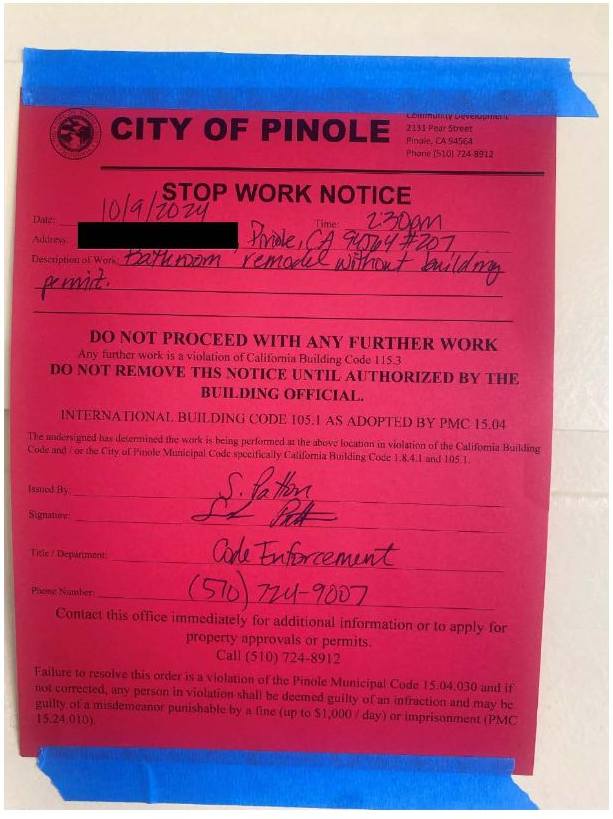
In October 2024, Ms. Moore contacted Pinole Code Enforcement Officer Sarrah Patton. Officer Patton visited the property. Following that first visit, according to Ms. Moore’s account, John Stewart Property Management was fined, the building was subsequently red-tagged, multiple violations were issued, and a required correction eventually forced the relocation of all second-floor tenants to a hotel for approximately a month while the second-floor walkway was demolished and rebuilt. Ms. Moore says she was also informed that the City of Pinole requires rental properties to renew a Rental Business License every three years — and that the property in Pinole Apartments had not held one in roughly twelve years.
Approximately one month after Officer Patton’s first visit and after JSPM was fined, Ms. Moore says, she was served with a Notice to Quit.
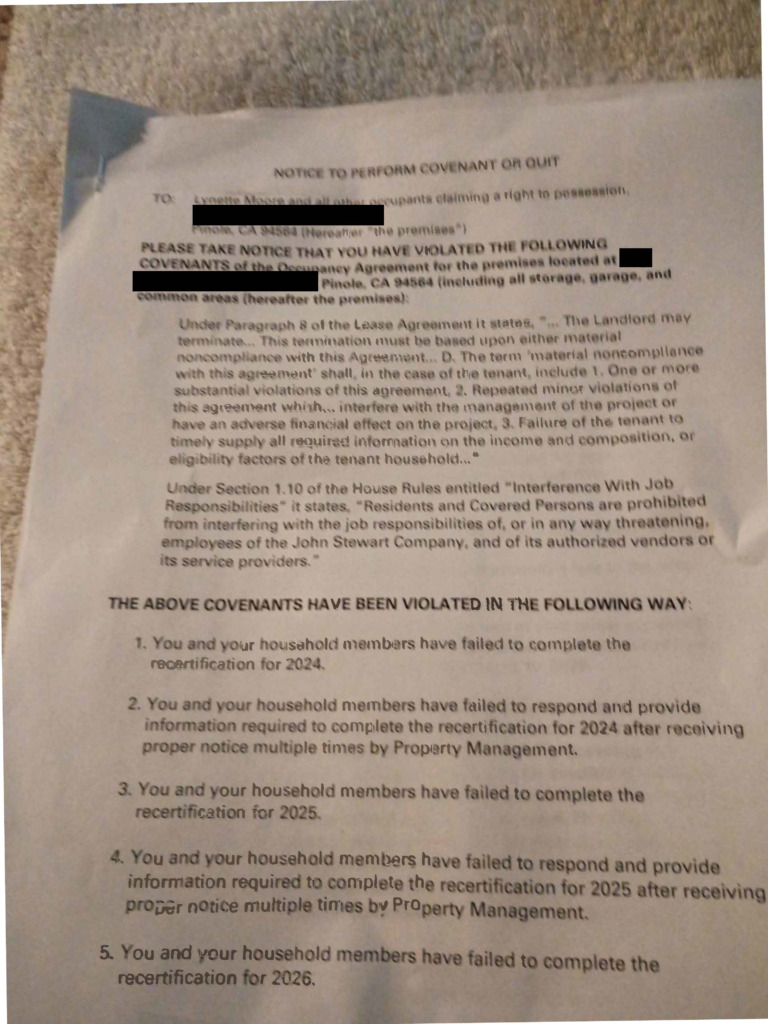
“Retaliation then and now,” she said.
The stated grounds for that Notice to Quit, she says, were that she had threatened Latoya. Management pointed to two things. First, a doorbell-camera clip that allegedly captured her, months earlier, saying something like, “Yeah, I will wear that orange, cause I will beat your ass,” as she walked past Latoya’s unit — a unit she must pass to reach her own. Ms. Moore says she never stopped, never looked at the manager’s door, never spoke her name. She was, she says, speaking aloud at a TikTok video on her phone. Second, an email in which she quoted the proverb, “When you dig one ditch, you better dig two.” Management, she says, characterized that biblical reference as a threat that she intended to “dig a ditch and put her in it.”
There is, Ms. Moore notes, no police report from Latoya documenting the alleged threat. There is, however, a police report filed by Ms. Moore — after Latoya, in Ms. Moore’s telling, told her she was going to “catch me in the morning.” The next morning, Ms. Moore called Pinole police and requested an escort to her car. That morning, she says, Latoya was in the back parking lot at an hour when, in years of the same 5:30 a.m. departure for work, she had never once seen her there.
Code enforcement in, fines issued, eviction paperwork out. That is the same retaliation signature this reporter has documented in San Francisco.
Two Years and Still No Lawful Rent Figure: The Recertification John Stewart Never Performed
There is one further fact that must be understood clearly, because it goes to the heart of what John Stewart Property Management has and has not done for Lynette Moore over the past two years.
MS. MOORE HAS NOT WITHHELD RENT.
What has happened is that John Stewart Property Management has failed to perform an interim recertification of her rent — the calculation that, under the rules governing federally subsidized affordable housing, must be redone when a tenant’s income changes materially. The last time the company completed the paperwork to calculate what Ms. Moore was to pay, the figure was based on her wages from full-time employment. Ms. Moore has not been employed for the past several years. She has repeatedly requested that management redo the calculation.
It gets worse. Approximately two years ago, in a prior court proceeding between Ms. Moore and John Stewart Property Management, the parties reached an agreement. One of the terms of that agreement was that John Stewart would perform the recertification. Two years later, according to Ms. Moore, that calculation still has not been done.
The consequence of that inaction is not a minor administrative lapse. It is that a medically vulnerable, unemployed single mother has been left, for two years, without a lawful rent figure to pay — while the same company that would not do the math has now filed a fresh eviction petition against her on the same day it settled her habitability case. Any narrative that describes Ms. Moore as a tenant who “stopped paying” is not merely wrong. It inverts responsibility.
This reporter has been advised that Ms. Moore has been counseled by community advocate Arieann Harrison, Founder and CEO of the Marie Harrison Community Foundation, to request the rent-calculation verification from management in writing, for tracking purposes, and to have her counsel work to ensure that her housing record does not reflect an eviction that would jeopardize her ability to secure future housing. That is precisely the protective posture the law contemplates for tenants in Ms. Moore’s position — and it is a posture Ms. Moore should not have needed community advocates to advise her to take. The obligation to perform the recertification belonged, and belongs, to John Stewart.
The Small Cruelties Are the Loudest Evidence
It is often the smallest details that reveal the largest intent. Ms. Moore says that when new front doors were installed across the property, every unit received a peephole — except hers. Peepholes are not standard on new doors; they must be installed. She had to ask.
She says her toilet once sat in her bathtub for weeks, forcing her to order a camping toilet — “Yes, I was having to s*** in a bucket,” she wrote — while she waited on repairs. She says she once paid out of pocket for roughly ten days in a hotel after her unit flooded, because although she reported water entering her home, management did not shut the water off for three days, flooding both her unit and the one below. She has told this reporter she will detail, in a forthcoming submission, what she describes as the diversion of federal Housing Is Key relief funds intended for her rent, and the outcome of the July 30 eviction hearing.
These are not the details of a difficult tenant. These are the details of a woman keeping receipts.
Ms. Moore has also reflected on what her experience has taught her about the burden California places on tenants who try to prove what management has done to them: “I have found along the way that it is next to impossible to prove harassment.” That she has done it anyway, and that a corporate insurance carrier has paid to end her habitability case, is a fact this state should not overlook.
Mission Local’s Marina Newman Confirms the Same Pattern in San Francisco
What Ms. Moore is describing in Pinole is not an isolated case, and this reporter is not alone in documenting it. In recent months, Marina Newman, a staff reporter at Mission Local covering Bayview–Hunters Point housing, has independently reported findings that align, point for point, with the pattern documented in “The Price of Being Poor.”
In her July 2026 investigation, “Public housing complex considered a model spiraled out of control,” Newman documented the deterioration of Alice Griffith Apartments — owned by McCormack Baron Salazar and managed by the John Stewart Company — including rodent infestation, failed health inspections, and the recovery of a tenant’s decomposed body inside an apartment. Her reporting identifies the John Stewart Company as one of eight companies that own or manage 37 complexes removed from the San Francisco Housing Authority’s portfolio, situating Alice Griffith’s collapse inside a larger structural failure of privatized affordable housing oversight in San Francisco.
Newman’s earlier reporting is equally damning. In “SF public housing tenants sued property manager. Now it’s leaving,” Newman documented that the John Stewart Company — which she confirms is the largest affordable housing manager in California, overseeing 283 properties statewide including 41 in San Francisco — was leaving Plaza East in the Western Addition after 28 tenants filed a lawsuit alleging harassment, charging rent for uninhabitable living conditions, and negligence. Tenant Silvio Ocampo told Newman that mold sits under his carpet and sewage seeps through his floorboards, and that when he brought his complaints to a staff member he was told, “Remember where you are.”
That is not the language of maintenance. That is the language of intimidation. And it is precisely what Ms. Moore describes in Pinole — a manager who moves on a tenant who dares to speak.
Newman has also reported — in “Bayview residents, S.F. supervisor slam public housing conditions” and in “Only elevator at S.F. public housing building will be out for weeks” — conditions and management failures at John Stewart–managed properties in Bayview–Hunters Point that echo what this reporter has been documenting since January. When two independent reporting operations, one at the Davis Vanguard and one at Mission Local, converge on the same landlord and the same pattern in the same year, the state of California can no longer describe this as anecdotal.
The Pattern I Have Already Reported in San Francisco
Across properties tied to the John Stewart Company in San Francisco, tenants have described repair delays, restricted access, targeted pressure, and a security posture experienced as surveillance rather than safety after they spoke publicly. The Davis Vanguard has previously reported that the John Stewart Company has been characterized as a “slumlord” based on persistent tenant complaints, code violations, and prolonged habitability failures. See Open Letter to California Attorney General Rob Bonta, Special Investigative Report: The Price of Being Poor, The People Fight Back, and The Legal Reckoning Begins.
At Alice Griffith, residents have described mold, water intrusion, roaches, rodents, broken elevators, malfunctioning fire systems, ventilation failures, and roof concerns, alongside a reported cluster of approximately ten deaths since January 2026 that Destination Freedom Media Group has called on public officials to investigate independently. This has unfolded even as management pursued a coordinated rent-collection campaign through publicly posted “Balance Due” notices in July 2026. That is the contradiction that gave the ninth installment its title: Built on Promises, Managed by Contradictions.
Ms. Moore’s case extends that pattern beyond San Francisco. She describes the same architecture: sustained habitability complaints, escalation to a public enforcement authority, and adverse action against the tenant who called that authority. The through-line is not geography. The through-line is management.
Why the Attorney General’s Actions Matter Here
California has already accepted the premise that private property-management companies can turn uninhabitable housing into a business model, and that such conduct can warrant statewide intervention. On June 12, 2025, California Attorney General Rob Bonta filed a sweeping lawsuit against PAMA Management and landlord Mike Nijjar, alleging — after a three-year investigation — rodent and cockroach infestations, leaking roofs, overflowing sewage, deceptive lease terms, discrimination against Section 8 tenants, unlawful rent practices, and other systemic violations. See Attorney General Bonta Sues Notorious Landlord Mike Nijjar and PAMA Management.
He then went further: he publicly asked Californians harmed by “any other landlord” engaged in similar misconduct to report their experiences directly to the California Department of Justice. See Attorney General Bonta Asks California Tenants Harmed by Landlords to Share Their Stories.
That is the doorway. Attorney General Bonta has explicitly told California tenants harmed by exploitative property-management operators that his office wants to hear from them. The public record shows a state willing to spend three years building a case against a landlord accused of exploiting the poor. If the conditions and retaliation described by tenants across John Stewart properties — from Bayview–Hunters Point to Pinole — reflect a pattern, then this is precisely the category of case the Attorney General has already signaled his office is prepared to consider.
What This Case Now Proves
Ms. Moore’s settlement is not just money. It is evidence. It is a corporate insurance carrier’s willingness — after litigation — to resolve a habitability case brought by a tenant whose account this reporter has heard, in structure, from residents of Alice Griffith. The termination of the on-site manager is evidence too. It is management confirming, through personnel action, that something at the property in Pinole went wrong.
And the eviction motion filed the same day she settled is the loudest evidence of all. Because it tells California what tenants in San Francisco have been trying to tell this state for years: that when poor and medically fragile tenants win, the machinery does not stop. It resets.
Ms. Moore appeared in court on Thursday, July 30, 2026. This reporter will publish the outcome of that hearing as a follow-up installment in “The Price of Being Poor” as soon as the result is verified through Ms. Moore, her legal counsel, and available court records. She has a 15-year-old daughter watching her mother refuse to be broken. She has, in her own words, the receipts.
“I am truly tired,” she wrote. “And my father sits high and looks low. I have no doubt that I have favor. And that’s because I have seen him fight my battles and the weapons have not been able to hit their target.”
The price of being poor in California has never been just bad housing. It has been the demand that tenants prove their suffering over and over again, in the correct form, on the correct letterhead, to the correct desk, while the harm continues. Alice Griffith proved that in San Francisco. Lynette Moore is proving it in Pinole. It is now for Attorney General Rob Bonta’s office, the courts of Contra Costa County, and the City of Pinole to answer whether that price will finally have a limit.
Coming in Part Two — “The Pinole File”
In the next installment of this series, this reporter will document, with Ms. Moore’s receipts, photographs, and video evidence, matters that could not be fully corroborated in time for this publication. Among them:
• The flooded unit and the three-day delay in shutting off the water, resulting in damage to both Ms. Moore’s home and the unit below, and ten nights she paid out of pocket to stay in a hotel.
• The weeks during which Ms. Moore’s toilet sat in her bathtub, forcing her to purchase and use a camping toilet inside her own home.
• The alleged diversion of federal Housing Is Key relief funds intended for her rent.
• John Stewart Property Management’s failure, over approximately two years, to complete an interim recertification of Ms. Moore’s rent — a recalculation the company was obligated to perform following a prior court proceeding, and which remains unperformed despite Ms. Moore’s repeated requests. Ms. Moore has not withheld rent; she has been waiting for a lawful rent figure to pay.
• The outcome of the July 30, 2026 eviction hearing.
• And a new matter Ms. Moore has raised with this reporter: visible damage to her vehicle, which she says occurred on the property. Ms. Moore has told this reporter that workers appeared to have used her car to prop up wood and to lean against during repairs on the property, and that visible fingerprints were left on the vehicle. She says regional supervisor Uella Laughlin “was extremely forceful in her denial of any damage.” Ms. Moore has provided video of the damage and is forwarding management’s written response. Those materials will be examined and reported on in Part Two.
Editor’s Note: This is Part One of a multi-part series. Readers with information regarding conditions at John Stewart–managed properties in California are encouraged to share their accounts, and, per the California Attorney General’s public request, may also report their experiences directly to the California Department of Justice.
Sources & References (Clickable Links)
Prior reporting by Malik Washington — “The Price of Being Poor” series:
• Open Letter to California Attorney General Rob Bonta
• Special Investigative Report: The Price of Being Poor
• The Price of Being Poor — Part 4: The People Fight Back
• THE PRICE OF BEING POOR — PART 6: The Legal Reckoning Begins
• The Price of Being Poor – Part 7
• The Price of Being Poor – Part 8
• Built on Promises, Managed by Contradictions – Price of Being Poor Part 9
Marina Newman — Mission Local:
• Public housing complex considered a model spiraled out of control (July 2026)
• SF public housing tenants sued property manager. Now it’s leaving.
• Bayview residents, S.F. supervisor slam public housing conditions
• Only elevator at S.F. public housing building will be out for weeks
California Department of Justice — Office of the Attorney General Rob Bonta:
• Attorney General Bonta Sues Notorious Landlord Mike Nijjar and PAMA Management (June 12, 2025)
• Attorney General Bonta Asks California Tenants Harmed by Landlords to Share Their Stories
• California DOJ — Landlord-Tenant Issues
Our song/video for this article is:
STAND UP! – Cynthia Erivo | DGLS Cover