New documentation alleges SFPUC and City contracting systems turned civil rights promises into paperwork while Bayview workers received only pennies on the dollar

Southeastern Treatment Plant – courtesy of SF Water Power Sewer (https://www.sfpuc.gov/construction-contracts/construction-projects/sepconstruction) – top left
SF Labor rally – courtesy of Dennis Williams (https://www.instagram.com/p/DOPgv78iXUg/) – bottom left
Construction workers courtesy of SF Hyper Local Building Trades Contractors Collective (https://www.sfhlbtcc.com) – bottom right
Below are links to past articles that we’ve published that are relevant to the subject matter of this article:
San Francisco Gateway, Part I
Inclusion Without Ownership: Why a Billion-Dollar Project in Historic Bayview–Hunters Point Has Room For Black Labor—But Not Black Developers
https://destination-freedom.org/wp-content/uploads/2026/05/San-Francisco-Gateway-Part-1.pdf
Black Builders, Contaminated Land, and the Billion-Dollar Betrayal: San Francisco’s Fight for Environmental and Economic Justice
https://destination-freedom.org/wp-content/uploads/2026/05/Black-Builders-Contaminated-Land-and-the-Billion-Dollar-Betrayal.pdf
In Bayview Hunters Point, people know the difference between development and extraction.
Development leaves roots.
Extraction leaves reports.
Development builds ownership.
Extraction builds ribbon-cuttings.
Development asks a community what it needs.
Extraction tells that community to be grateful while the money leaves. That is why Elder Kevin Williams, Senior Advisor to the Bayview Hunters Point Coordinating Council, is sounding the alarm about what he describes as one of San Francisco’s most sophisticated forms of modern racial exclusion: billions of public infrastructure dollars moving through a historically Black community while Black contractors, Black workers and Bayview residents remain locked outside the gates of meaningful economic participation.
Williams is not speaking in slogans. He has brought documents.
The materials reviewed by Destination Freedom Media Group and The Davis Vanguard include:
Chapter 54 Wage Disparity Presentation
https://destination-freedom.org/wp-content/uploads/2026/05/Updated_Chapter54_Disparities_Presentation_With_Conclusion1.pdf
Bayview Hunters Point Wage Disparities Analysis
https://destination-freedom.org/wp-content/uploads/2026/05/Bayview_Wage_Disparities_CompleteNarrative-2.pdf
A legal critique of San Francisco’s FY 2023–24 LBE Participation Report under Administrative Code Chapter 14B
https://destination-freedom.org/wp-content/uploads/2026/05/Analysis-of-the-FY-2023–24-Annual-LBE-Participation-Report-.pdf
Kevin Williams’ civil rights speech framing the contracting system as “contracting apartheid”
https://destination-freedom.org/wp-content/uploads/2026/05/Kevin-Williams-Civil-Rights-Speech.pdf
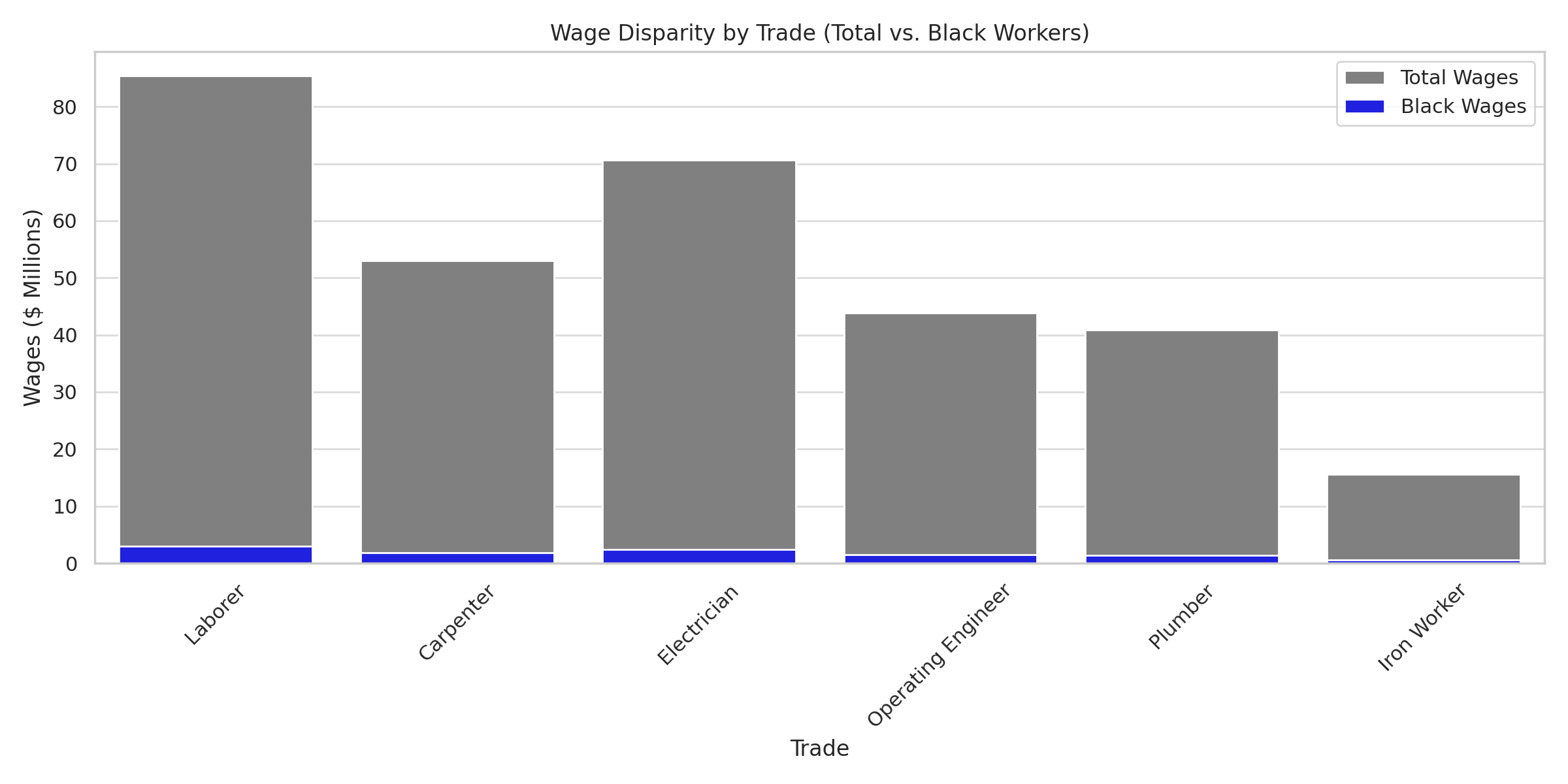
Wage Disparity by Trade (total v. Black workers)
https://destination-freedom.org/wp-content/uploads/2026/05/Wage_Disparity_by_Trade1.png
Together, the documents present a serious allegation: that San Francisco has not merely failed to include Bayview Hunters Point in the economic benefits of public infrastructure spending — it has built a bureaucratic system capable of making exclusion look like compliance.
“At no point since the report’s release has any City department challenged the data or disputed the conclusions,” Williams said. “Their silence became an admission of the report’s accuracy.”
THE CORE QUESTION: WHO IS ACTUALLY GETTING PAID?
At the center of the dispute is the San Francisco Public Utilities Commission and the massive Sewer System Improvement Program connected to the Southeast Treatment Plant — the wastewater infrastructure complex located in the heart of Bayview Hunters Point.
SFPUC has spent more than $5 billion on upgrades and modernization connected to the Southeast Treatment Plant corridor, with billions more expected in future infrastructure investment.
But Williams says the community carrying the environmental burden is not receiving a proportional share of the economic benefit. According to the Bayview wage-disparity analysis, workers from Bayview Hunters Point ZIP codes 94124 and 94134 earned only 8.1 cents of every project wage dollar, while workers from outside San Francisco earned 23.1 cents of every dollar.
Worker and Wage Summary by ZIP Code – ZIP Code / Area
Workers
Wages
Share of Project Wage Dollars
94124 (Bayview Hunters Point)
287
$5,928,120
4.5 cents
94134 (Visitacion Valley/Sunnydale)
230
$4,716,840
3.6 cents
Other San Francisco ZIP codes
1,205
$24,719,280
18.8 cents
Outside San Francisco
1,513
$30,345,600
23.1 cents
That means the communities most impacted by the Southeast Treatment Plant — Bayview Hunters Point and Visitacion Valley — allegedly received only a fraction of the wages generated by infrastructure work tied directly to their neighborhoods.
The plant is in Bayview.
The burden is in Bayview.
The pollution history is in Bayview.
But the money leaves.
Williams argues this is not accidental. He says it is the architecture of extraction.
WHAT CHAPTER 54 WAS SUPPOSED TO DO
A major part of Williams’ argument centers on San Francisco Administrative Code Chapter 54, which governs community benefits and mitigation connected to the Southeast Treatment Plant and surrounding sewer infrastructure projects.
According to the materials Williams provided, Chapter 54 was intended to ensure that communities carrying the environmental burden of the infrastructure would also receive meaningful economic participation through:
Local hiring
Workforce development
Apprenticeship pathways
Community economic investment
Neighborhood-level mitigation
But Williams argues the system was never built with sufficient enforcement power. According to the Chapter 54 presentation, the Project Labor Agreement allegedly lacks:
Independent compliance monitoring
Transparent public audits
Strong enforcement mechanisms
Community signatory authority
Meaningful penalties for noncompliance
That is where the issue moves beyond symbolism and into structural failure.
Because mitigation without enforcement is theater.
Equity without audits is decoration.
Local hire without consequences is a press release.
Williams argues the City created the language of inclusion without building the machinery required to enforce it.
THE TOWN HALL THE COMMUNITY NEVER RECEIVED
Williams says he formally presented the disparity findings before the Southeast Community Facility Commission on Sept. 24, 2025.
The Commission exists to advise the SFPUC and Board of Supervisors while advocating for the economic and public-health interests of southeast San Francisco residents.
According to Williams, commissioners reacted with concern and supported the idea of a public Town Hall where the findings could be presented directly before the Public Utilities Commission. But the Town Hall never happened. Eight months later, Williams says the community is still waiting. The delay matters because contracts are being awarded now.
Payrolls are being processed now.
Prime contractors are being enriched now.
Workers from outside San Francisco are being paid now.
“A Town Hall after the money is gone is not accountability,” Williams argues. “It is an autopsy.”
THE CHAPTER 14B ALLEGATION: COMPLIANCE WITHOUT JUSTICE
Williams also provided a legal analysis criticizing San Francisco’s FY 2023–24 Local Business Enterprise Participation Report under Administrative Code Chapter 14B. The critique argues that the City’s contracting system hides racial and geographic disparities behind broad aggregate categories that obscure who is actually receiving public money.
According to the analysis:
The Contract Monitoring Division reported approximately $528 million in contract awards to LBEs and approximately $455.8 million paid out. More than 70 percent of contract dollars allegedly flowed to firms located outside San Francisco.
Historically disadvantaged ZIP codes such as 94124, 94134 and 94107 allegedly received minimal participation compared to wealthier commercial districts.
Geographic Disparities in Contract Awards — FY 2023–24
ZIP Code / Area
Average or Reported Contract Awards
94124 — Bayview Hunters Point
Approximately $132,000 average per LBE
94134 — Sunnydale / Visitacion Valley
Approximately $120,000–$140,000 average per LBE
94107 — Potrero Hill / Mission South
Approximately $132,000 average per LBE
94110 — Mission District
More than $25 million
94111 — Financial District / Embarcadero
More than $40 million
Outside San Francisco
More than $200 million
Williams argues the numbers reflect a system where impacted Black communities absorb the burden while wealthier districts and outside firms receive the economic benefit.
Bayview gets the plant.
The Financial District gets the contracts.
Outside firms get the wealth.
The community gets another report.
“WHITE SUPREMACY IN A THREE-PIECE SUIT”
One of the most emotionally charged documents Williams shared is a civil-rights speech describing San Francisco’s contracting structure as “a modern-day Jim Crow ledger.” The speech argues that City systems continue to favor entrenched firms while excluding Black and Brown contractors from meaningful participation.
“This is white supremacy in a three-piece suit,” the speech states. “Jim Crow in a business tie.”
The language is intentionally sharp. But Williams argues the exclusion itself is sharp. He says Bayview Hunters Point has long carried the sewage infrastructure, truck traffic, pollution exposure and public-health burdens while receiving only a limited share of the contracts, wages and ownership opportunities tied to the projects surrounding them.
The speech also references San Francisco’s own history — including the 1984 disparity study and The Unfinished Agenda — which documented racial disparities in public contracting decades ago. Williams argues the most damning part is not that the City failed to identify the problem. It is that the City already knew.
And if the current documentation is accurate, the system was not dismantled.
It was refined.
THE FEDERAL LAW QUESTION
One of the most serious allegations in the Chapter 14B legal analysis involves the interaction between California law and federal contracting requirements. According to the analysis, San Francisco has relied heavily on Proposition 209 and the Coral Construction decision to limit race-conscious local contracting remedies.
However, the critique argues that federally funded infrastructure projects may still trigger federal DBE, MBE and WBE participation requirements.
The analysis cites cases including:
Sherbrooke Turf v. Minnesota DOT
Western States Paving v. Washington State DOT
Northern Contracting v. Illinois DOT
Williams argues the City may have invoked state restrictions while allegedly failing to fully enforce federal participation obligations tied to federally funded projects. If accurate, that would not simply be a policy disagreement. It would raise serious civil-rights questions.

WHO IS KEVIN WILLIAMS?
“I have relentlessly fought overt government corruption in San Francisco as a young man and am still fighting covert discrimination perpetrated against my community as an old man, and I won’t give up until justice is done.
“There is a new movement afoot led by an outstanding and well-educated collection of young leaders of the Bayview Hunters Point Coordinating Council, who are connecting and collaborating with other organizations determined to kick down the doors of economic despair that block the pathway to prosperity for future generations.

Courtesy of San Francisco Water Power Sewer
“These data show that the “Downtown Gang” led by the S.F. PUC General Manager, Dennis aka “J Edgar” Herrera, and other political hacks and their surrogates, can pull a gun on the Black Community loaded with bullets of White Supremacy – triggered by embolden bigotry for no other purpose than to continue a pervasive pattern of exploitation of jobs, contracts, and billion-dollar community benefits that by law belong to the long-suffering residents of BVHP most affected by an “Outhouse” build in the living room of their hood.
“Instead of promised compensable mitigation, resident workers, contractors, and credible community-based organizations are subjected to the foul odor of discrimination that has devolved further to veiled intimidation, repression, and unmitigated disrespect towards Black People that would have been unheard of during the 70’s and 80’s.
“To the naked eye, the Southeast Pollution Control Plant looks like any other facility of its type, but when placed under a forensic microscope, the wage and workforce distribution data so carefully analyzed alone demonstrate clear and convincing evidence that it functions and operates not just as a plant, but a racist ‘Plantation.'”
Elder Kevin Williams
WHAT ELDER KEVIN WILLIAMS IS DEMANDING
Williams says the purpose of the documentation is not merely to condemn the system, but to force structural reforms.
Among the recommendations contained in the materials are:
Chapter 54 Recommendations
Independent compliance audits
Community participation in PLA negotiations and oversight
Stronger local-hire enforcement
Contractor penalties for noncompliance
Quarterly ZIP-code wage-equity reporting
Expanded apprenticeship pathways tied to real placement opportunities
Chapter 14B Recommendations
New disparity studies
Race and gender disaggregation in reporting
Stronger enforcement mechanisms
Revitalized Human Rights Commission oversight authority
Enforcement of federal DBE requirements where federal funding exists
Williams argues these are not radical demands. They are the minimum requirements of honest government.
“If the City is proud of its contracting system, publish the data,” Williams argues.
“If the contractors are complying, audit them.”
“If Chapter 54 means something, enforce it.”
THE MORAL QUESTION FACING SAN FRANCISCO
For Williams, this fight is larger than contracts. It is about whether Black San Franciscans still have the right to participate in the economic life of a city they helped build. It is about whether public money can continue to move through Black neighborhoods without building Black power. It is about whether City Hall’s language of equity will ever be forced to meet the ledger.
Williams calls the exclusion of Black residents from meaningful participation in their own economy “a form of domestic apartheid, both by race and by zip code.”
And the documents he provided explain why he uses language that strong. Because when Bayview Hunters Point receives the burden but not the benefit, that is not equity.
When impacted ZIP codes receive only a fraction of the wages tied to projects in their own neighborhoods, that is not mitigation.
When public reporting structures aggregate data in ways that allegedly obscure racial and geographic exclusion, that is not transparency.
When oversight exists on paper but not in power, that is not democracy.
That is extraction with a government seal attached to it.
Before I transition to this next section, I want to make something clear. It’s not Daniel Lurie’s fault that we are in the place we are in. What has happened is the result of decades upon decades of policies and actions implemented by the City and County of San Francisco in such a way that it places the Black community and other disadvantaged/underserved communities in a weak and vulnerable position. However, Mayor Daniel Lurie can read this article, acknowledge the empirical facts and data, and then do something to change drastically the way the “game” has been played.
THE QUESTION CITY HALL MUST ANSWER
Williams says San Francisco should not be allowed to bury these allegations beneath procedure, delay or technical language. He argues the SFPUC, Board of Supervisors, Contract Monitoring Division, City Attorney’s Office and District 10 leadership should all publicly address the findings. He also says the Southeast Community Facility Commission should receive the Town Hall it allegedly supported months ago — not as a favor, but as a democratic obligation.
Because the money belongs to the public.
The burden has been carried by Bayview.
And the truth should not need permission.
The question Elder Kevin Williams places before San Francisco is ultimately simple:
Who got paid, who got excluded, and who carried the cost?
Here’s our song/video for this article:
The Payback – James Brown – Live – Zaire 1974