
Under the leadership of Robynne Jeisman, a quiet revolution is taking shape—one rooted in safety, belonging, and the radical insistence that young people deserve more than survival

Courtesy of Founder, Robynne Jeisman
In the Bay Area, the housing crisis is often reduced to numbers. Median rents. Vacancy rates. Encampment counts. Affordable housing shortages. Policy debates wrapped in spreadsheets and projections.
But statistics have a way of stripping humanity from the people living inside them. They rarely tell you what it feels like to be 19 years old, carrying trauma that never clocks out. They do not explain what it means to navigate adulthood while trying to survive homelessness, exploitation, abandonment, violence, or the emotional exhaustion that comes from being forced to grow up far too soon. And they certainly do not capture what happens when a young person begins to lose faith that stability, peace, or belonging are even possible.
For vulnerable youth, housing has never been just about shelter. It is about safety. It is about nervous systems finally being allowed to rest. It is about whether a young person will be given enough stability to imagine a future beyond survival.
That is where Turntable enters this story.
Because what is happening inside this Bay Area organization is not simply housing placement. It is not a transactional response to a social crisis. It is something more deliberate, more relational, and, frankly, more difficult to build in a society increasingly defined by disconnection: a living infrastructure of care.
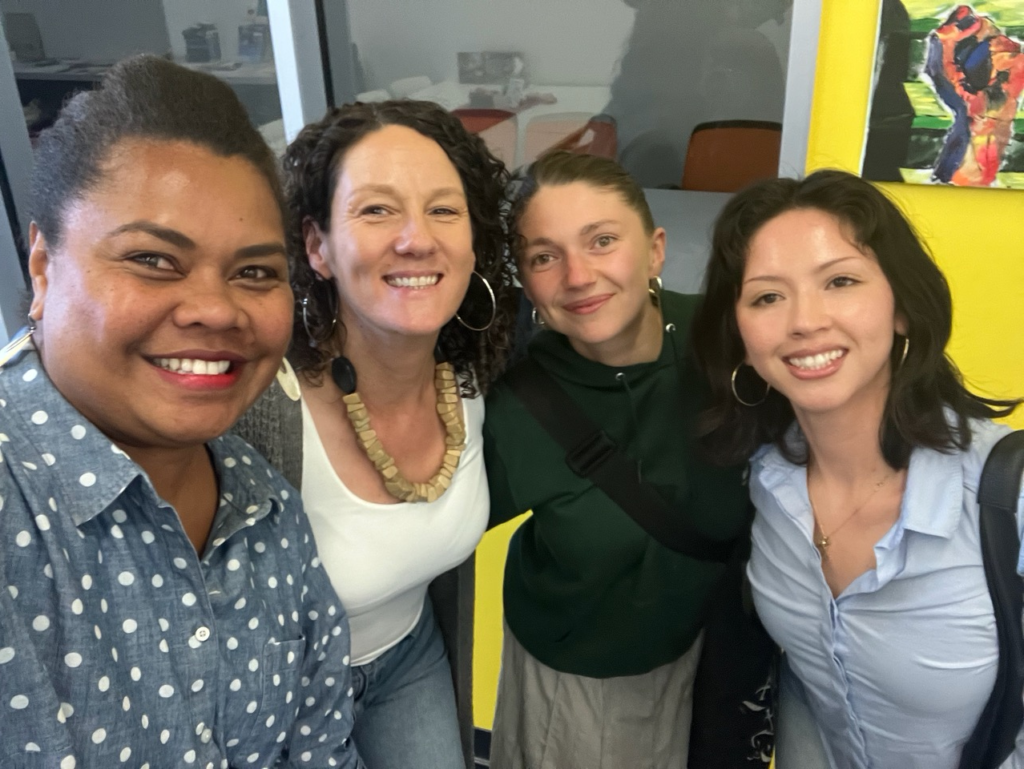
Brittany Ward, Robynne Jeisman, Jaydy Diaz, Matha Wong
Under the leadership of founder Robynne Jeisman, Turntable is creating spaces where transitional-aged youth impacted by homelessness, trafficking, exploitation, foster care instability, juvenile justice involvement, addiction, and trauma are not treated as problems to manage, but as human beings worthy of restoration.
And that distinction matters.
Deeply.
HOUSING AS A FOUNDATION FOR HEALING
Turntable’s public mission is both practical and profoundly human: cultivating places where young people can experience health, independence, and safe places of belonging.
That language stands out because it reflects a philosophy often absent from mainstream conversations about housing. In the Turntable model, housing is not treated as the finish line. It is treated as the beginning.
A stable address can become the first interruption to chaos.
A safe room can become the first place where hypervigilance begins to loosen its grip.
A trusted mentor can become the first adult a young person has learned to consistently rely upon.
And a peaceful environment can become the first place where healing even has a chance to begin.
Turntable’s work appears rooted in a recognition that trauma rarely arrives alone. Housing instability often overlaps with fractured family relationships, interrupted education, untreated mental health struggles, financial insecurity, exploitation, isolation, and the emotional burden of surviving systems that frequently ask vulnerable youth to advocate for themselves while carrying impossible weight.
Rather than isolate those realities into separate silos, Turntable’s model attempts to respond to the whole person.
Its publicly described approach includes housing, mobile case management, mentoring, group support, and nature and adventure therapy. Together, those elements form something larger than a program structure. They form an ecosystem designed to restore stability, trust, and personal agency.
That is not easy work.
But it is necessary work.
LEADERSHIP ROOTED IN LIVED EXPERIENCE
To understand Turntable, it is important to understand the leadership shaping it.
Public profiles describe Robynne Jeisman as someone who has spent more than 25 years working with high-risk adolescents across Australia, the United States, Thailand, and India. Her work has spanned homelessness, juvenile justice systems, trafficking and exploitation, addiction, and mental health crises. But what emerges most clearly is not simply professional expertise.
It is proximity.
Jeisman’s connection to this work is personal.
When asked what inspired and motivated her to enter this field of advocacy, she did not begin with organizational achievements or career milestones. She began with truth.
“What inspired me and motivated me to enter this work and advocacy is the combination of my personal story and me continuing to say yes as society changed and my insight grew,” Jeisman explained.
“I was once a vulnerable youth with a trauma story.”
That statement carries extraordinary weight because it reframes the work through lived understanding rather than distant observation. Jeisman is not speaking about vulnerable young people from the outside looking in. She understands what instability can feel like. She understands what support can mean. And she understands how life-changing it can be when someone chooses not to abandon a young person in their most vulnerable moments.
She also reflected on how her advocacy evolved over time through expanding awareness and continued commitment.
“I believe that youth need to be advocated for,” she said. “And as life seems to get harder, I look back on those who supported me and want to make sure I do my part for young people to have what they need for a healthy, peaceful place to call home.”
That perspective feels embedded in the DNA of Turntable itself.
Because the organization’s work does not feel detached from human understanding. It feels shaped by people who recognize that safety can alter the trajectory of a life. That consistency matters. That belonging matters. That trust matters.
And for many vulnerable youth, those things have been in painfully short supply.
TRUST AS A LIFE-CHANGING FORCE
One of the most compelling aspects of Turntable’s philosophy is its emphasis on relationship.
In public interviews and presentations, Jeisman repeatedly returns to the importance of trust, consistency, and community. Those are not abstract ideas for young people navigating trauma. They are survival-level needs.
Many vulnerable youth have experienced systems that were temporary, fragmented, or conditional. Adults came and went. Programs expired. Promises dissolved. Stability became unpredictable.
Turntable’s approach appears to push back against that instability by creating continuity wherever possible. Not by pretending healing is linear. But by remaining present.
That distinction matters because young people emerging from exploitation, violence, trafficking, homelessness, or abandonment are often carrying more than logistical barriers. They are carrying exhaustion. Isolation. Distrust. Fear. Emotional survival patterns that were built under pressure.
In that context, trust itself becomes transformative.
And Turntable’s model appears to understand that deeply.
The organization’s repeated use of the phrase “safe places of belonging” reveals something important about how it views healing. Belonging is not treated as a bonus feature attached to housing. It is treated as essential infrastructure.
Because every young person deserves a place where they do not have to brace themselves for harm.
COMMUNITY WORK REQUIRES COMMUNITY
Another reason Turntable stands out is its clear understanding that no organization can address these crises alone. Its publicly listed partnerships across the Bay Area reflect an intentional ecosystem of collaboration involving organizations focused on trafficking recovery, youth empowerment, food security, mentoring, recreation, counseling, and wellness.
Partners include:
Love Never Fails, Wings of the Way, Brave Bay Area, New Day for Children, SF Recreation & Parks, YUPP Org, District 10 Community Market, and others.
That network matters because real community work is rarely accomplished in isolation.
The strongest organizations understand that healing requires many hands. It requires trusted adults, mentors, clinicians, advocates, public agencies, neighborhood organizations, employers, and people willing to remain engaged long after headlines move on.
TURNTABLE’S PUBLIC PROFILE REFLECTS THAT UNDERSTANDING
The organization’s collaborations reportedly include job support, affordable housing opportunities, safe evening spaces for youth, food assistance, church partnerships, emergency dental care, and psychological support services.
The picture that emerges is one of an organization attempting to close gaps wherever possible while helping young people move toward stability one relationship at a time.
And that work carries enormous value in a society where vulnerable youth are too often pushed into invisibility.
RESTORING THE ABILITY TO IMAGINE A FUTURE
There is another truth embedded inside this work that deserves attention.
Trauma does not only disrupt the present.
It disrupts the future.
When young people spend years in survival mode, even ordinary milestones can begin to feel unreachable. A stable address. A steady job. A savings account. College classes. A peaceful night of sleep. The ability to plan next month without fear. Hope itself can become difficult to access.
That is part of what makes Turntable’s work so important. At its core, the organization appears committed to restoring possibility. To helping young people believe that life can become larger than crisis management.
That next summer can look different than this one.
That peace is not something reserved for other people.
That they deserve stability too.
And perhaps that is why Turntable resonates so deeply with the communities and individuals who encounter its work. Beneath the housing support and wraparound services is something even more fundamental: the belief that vulnerable young people deserve advocacy, consistency, dignity, and care.
Not after they prove themselves worthy.
NOW.
A NECESSARY COUNTER-NARRATIVE
At a moment when conversations about homelessness, trafficking, and vulnerable youth are often dominated by burnout, bureaucracy, and despair, Turntable offers another narrative. One rooted in compassion. One rooted in sustained relationship. One rooted in the belief that healing is possible when young people are given safety, support, and the opportunity to belong. And perhaps most importantly, Turntable challenges the rest of us to think differently about what community responsibility actually means.
Because the question facing society is not whether vulnerable youth exist. They do. The question is whether we are willing to build systems, organizations, and communities capable of meeting them with humanity.
Under Robynne Jeisman’s leadership, Turntable appears to be answering that question with action.
Quietly.
Consistently.
And with the understanding that changing a young person’s life does not always begin with sweeping political speeches or multimillion-dollar initiatives. Sometimes it begins with something much simpler.
Someone deciding that a young person deserves safety.
Deserves advocacy.
Deserves peace.
And deserves a place to belong.
MEDIA REFERENCES AND SOURCES
1.) Turntable Official Website
https://www.turntablehousing.org/
2.) Turntable Leadership and Board Information
https://www.turntablehousing.org/board-of-directors
3.) Turntable Staff and Team Information
https://www.turntablehousing.org/team
4.) Turntable Community Partnerships
https://www.turntablehousing.org/partners
5.) “We Love SF” Speaker Series Featuring Robynne Jeisman
https://www.youtube.com/
6.) DVULI Alumni Profile: Robynne Jeisman
https://www.dvuli.org/
7.) SF Weekly Public Reporting Referencing Robynne Jeisman and Turntable Housing
https://www.sfweekly.com/
The Turntable Team chose this song/video for the article (Love it!)
KOOL & THE GANG – Get Down on it (1982)