
Hanging Deaths, Official Silence, and the Return of America’s Oldest Terror
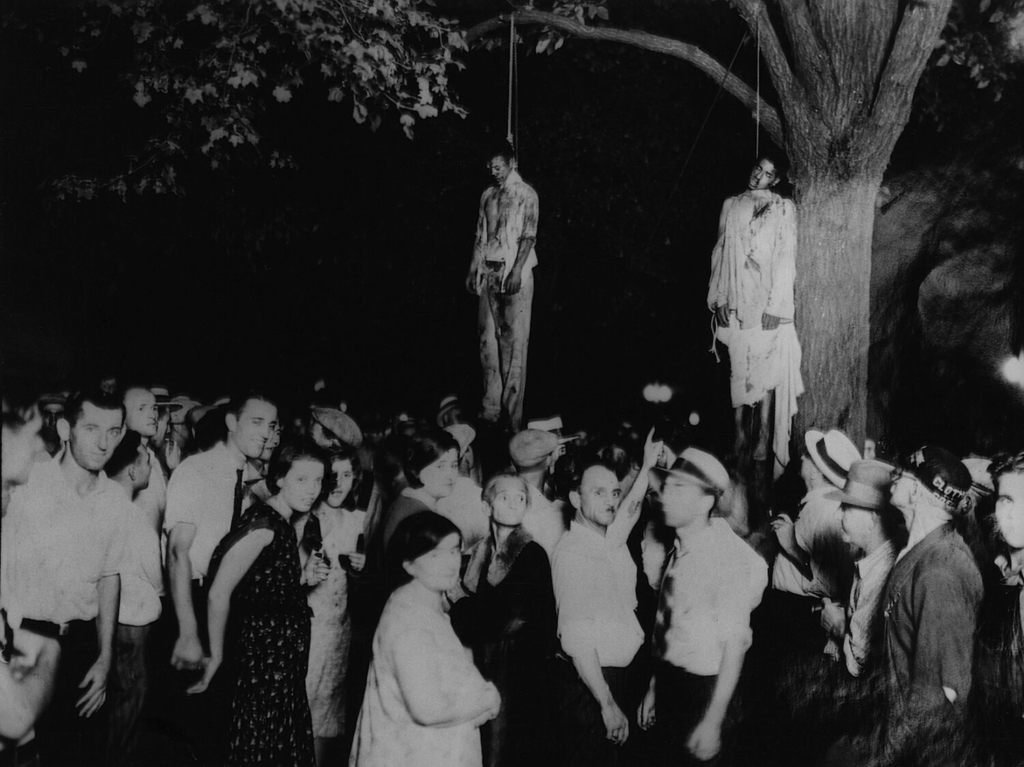
https://www.abhmuseum.org/an-iconic-lynching-in-the-north/ – Hanging of Abram Smith and Thomas Shipp in Marion, Texas.
“This is probably the most well-known photo of a lynching. It was taken by professional photographer in Marion, Lawrence Beitler, who printed and sold hundreds as souvenirs and postcards. The photo inspired the song Strange Fruit. It was featured by LIFE magazine in its 2011 book 100 Photographs That Changed the World.”
There are moments in American life when the facts arrive late, but the fear arrives immediately.
A body hanging from a tree is one of those moments.
On April 13, 2026, a 19-year-old Latino man was found hanging from a tree on Quackenbos Street NW in Washington, D.C.—within sight of the Metropolitan Police Department’s Fourth District headquarters. He was unconscious. Not breathing. He was pronounced dead at the scene.
And then, for three days, there was silence.
No immediate public alert.
No press release.
No acknowledgment to a community already watching, already whispering, already remembering.
By the time the Metropolitan Police Department publicly disclosed the death on April 16—after inquiries from the Washington Informer—the official line was clear: no foul play suspected, investigation ongoing, believed to be a suicide.
But by then, the public had already filled in the silence. Because in America, when a body is found hanging from a tree, the question is never just what happened.
The question is:
What are we being asked to believe?
THE IMAGE THAT WILL NOT STAY NEUTRAL
THE ROPE.
THE TREE.
THE BODY.
These are not neutral objects in the American imagination. They are historical artifacts. They carry the weight of lynching, racial terror, and a century-long pattern of official explanations that too often arrived faster than the truth.
That is why what happened in Washington, D.C., did not remain a local incident. It became part of a broader and deeply unsettling pattern—one that has unfolded across the South and beyond over the last year.
In Cobb County, Georgia, 21-year-old Kyle Bassinga was found hanging from a tree in February 2026. Officials ruled the death a suicide and stated that investigators found no evidence of foul play. But even local authorities acknowledged the historical sensitivity of the scene: a young Black man, hanging from a tree, in a region defined by the legacy of racial violence.
In Cleveland, Mississippi, on the campus of Delta State University, 21-year-old Demartravion “Trey” Reed was found hanging from a tree near recreational courts in September 2025. Officials initially said there was no evidence of foul play. The state medical examiner later ruled the death a suicide by hanging. But the reaction was immediate: calls for FBI involvement, demands for independent autopsy review, and national attention rooted not just in the facts—but in the geography. Mississippi is not just a place. It is a memory.
And just beyond the one-year window, the death of Javion Magee in North Carolina continues to cast a long shadow. Found with a rope around his neck in September 2024, his case became a template for the modern dispute: swift official conclusions, family skepticism, legal pressure for transparency, and a public unwilling to accept closure without evidence.
These cases are not identical. They should not be collapsed into a single conclusion.
But they are linked by something more powerful than similarity: they are linked by what they evoke.
WHO GETS BELIEVED
The central question running through these cases is not simply whether each death was a suicide or something more sinister.
The deeper question is this:
Who gets believed in America when the dead cannot speak?
Police departments issue statements.
Medical examiners issue findings.
Officials ask for patience.
But families ask for answers.
Communities ask for transparency.
History asks for proof.
In Washington, D.C., that tension was amplified by delay. The Metropolitan Police Department’s three-day gap between discovery and public disclosure became a catalyst for protest, outrage, and renewed distrust. Community members and organizers questioned not only what happened—but why it took so long to say anything at all.
Because silence, in these moments, is not neutral.
Silence becomes narrative. And narrative, in America, is shaped by memory as much as evidence.
THE LANGUAGE OF SUSPICION
Across these cases, a vocabulary has emerged—one that exists outside official reports but within community discourse.
“Quick call suicide.”
“Lynching by suicide.”
“Cover-up.”
These are not legal findings. They are expressions of distrust. They reflect a belief held by some activists, families, and observers that certain deaths—particularly those involving hangings—are too quickly categorized, too narrowly investigated, or too rapidly closed without full public accounting. That belief is not proof.
But it is evidence of something else: a widening gap between institutional authority and public confidence.
And that gap is where this story lives.
WHEN WASHINGTON FINDS ITS LOUDEST VOICE
If the country needed a measure of official priorities, it did not arrive in the form of a coordinated civil-rights response to these deaths. It arrived as an indictment.
On April 21, 2026, the Justice Department announced that a federal grand jury in Alabama had returned an 11-count indictment against the Southern Poverty Law Center—the Montgomery-based organization long known for tracking hate groups and extremist networks. Federal prosecutors charged the organization with wire fraud, false statements to a federally insured bank, and conspiracy to commit money laundering, alleging that more than $3 million in donor funds had been funneled to individuals connected to extremist groups through covert financial channels.
Acting Attorney General Todd Blanche accused the SPLC of “manufacturing racism to justify its existence.” FBI Director Kash Patel described the alleged conduct as a “massive fraud operation.”
The SPLC has denied the allegations, calling them false and politically motivated. The organization maintains that its use of informants was part of longstanding efforts to monitor extremist activity and prevent violence. Legal observers have noted that the use of confidential sources is a routine investigative practice within law enforcement itself.
The case will be decided in court.
But its timing—and its visibility—cannot be ignored.
Because while the federal government moved with clarity, speed, and force in prosecuting one of the nation’s most recognizable anti-hate organizations, its public posture across recent hanging-death cases has been far more restrained.
In Mississippi, federal authorities signaled a willingness to review the Reed case and received investigative materials. In Washington, D.C., and Georgia, public response centered largely on local authorities, local protests, and local demands for accountability.
The distinction is not between action and inaction. It is between posture.
One posture is loud, immediate, and declarative.
The other is cautious, procedural, and largely unseen.
That contrast does not prove intent. But it reveals something about how power is expressed—and how it is experienced.
THE WEIGHT OF THE IMAGE
A hanging from a tree is not just a forensic event.
It is a historical signal.
It is a visual language that predates modern policing, modern courts, and modern media. It speaks to a time when justice was not administered in courtrooms, but enacted in public, without due process, without accountability, and without consequence.
That history cannot be separated from the present. And it should not be.
Because when communities react with fear, suspicion, and anger, they are not reacting only to the facts in front of them. They are reacting to a pattern that has taught them to question those facts—especially when those facts arrive late, incomplete, or filtered through institutions they do not trust.
WHAT ACCOUNTABILITY REQUIRES
If there is a path forward, it is not through dismissal of those fears. It is through transparency that meets the moment.
That means:
Immediate public disclosure when deaths of this nature occur
Clear, detailed timelines of police response
Release of incident reports, dispatch logs, and body-camera footage where appropriate
Full medical examiner findings made accessible to families and, when possible, the public
Independent review mechanisms when requested
Communication that acknowledges not just the facts—but the history those facts exist within
Because the burden is not on the public to trust. The burden is on institutions to earn it.
THE QUESTION THAT REMAINS
In each of these cases, officials may ultimately be correct in their findings. But correctness alone is not enough.
Not when the image is this powerful.
Not when the history is this deep.
Not when the trust is this fragile.
Because in America, a hanging from a tree does not wait for the final report to be understood. It is understood instantly.
The only question is whether the truth will arrive with the same urgency.
Here’s our song/video for this article:
Billie Holiday – “Strange Fruit” Live 1959 [Reelin’ In The Years Archives]