
City Hall, DevelopeCity Hall, Developers, and the Architecture of Impunity – Part 2
By Journalist Malik Washington
Destination Freedom Media Group and the Davis Vanguard
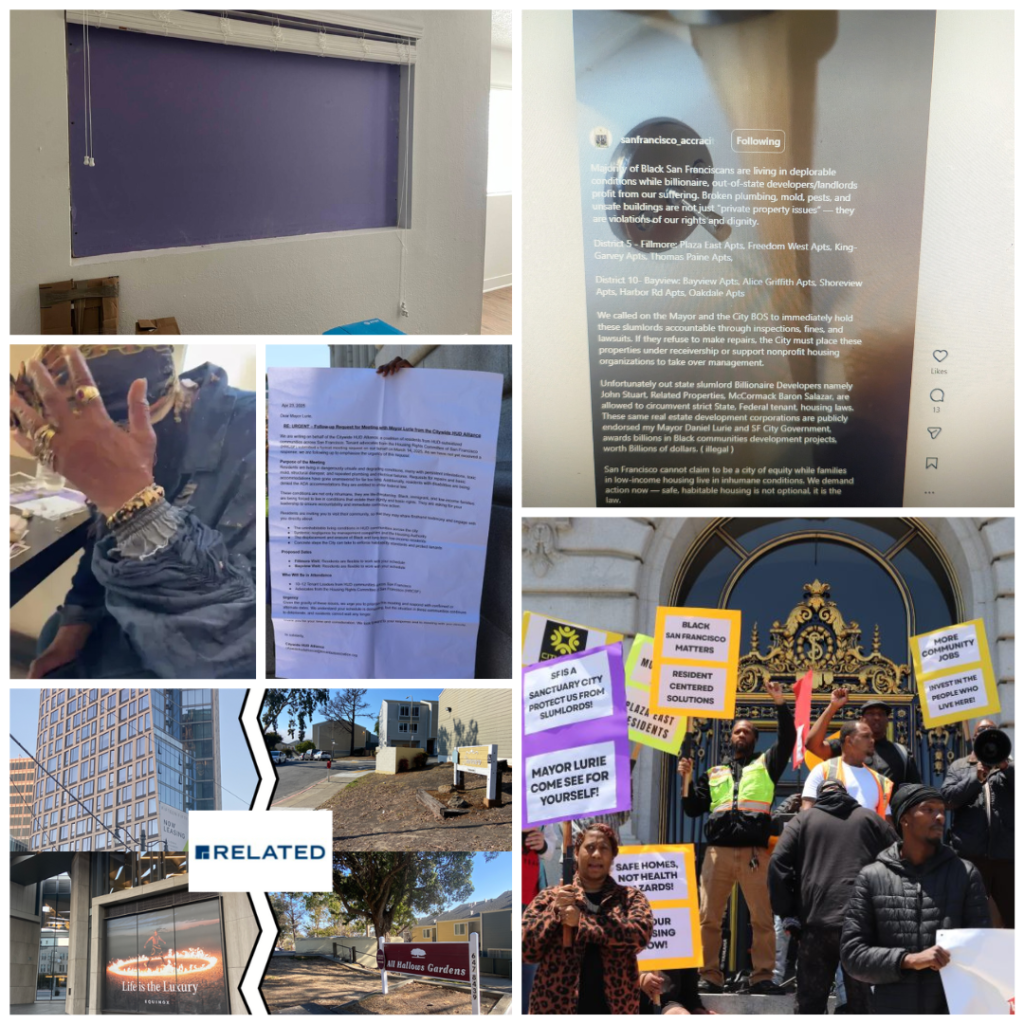
Photo credits:
S.F. public housing tenants rally at City Hall, urging Mayor Lurie to step up
https://missionlocal.org/2025/07/s-f-public-housing-tenants-rally-at-city-hall-urging-mayor-lurie-to-step-up/ (middle right (letter) and bottom right)
Part II: Multibillion-dollar company delays Hunters Point housing renovation, cites lack of funds (2022)
https://missionlocal.org/2022/11/60-billion-company-delays-renovation-of-failing-complex-cites-lack-of-funds/ (bottom left)
Bayview’s Alice Griffith housing was built in 2017. It’s already falling apart. Why?
https://missionlocal.org/2025/05/bayviews-alice-griffith-housing-was-built-in-2017-its-already-falling-apart-why/ (middle left) Caption: On April 21, during an art show held by Malik Seneferu, fiberglass tile fell on the head of an Alice Griffith resident, Annette McClendon, 66. Video courtesy of Malik Seneferu.
Dennis Williams’ 10/17/2025 Instagram post (top right) https://www.instagram.com/reels/DP7czjNEp48/
Missing windows, broken locks: Hunters Point residents come home after renovations
https://sfbayview.com/2025/08/hunters-point-residents-come-home-after-renovations/ (top left) caption: Mariah’s living room window
The suffering inside Bayview housing did not occur in secret.
It did not unfold behind closed doors or buried in obscure reports. It happened in full view—documented by tenants, photographed by residents, confirmed by inspectors, and ultimately walked through by the Mayor of San Francisco himself.
At that point, ignorance was no longer plausible.
The Mayor Walked the Hallways
After months of tenant complaints and sustained community pressure, Mayor Daniel Lurie toured multiple Related-managed housing complexes in Bayview–Hunters Point alongside residents, organizers, and advocates. According to contemporaneous reporting, the Mayor was shown units where mildew persisted, windows were missing, and new appliances had caught fire.
This matters—not symbolically, but substantively.
Once a mayor personally observes unsafe housing conditions, continued inaction is no longer a bureaucratic delay or an administrative oversight. It becomes a governing decision.
Yet despite this direct exposure, Related California continues to be awarded and considered for major public-private redevelopment projects across San Francisco—including in Sunnydale, Bayview, and proposed developments on Sansome Street.
The contradiction is stark.
On one hand, tenants are told to wait.
On the other, contracts move forward.
The Question Put Directly to Power
On Thursday, January 15, 2026, I attended Mayor Daniel Lurie’s State of the City address, held at Angelo Rossi Playground, not as a constituent, but as a member of the press. Following the Mayor’s remarks, members of the media were granted access to him for a brief question-and-answer session.
I used that moment to ask a question that Bayview tenants, community organizers, and advocates have been asking for years.
I asked the Mayor whether he intended to hold bad corporate actors—specifically John Stewart and Related Companies—accountable when they neglect or mistreat community members living in properties those companies manage. I told him plainly that I had been receiving a steady stream of complaints from tenants living in buildings under their control, describing unresolved habitability issues, neglect, and disregard.
The Mayor’s response was striking.
Mayor Lurie said that he does not have much authority over private companies.
That answer deserves scrutiny—not because it was evasive, but because it was incomplete.
Editor’s Note (Gale Washington): In my initial research regarding the Mayor’s Office of Housing and Community Development, it was discovered (though not yet verified) that the core functions of this agency are to:
• Awards and monitors public housing funds (local, state, and federal)
• Oversees affordable and mixed-income housing projects
• Enforces Regulatory Agreements that bind owners and managers to:
• Maintenance standards
• Habitability requirements
• Tenant protections
Our research is ongoing and will report further once we obtain the referenced regulatory agreements which bind owners and managers.
It is true that the City does not directly manage private landlords. But it is also true—undeniably so—that the City of San Francisco continues to award multi-million-dollar public contracts, subsidies, and redevelopment opportunities to the very same companies the Mayor now describes as outside his authority.
That contradiction sits at the heart of this investigation.
If the City lacks authority to hold these companies accountable for how they treat tenants, then why does it retain the authority to reward them with public land, public money, and public trust?
A Pattern Too Familiar to Ignore
This point has been repeatedly raised by Dennis Williams Jr., Executive Director of the Fillmore Community Development Corporation and Principal of D.C. Williams Development Company, who has spent many years working on the front lines of community-based development and advocacy, pushing for accountability and equity in San Francisco’s redevelopment process.
Williams told me what is unfolding in Bayview–Hunters Point cannot be separated from race, power, and access.
“Our families are living with asbestos and toxic conditions while Related California continues to receive billion-dollar city contracts,” Williams said. “This is a civil rights crisis, and it’s being ignored by the same officials who claim to stand for equity.”
After sustained advocacy, city inspectors verified asbestos in multiple units—a finding that should have triggered immediate enforcement. Instead, accountability stalled.
“The Mayor toured the buildings after a public rally,” Williams said. “And despite everything being documented, the message from City Hall was essentially that ‘not much can be done’—even as the City continues to endorse Related for new projects.”
Williams also noted that his Black-led development firm—despite years of documented experience and deep community roots—has been systematically excluded from redevelopment and joint-venture opportunities in the very neighborhoods where Related continues to expand.
“The same Mayor who endorses slumlords refuses to support qualified Black developers fighting to rebuild our communities,” Williams said. “It’s clear who City Hall is protecting.”
Williams and the Fillmore CDC are now calling for federal and state intervention, including:
• An immediate HUD and California Attorney General investigation into Related California’s operations and San Francisco’s contracting practices
• A moratorium on new city contracts with Related California until violations are resolved
• The inclusion of qualified Black-owned development firms in redevelopment projects
• Full transparency in inspection and compliance records for all Related-managed properties
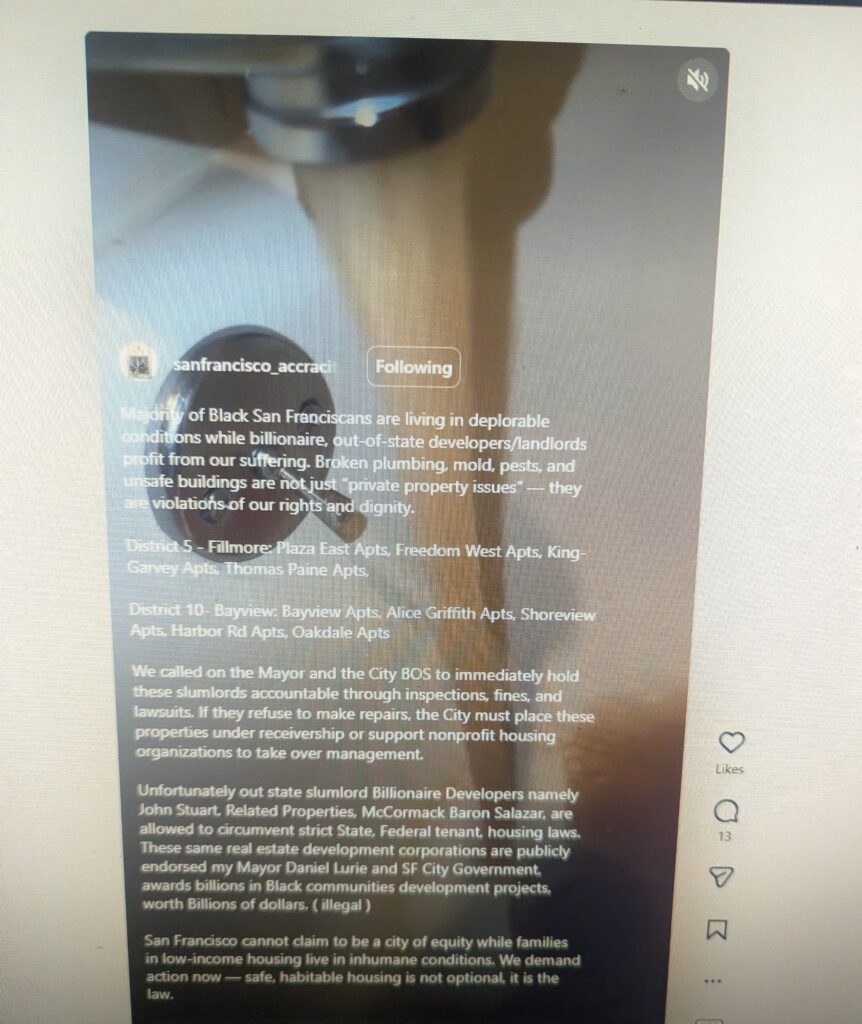
“This is not just a housing issue,” Williams said. “It’s about racial justice and government accountability.”
A National Giant, a Local Failure
Related Companies is not an overstretched operator lacking resources. It is a housing behemoth.
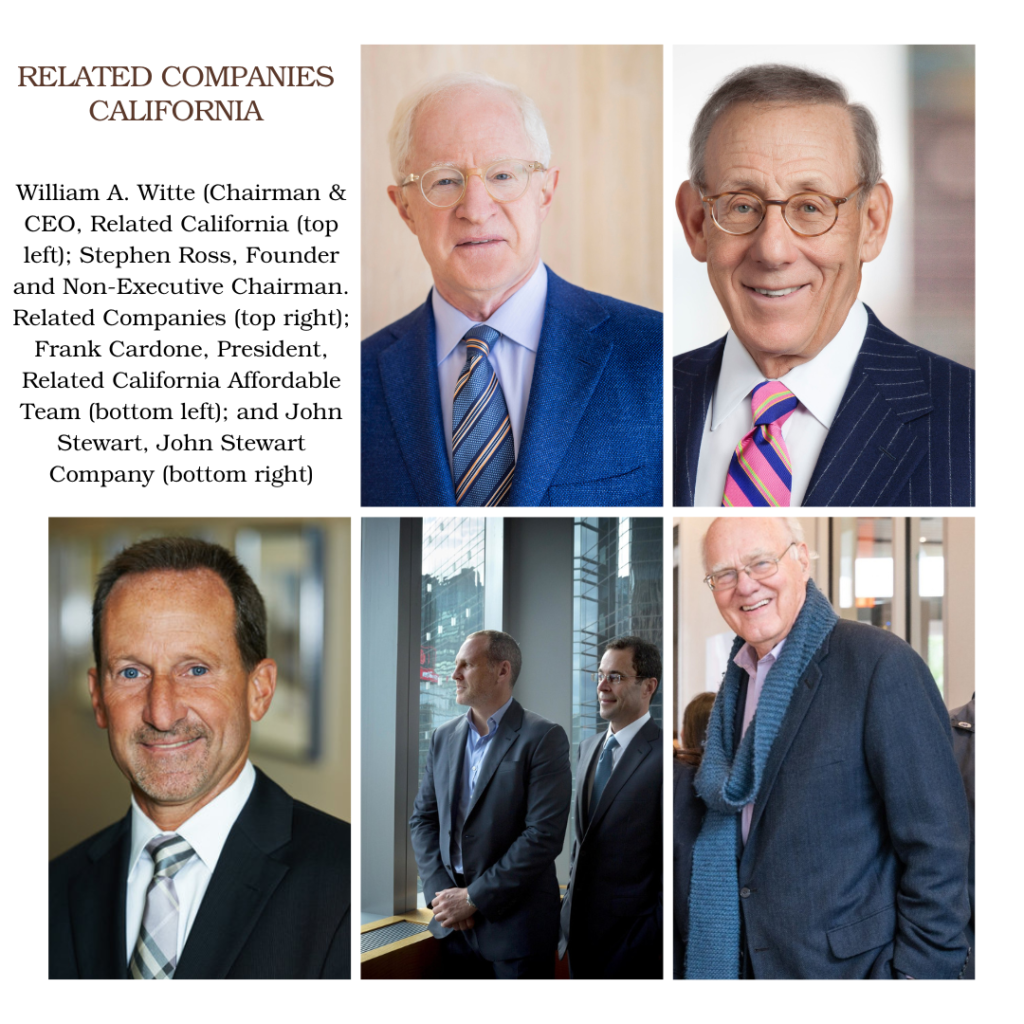
The company controls approximately 73,000 apartment units across 24 states, with roughly 60,000 designated as affordable or subsidized housing. Its real estate portfolio is valued between $60 and $100 billion.
Across jurisdictions, investigative reporting and housing-court data show aggressive eviction practices and two-tier treatment of tenants in Related developments nationwide, including at Hudson Yards in New York. During the COVID-19 pandemic, Related-linked entities appeared in eviction datasets even as the company reported approximately $882 million in pandemic-era revenue.
If a company of this scale cannot ensure basic habitability in San Francisco, the issue is not capacity.
It is priority.
When the State Steps In — and When It Doesn’t
California has already shown that it knows how to respond when corporate landlords exploit low-income tenants.
On June 12, 2025, California Attorney General Rob Bonta filed a sweeping lawsuit against Mike Nijjar and PAMA Management after a three-year investigation uncovered egregious and systemic violations of California housing laws. The complaint alleged unsafe and uninhabitable living conditions, deferred maintenance, deceptive leases, discrimination against Section 8 voucher holders, unlawful rent increases, and a business model that treated lawsuits and code violations as routine operating costs.
“Enough is enough,” Attorney General Bonta said at the time, noting that Nijjar’s companies had continued to operate and collect hundreds of millions of dollars while tenants endured dangerous conditions.
The relevance to San Francisco is not speculative.
The State of California has already articulated—through formal enforcement—what a pattern of neglect in low-income housing looks like, and what accountability requires when that pattern is proven.
Tenants in Bayview–Hunters Point are not asking for special treatment. They are asking for the same seriousness of response.
When City Hall claims it lacks authority — like Mayor Lurie did in his response to my question at his State of the City Address — the Attorney General’s office stands as proof that authority exists—when the will to use it does.
Public Money, Private Silence
Tenants also turned to publicly-funded defenders.
In 2024, Open Door Legal reported receiving approximately $6.9 million in grants and contributions. Of that amount, over $5.29 million was spent on salaries and compensation, while roughly $30,000 was reported in court-related costs.
Open Door Legal – 2024 Form 990: https://1drv.ms/b/c/bd2dbf553c0a1145/IQCbjfylee3AQ5sVkGPJRTZ4AdjESFVVtikzLxCKO8LvrfI?e=iPsnyR
Those figures do not, on their own, establish wrongdoing. But they raise a serious question: where is the enforcement leverage when tenants face billion-dollar corporate landlords with vast legal resources?
Public dollars are not an entitlement.
They are a trust.
The Question City Hall Refuses to Answer:
If tenants suffer,
if inspectors confirm hazards,
if the Mayor tours the damage,
if corporations keep winning contracts,
and if advocates lack leverage—
Who is the system designed to serve?
Part 3 will follow the money, the inspections, and the enforcement failures.
Because when power is protected and the doors stay closed, journalism must open the record.
I often remind people that on top of being a journalist, I am an activist-minded US Army veteran. Freedom of speech and the exercise of all Constitutional rights are very dear to me. I want to let all landlords and the City and County of San Francisco know that the State of California has policies, laws, and protections in place for tenants when they peacefully speak out about habitability issues and other various topics they encounter when dealing with corporate landlords like Related California and John Stewart. If you think that I am not instructing my fellow community members of their rights, you’re wrong. Retaliation for the exercise of free speech will not be tolerated.
PART 2 — SOURCES & REFERENCES
(Related Companies, City Accountability, and Patterns of Tenant Neglect)
A. PRIMARY REPORTING — BAYVIEW–HUNTERS POINT
- Griffin Jones, “Missing windows, broken locks: Hunters Point residents come home after renovations”, San Francisco Bay View National Black Newspaper, August 19, 2025.
https://sfbayview.com/2025/08/missing-windows-broken-locks-hunters-point-residents-come-home-after-renovations/
Documents tenant displacement, missing windows, faulty locks, destroyed personal property, substandard renovations, and Mayor Daniel Lurie’s tour of Related-managed properties in Bayview–Hunters Point.
B. RELATED COMPANIES — NATIONAL REPORTING & INVESTIGATIONS
- Ginia Bellafante, “At Hudson Yards, the Poor Door Is Hard to Miss”, New York Times, April 16, 2019.
https://www.nytimes.com/2019/04/16/nyregion/hudson-yards-affordable-housing.html
Examines two-tier treatment of affordable housing tenants in Related Companies developments. - THE CITY (New York), “Luxury Living at Hudson Yards, but Affordable Tenants Say They’re Treated Differently”, February 11, 2020.
https://www.thecity.nyc/2020/2/11/21210427/hudson-yards-affordable-housing-poor-door
Follow-up investigation into management practices affecting subsidized tenants in Related developments. - ProPublica, “Landlords Filed Thousands of Evictions During COVID Despite Aid”, 2021.
https://www.propublica.org/article/landlords-filed-thousands-of-evictions-during-covid
National analysis of eviction filings by large corporate landlords during the pandemic, including entities connected to Related.
C. COURT RECORDS & HOUSING DATA — RELATED ENTITIES
- New York City Housing Court Records, NYC Open Data Portal.
https://opendata.cityofnewyork.us/
Search terms: “Related Management,” “Related Companies,” “RMC.”
Demonstrates repeated nonpayment and holdover eviction proceedings involving Related-managed properties. - U.S. Department of Housing and Urban Development (HUD), Fair Housing & Habitability Complaint Process.
https://www.hud.gov/program_offices/fair_housing_equal_opp/complaint-process
Federal framework for habitability and discrimination complaints involving subsidized housing operators nationwide.
D. SAN FRANCISCO & CALIFORNIA REPORTING — DEVELOPERS & MANAGEMENT
- Mission Local, reporting on John Stewart Company tenant conditions and city oversight.
https://missionlocal.org/
Multiple articles documenting tenant complaints, repair failures, and oversight gaps involving major affordable housing operators in San Francisco. - San Francisco Chronicle, reporting on public-private housing partnerships and developer accountability.
https://www.sfchronicle.com/
Context on city contracting practices, developer relationships, and housing enforcement. - San Francisco Department of Building Inspection (DBI), Public Inspection & Complaint Records.
https://sf.gov/departments/department-building-inspection
Official records of habitability complaints, code violations, and enforcement actions for residential properties.
E. CORPORATE LANDLORD PRACTICES — STUDIES & POLICY ANALYSIS
- National Housing Law Project, “The Rise of Corporate Landlords and the Impact on Tenants”.
https://www.nhlp.org/
Documents systemic risks posed by large corporate housing operators to low-income tenants and communities of color. - Urban Institute, research on large landlords and affordable housing outcomes.
https://www.urban.org/
Provides national data and policy analysis relevant to patterns described in Part II - ACCE Institute / Housing Rights Committee of San Francisco, reports on corporate landlord behavior.
https://www.acceinstitute.org/
California-based advocacy research documenting displacement, neglect, and enforcement failures.
F. CORPORATE PROFILE & FINANCIAL CONTEXT — RELATED COMPANIES
- Related Companies, Corporate Overview.
https://www.related.com/about
Portfolio size, geographic reach, and affordable housing holdings. - Forbes, Stephen M. Ross Profile.
https://www.forbes.com/profile/stephen-ross/
Ownership, net worth estimates, and political influence context.
G. COMPARATIVE ENFORCEMENT — STATE ACCOUNTABILITY BENCHMARK
- California Department of Justice, Attorney General Rob Bonta Sues Notorious Landlord Mike Nijjar and PAMA Management, June 12, 2025.
https://oag.ca.gov/news/press-releases/attorney-general-bonta-sues-notorious-landlord-mike-nijjar-and-pama-management
Demonstrates state-level enforcement response to systemic habitability violations in low-income housing.
- People of the State of California v. Nijjar et al., Los Angeles County Superior Court, 2025 (Complaint).
https://oag.ca.gov/system/files/attachments/press-docs/Complaint_7.pdf
Official complaint detailing unlawful landlord practices.
As always, we include a song/video for our article. Here’s our selection for this article:
ENERGY by Drake
ABOUT THE AUTHOR
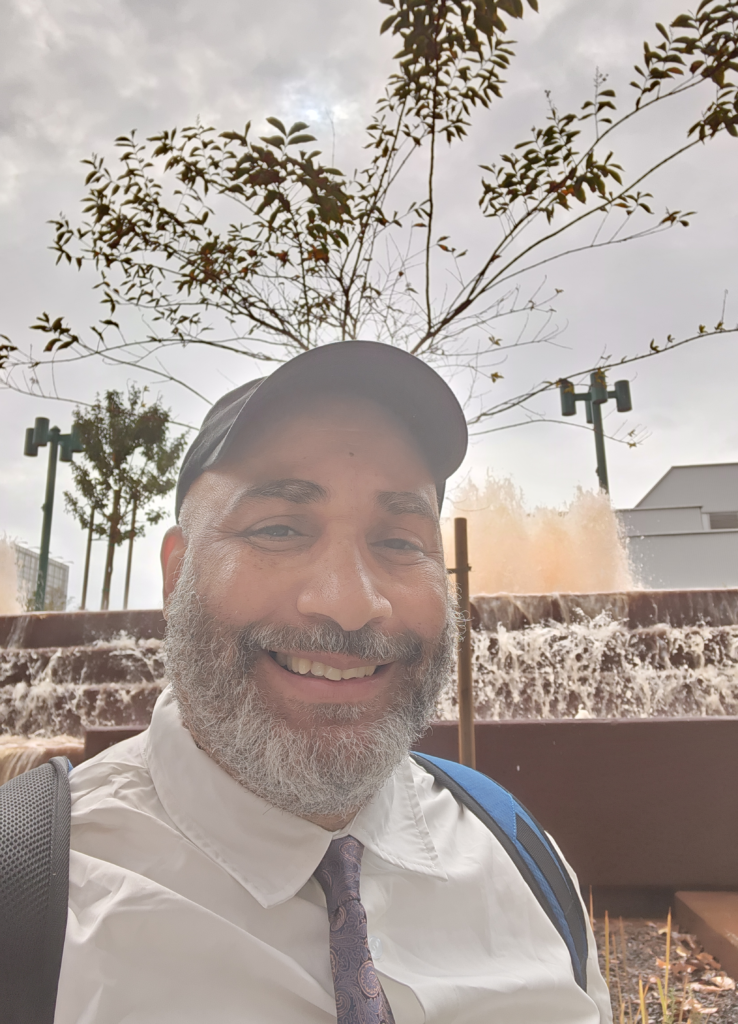
Malik Washington is an investigative journalist and co-founder of Destination Freedom Media Group, an independent nonprofit newsroom dedicated to accountability reporting at the intersection of civil rights, public integrity, and community survival. He has been a published journalist for over 14 years.
His work—published in partnership with the Davis Vanguard—focuses on government power, criminal justice, environmental justice, and the human consequences of policy decisions too often insulated from public scrutiny. Washington’s reporting amplifies the voices of impacted communities while insisting on documentary evidence, transparency, and the unvarnished truth—especially when institutions demand silence.
You can reach him via email: mwashington2059@gmail.com or call him at (719) 715-9592.
Suggestions or leads on stories are always welcome.
Please follow us on:
Facebook: https://www.facebook.com/destfreedom13
Instagram: https://www.instagram.com/destinationfreedom13/
X: https://x.com/dest_freedom