How New York’s Police Accountability System Documents Abuse but Refuses to Correct it
By Journalist Malik Washington
Destination Freedom Media Group & The Davis Vanguard
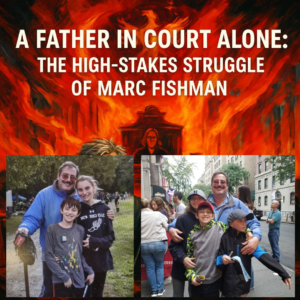
Photo credit: https://fatherandco.substack.com/p/a-father-in-court-alone-the-high
(Michael “Thunder” Phillips)
This article was the result of an email that I received from James Christopher of James Christopher Communications, LLC who’s been advocating for Marc Fishman. The article that we published last week regarding the update in the Robert Brooks’ case, grabbed his attention.
GUEST COMMENTARY UPDATE: ROBERT BROOKS’ DEATH AND THE COST OF UNCHECKED VIOLENCE BEHIND PRISON WALLS
New York State knows which police officers repeatedly violate the public trust.
It knows because it has investigated them. It has verified patterns of misconduct. It has published their names in official reports. Under the Attorney General’s Law Enforcement Misconduct Investigative Office — LEMIO — these officers are formally designated “Pattern Misconduct Officers.”
Yet for Marc Fishman, a disabled Bronx father, that acknowledgment changed nothing.
More than six years after his arrest on a misdemeanor charge, Fishman remains trapped in a prosecution tied to conduct the State of New York has already recognized as improper. His case has survived not because evidence justified it, but because New York’s accountability framework stops short of requiring correction.
The result is a justice system that documents abuse — then allows it to stand.
THE VIDEO THE COURT NEVER SAW
In December 2025, long-withheld police footage finally surfaced.
Recorded in 2018 inside a New Rochelle police precinct, the video shows then-Officer Lane Schlesinger stating — repeatedly — that Marc Fishman committed no crime and had no malicious intent. Fishman is visible in the holding cell as the officer makes the admission.
Neither the judge nor the jury ever saw the tape. Fishman himself was never shown the footage until years later.
When I asked Fishman what it felt like to finally see the video, his response was measured — and devastating.
“When I viewed the withheld exonerating evidence video,” Fishman said, “with real-time transcription stating multiple times that I did not commit a crime or have malicious intent, I felt robbed of my civil rights — to be an active father and as a disabled member of the community with cognitive and hearing impairments.”
For Fishman, the video was both vindication and indictment.
“I felt vindicated for the federal disability-discrimination lawsuit I filed over six and a half years ago,” he said. “The police knew I was totally innocent. They knew I was following a family-court-ordered visitation and disability accommodation order — and they still denied my constitutional rights.”
That lawsuit, filed pro se in federal court, forced disclosures that state prosecutors never made voluntarily. Fishman says that without federal discovery, the evidence clearing his name would never have surfaced.
A SYSTEM THAT WITHHOLDS — AND RETALIATES
Fishman lives with documented hearing and neurological disabilities. Federal courts later ordered that he receive specific ADA accommodations. According to Fishman, those orders were routinely ignored as his case moved forward.
“If you sue state entities for disability rights under the ADA,” he said, “you receive years of extreme retaliation and retribution from state court actors — judges, prosecutors, and court staff.”
Fishman alleges that multiple Westchester County District Attorneys — across administrations — withheld exculpatory evidence in violation of New York discovery law, including disciplinary histories, body-camera footage, and even a critical page of an unserved order of protection that jurors never saw.
Those allegations are not abstract. They carry a cost — to families, to constitutional rights, and to taxpayers funding litigation that continues long after legitimacy has collapsed.
A JUDGE DECLINES TO PAUSE
Just days before the video was released publicly, New York Supreme Court Judge Anthony Cannataro denied Fishman a limited 45-day stay that would have allowed the newly surfaced evidence to be presented in federal court.
The ruling left Fishman facing incarceration — despite the officer’s recorded admission, despite federal appellate rulings on disability accommodations, and despite the fact that Officer Schlesinger was later terminated.
The system did not slow down. It pressed forward.
PATTERN MISCONDUCT, ZERO CONSEQUENCES
Officer Schlesinger accumulated more than two dozen civilian misconduct complaints. In 2024, he was formally identified by Attorney General Letitia James as a Pattern Misconduct Officer.
And still, the cases tied to his arrests remained intact.
That outcome is not accidental. Under LEMIO, the Attorney General may investigate, verify, and report misconduct — but cannot compel district attorneys to review prosecutions, reopen cases, or explain why charges remain.
Accountability stops at documentation.
For Fishman, the consequences were personal and permanent. “I am suing not only to recover hundreds of thousands of dollars in litigation costs,” he said, “but to regain access to my children — access that was illegally taken from me.”
FROM DEFENDANT TO REFORMER
Out of that experience, Fishman launched ProtectNewYorkers.com, advocating for a narrowly tailored amendment to Executive Law § 75(5)(b), the statute governing LEMIO.
The proposed reform would require district attorneys to review cases tied to Pattern Misconduct Officers, issue public explanations for their decisions, and ensure defendants receive bail hearings when misconduct is formally acknowledged. This is not about punishing police. It is about protecting the integrity of prosecutions — and protecting taxpayers from funding cases the State of New York already knows are compromised.
THE QUESTION NEW YORK MUST ANSWER
When I asked Fishman whether he believes the State of New York should compensate him for the emotional and financial harm he has endured, his answer was direct — but rooted in a larger concern.
“This isn’t just about me,” he said. “Without federal court intervention, none of this evidence would exist. New York taxpayers are paying for prosecutions that should never have continued.”
That is the question now facing New York lawmakers.
What does accountability mean if it never changes outcomes?
What does justice cost when misconduct is acknowledged — but ignored?
Marc Fishman’s case exposes a system that protects itself first and corrects itself last — if at all. Until that changes, documentation will continue to replace accountability, and New Yorkers will continue paying the price.
As always, here’s our song/video for this article:
ABOUT THE AUTHOR
Malik Washington is an investigative journalist and co-founder of Destination Freedom Media Group, an independent nonprofit newsroom dedicated to accountability reporting at the intersection of civil rights, public integrity, and community survival. He has been a published journalist for over 14 years.
His work—published in partnership with the Davis Vanguard—focuses on government power, criminal justice, environmental justice, and the human consequences of policy decisions too often insulated from public scrutiny. Washington’s reporting amplifies the voices of impacted communities while insisting on documentary evidence, transparency, and the unvarnished truth—especially when institutions demand silence.
You can reach him via email: mwashington2059@gmail.com or call him at (719) 715-9592.
Suggestions or leads on stories are always welcome.